

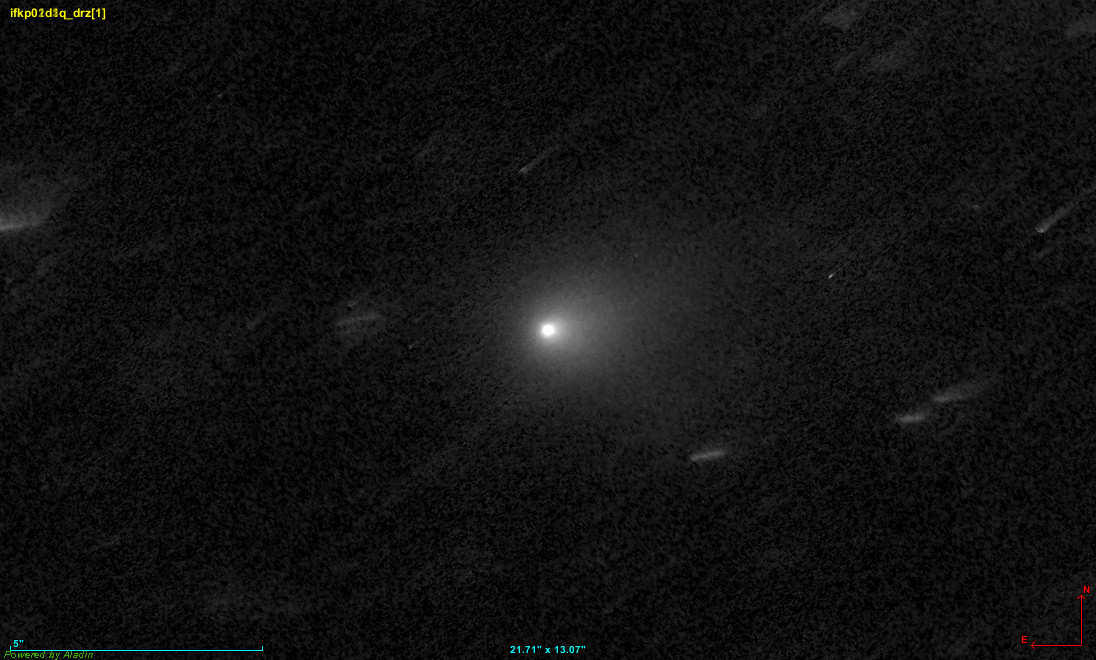
The Hubble Space Telescope photographed comet 3I/ATLAS for the first time. This is only the third object known to us that has arrived in the Solar System from interstellar space.
According to astronomers, numerous objects of interstellar origin regularly pass through our Solar System. However, they are extremely difficult to detect, as they are only visible when they are close enough and when our telescopes are pointed in the right place at the right time.
Throughout history, astronomers have only managed to find three objects of interstellar origin in the Solar System. The first one was the asteroid Oumuamua in 2017, the second was the comet Borisov in 2019, and the third was the comet 3I/ATLAS. It was discovered in early July by telescopes belonging to the ATLAS automated system.
Research shows that 3I/ATLAS may be even more interesting than originally thought. Its trajectory indicates that it originates from a region of the Milky Way that is older than our Solar System. The estimated age of the comet is 7 billion years. This makes 3I/ATLAS the oldest object we have ever seen.
It is not surprising that astronomers have focused all major observatories, including Hubble, on 3I/ATLAS. This was reported by a senior student of the astrophysics department, astrafoxen, who posted images of the comet taken by a space telescope on the social network Bluesky. The photo shows the comet’s nucleus surrounded by a cloud of dust and gas.
3I/ATLAS will reach the perihelion of its orbit on October 29. On this day, the interstellar comet will be at a distance of 1.357 AU (203 million km) from the Sun. As for Earth, 3I/ATLAS will come closest to our planet on December 19, at a distance of approximately 270 million km. After that, 3I/ATLAS will once again head into interstellar space in the direction of the constellations Gemini and Orion.

