

Scientists have studied the white dwarf WD 0525+526. The composition of its atmosphere indicates its formation through the merger of two smaller stars.
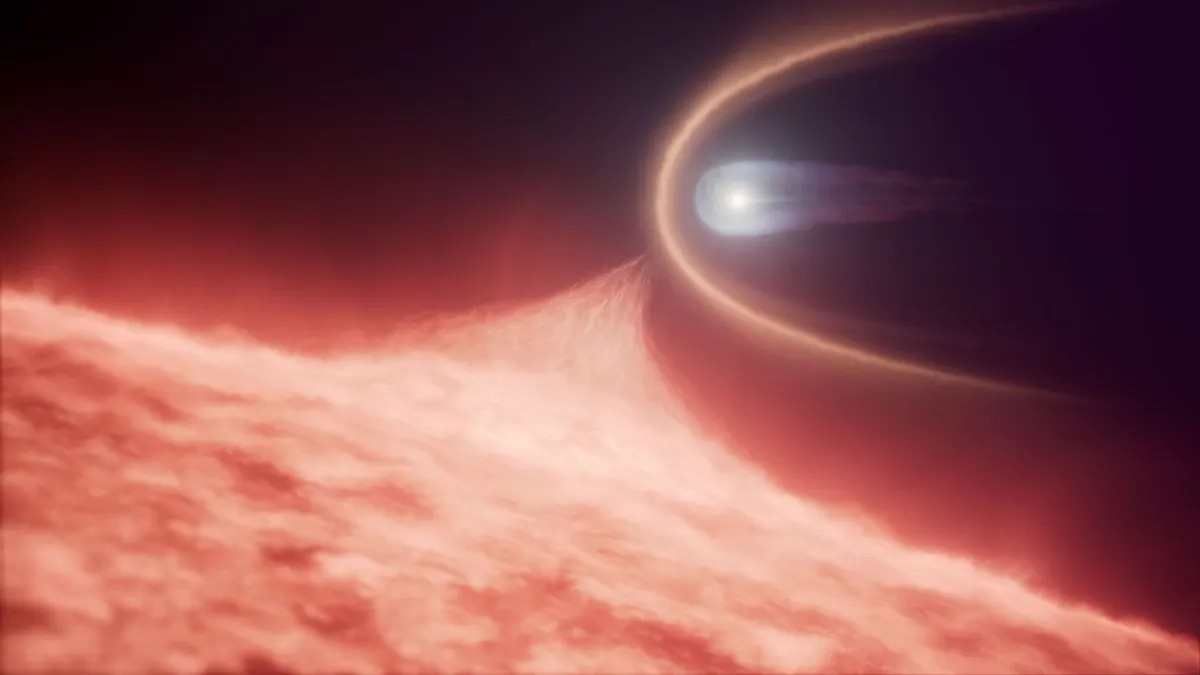
White dwarf hides secrets
Astronomers using the Hubble Space Telescope have discovered that a seemingly ordinary white dwarf is actually the result of a dramatic merger of stars. This result, described in detail in a new study by Snehalata Sahu and Boris Gaensicke of the University of Warwick in the UK, suggests that other “normal-looking” white dwarfs scattered throughout the Universe may also have had turbulent pasts.
The star WD 0525+526 is located approximately 128 light-years from Earth. Although it initially appeared fairly standard when observed in visible light, further observations using the Hubble telescope revealed clear signs of a more violent origin, according to a new study.
White dwarfs are dense remnants of stars similar to our Sun that have exhausted their fuel reserves and collapsed into objects the size of Earth. Despite their small size, they can have up to 1.4 times the mass of our sun. Most white dwarfs are formed as a result of the presumed evolution of individual stars approaching the end of their life cycle, which our own Sun is expected to undergo in approximately 5 billion years.
Signs of star merger
However, WD 0525+526 probably took a different path. Instead of forming from a single dying star, it appears to have been created by the violent collision and merger of two stars. This dramatic past, according to a new study, has left subtle but noticeable traces in the atmospheric composition of the white dwarf. When Gaensicke and his team studied WD 0525+526 using Hubble’s ultraviolet instruments, they discovered an unusual amount of carbon in the star’s atmosphere — a key sign that the star was formed as a result of a merger.
White dwarfs typically have outer layers of hydrogen and helium that conceal their carbon cores. But during mergers, as in this case, intense collisions can tear away many of these outer layers, allowing carbon to rise to the surface. The signals from such stars are difficult to detect in visible light, but they become clearer in ultraviolet wavelengths — and this is where Hubble excels.
Significance of the study
WD 0525+526 is one of only a few known white dwarfs that are remnants of mergers, according to the press release. It has a surface temperature of nearly 21,000 Kelvin (about 37,000 degrees Fahrenheit) and a mass 1.2 times greater than the mass of the Sun, making it both hotter and more massive than others in this rare category.
Since WD 0525+526 appeared completely normal in visible light, astronomers now suspect that many other white dwarfs may conceal similar explosive origins. “We would like to continue our research on this topic by studying how common carbon white dwarfs are among similar white dwarfs and how many star mergers are hidden among the normal white dwarf family,” said Antoine Bedrad, a researcher at the University of Warwick, who collaborated on the study, in a statement. “This will be an important contribution to our understanding of binary white dwarfs and supernova explosion pathways.”
According to www.space.com

