

Astronomers working with the Hubble Space Telescope have published an image showing the galaxy NGC 4102. It has an active nucleus.
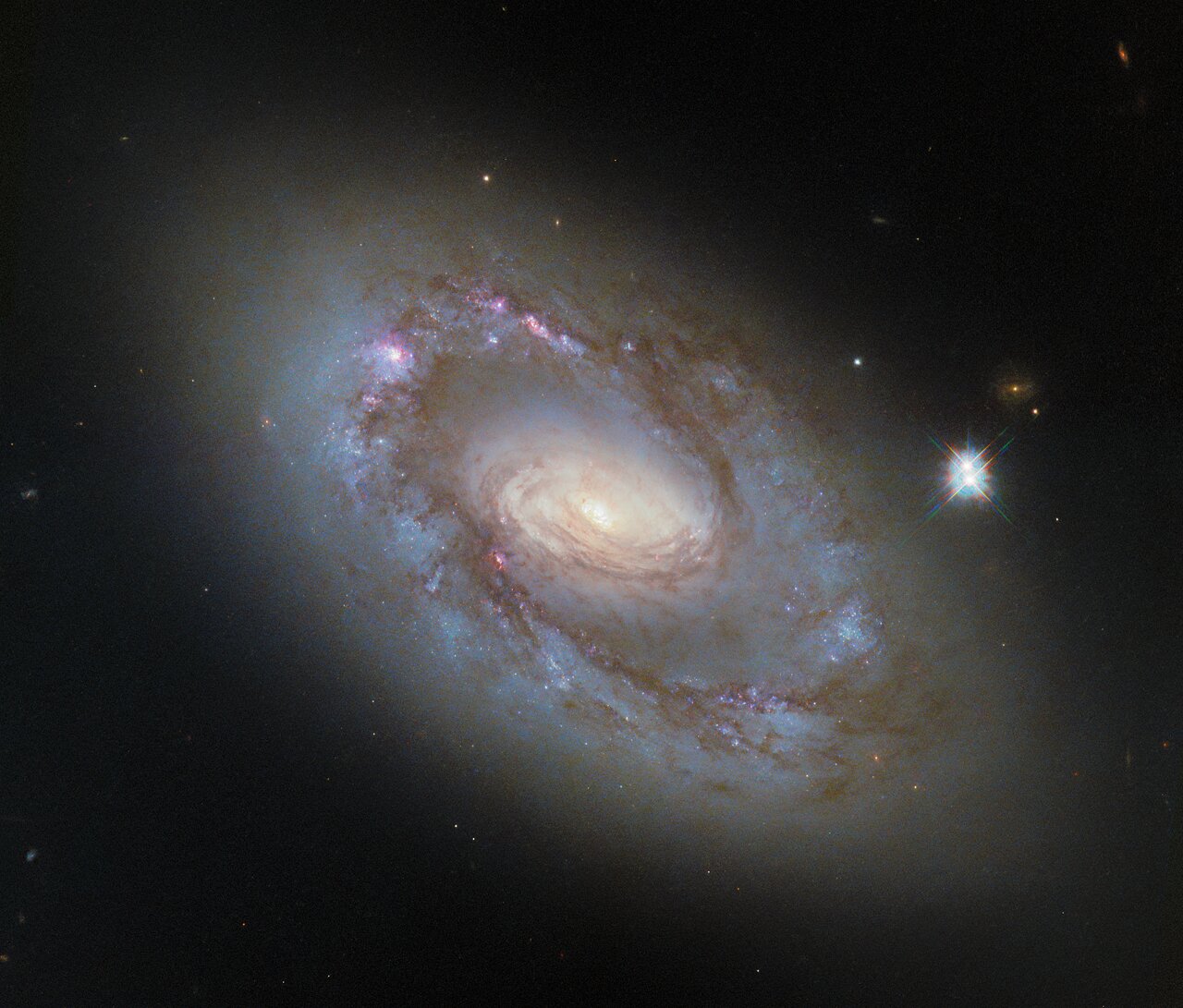
NGC 4102 is located 56 million light-years from Earth in the direction of the constellation Ursa Major. Like our Milky Way, it is a spiral galaxy with a bar. The Hubble photo shows its spiral arms, dotted with star clusters and regions of active star formation.
However, NGC 4102 differs from the Milky Way in some respects. Unlike our galaxy, it is home to what astronomers call an active galactic nucleus. Active galactic nuclei are luminous centers powered by supermassive black holes, whose mass is millions and billions of times greater than that of our Sun. When these black holes capture gas from their surroundings and pull it toward themselves, the gas heats up to such an extent that it begins to glow and emit light ranging from X-rays to radio waves.
NGC 4102 provides astronomers with an ideal opportunity to study how active galactic nuclei interact with their host galaxies. Active galactic nuclei come in different types: from extremely powerful ones that consume enormous amounts of matter and eject powerful jets, to calmer ones that absorb gas from their surroundings and glow more faintly.
The galaxy photographed by Hubble probably belongs to the latter category. Its core is hidden by a thick layer of gas, and emission lines of certain weakly ionized elements are observed in the spectrum. They may be fed by a supermassive black hole that “lazily” collects gas from its surroundings.
The image of NGC 4102 was obtained during a program aimed at studying the influence of active nuclei on their galactic surroundings. It will later be combined with the results of observations made by the Chandra X-ray Observatory, allowing astronomers to obtain maximum data.
Earlier, we reported on how Hubble photographed a star factory in Coma Berenices.
According to Esahubble

