

An article on hypervelocity white dwarfs was published in Nature Astronomy. The authors of the study linked their origin to supernovae.
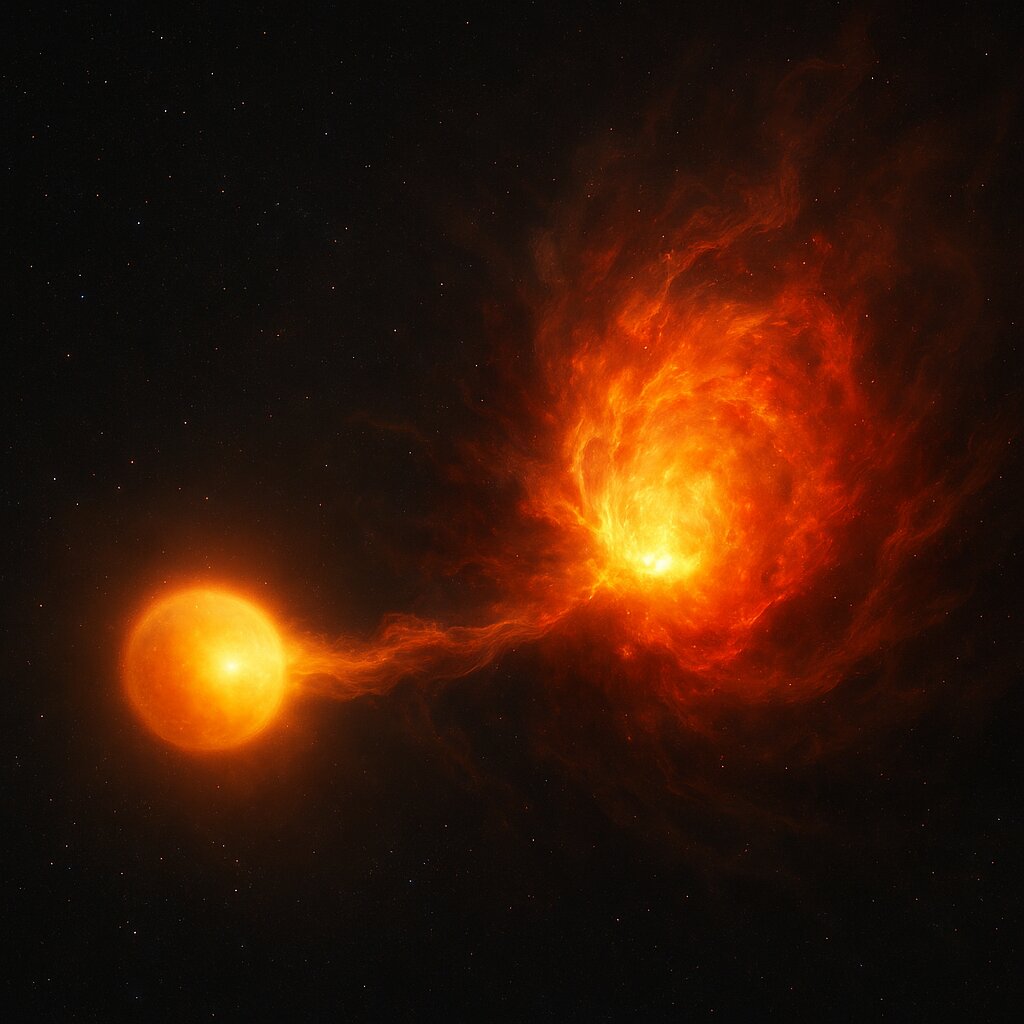
Hypervelocity white dwarfs are among the fastest stars ever observed by astronomers. They hurtle through the Milky Way at speeds exceeding 2,000 km/s.
An international team of researchers set out to uncover the nature of the mechanism that allows them to accelerate to such high speeds. For this purpose, they conducted three-dimensional hydrodynamic simulations of the merger of two rare hybrid white dwarfs consisting of helium, carbon, and oxygen.
The results revealed a dramatic sequence of events: when the lighter star partially collapses, the heavier one undergoes a double explosion, ejecting the remains of its companion into space at a hypervelocity exceeding 2,000 kilometers per second. That’s enough to leave the Milky Way forever and embark on an intergalactic journey.
Unlike previously proposed scenarios, the new model takes into account both extreme velocities and unusual temperatures and brightnesses of known hypervelocity white dwarfs, such as J0546 and J0927. It also provides insight into faint supernova explosions, which are an important instrument for measuring the expansion of the Universe and understanding how heavy elements are formed in galaxies.
According to the authors of the study, this is the first time they have found a clear scenario in which the remnants of white dwarf mergers can acquire hypervelocity and properties consistent with the hot, dim white dwarfs observed in the Milky Way halo. This solves the mystery of the origin of these runaway stars and also improves our understanding of the nature of faint and unusual Type Ia supernovae.
The discovery is also important for upcoming studies of transient phenomena and analysis of data from the Gaia observatory, which may reveal more information about these elusive stellar “cannonballs” flying through our galaxy.
Earlier, we reported on a rare white dwarf discovered by the Hubble telescope, formed as a result of the merger of two smaller stars.
According to Phys.org

