

The European Space Agency has published a spectacular image taken by the Copernicus Sentinel-2 mission. It shows the icy landscapes of Greenland.
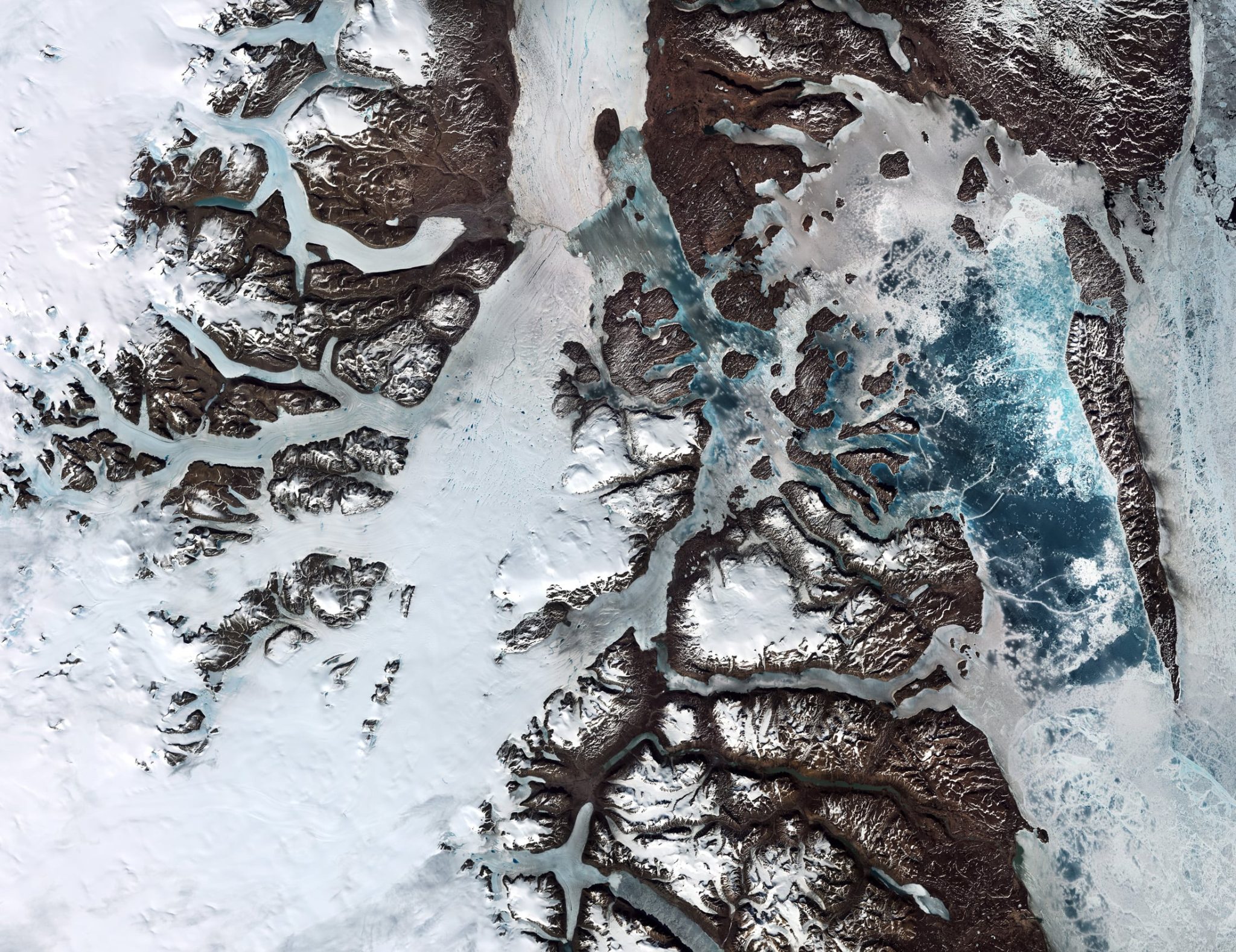
Greenland is the world’s largest island and home to Northeast Greenland National Park, the world’s largest national park. The park covers an area of 972,000 km², which is larger than Ukraine and Poland combined. At the same time, about 80% of its territory is permanently covered by a thick ice sheet, second only to the glaciers of Antarctica.
The photograph of Greenland was taken in the summer. It shows soil colors ranging from light brown to dark brown, ice and snow are shown in shades of white, and various shades of blue indicate water. The large blue area on the right is Dove Bay, which is partially ice-free, with seasonal cracks formed by currents and wind.
North of the bay, on the southern shore of the Germania Land Peninsula, visible in the upper right corner, is the Danmarkshavn weather station, where a permanent team of six people collects meteorological data used in international weather forecasting models. Danmarkshavn is one of the most isolated inhabited stations in the world. It is also known as the northernmost point on the east coast of Greenland accessible to non-icebreaker vessels.
The photograph shows several glaciers and their ice streams, as well as meltwater lakes, visible as blue spots on the ice, especially when zoomed in on the center of the image. Melt ponds are large bodies of open water that form on both sea ice and ice sheets in spring and summer when the air warms and the sun melts Greenland’s ice sheet. When snow and ice melt on the surface of glaciers, water flows through channels and streams and collects in depressions on the surface, forming ponds.
Meltwater ponds can accelerate ice melt by reducing its ability to reflect sunlight, which increases heat absorption and further accelerates ice melt. Although sea ice melt does not directly affect global sea levels, faster land ice melt, amplified by these processes, does contribute to sea level rise. It increases the risk of flooding in coastal areas around the world, affects marine ecosystems in the Arctic Ocean, and alters ocean and atmospheric circulation patterns, which influences weather conditions around the globe.
Satellite imagery is vital for mapping the rapidly changing appearance of the Greenland ice sheet. Observations from space can be used to verify how climate models simulate the melting of the ice sheet, which will improve predictions of how much Greenland will contribute to global sea level rise in the future.
According to ESA

