

Comets have attracted people’s attention since ancient times. They were often perceived as harbingers of important events and disasters, and records of their appearances can be found in written sources dating back to the 7th century BC.
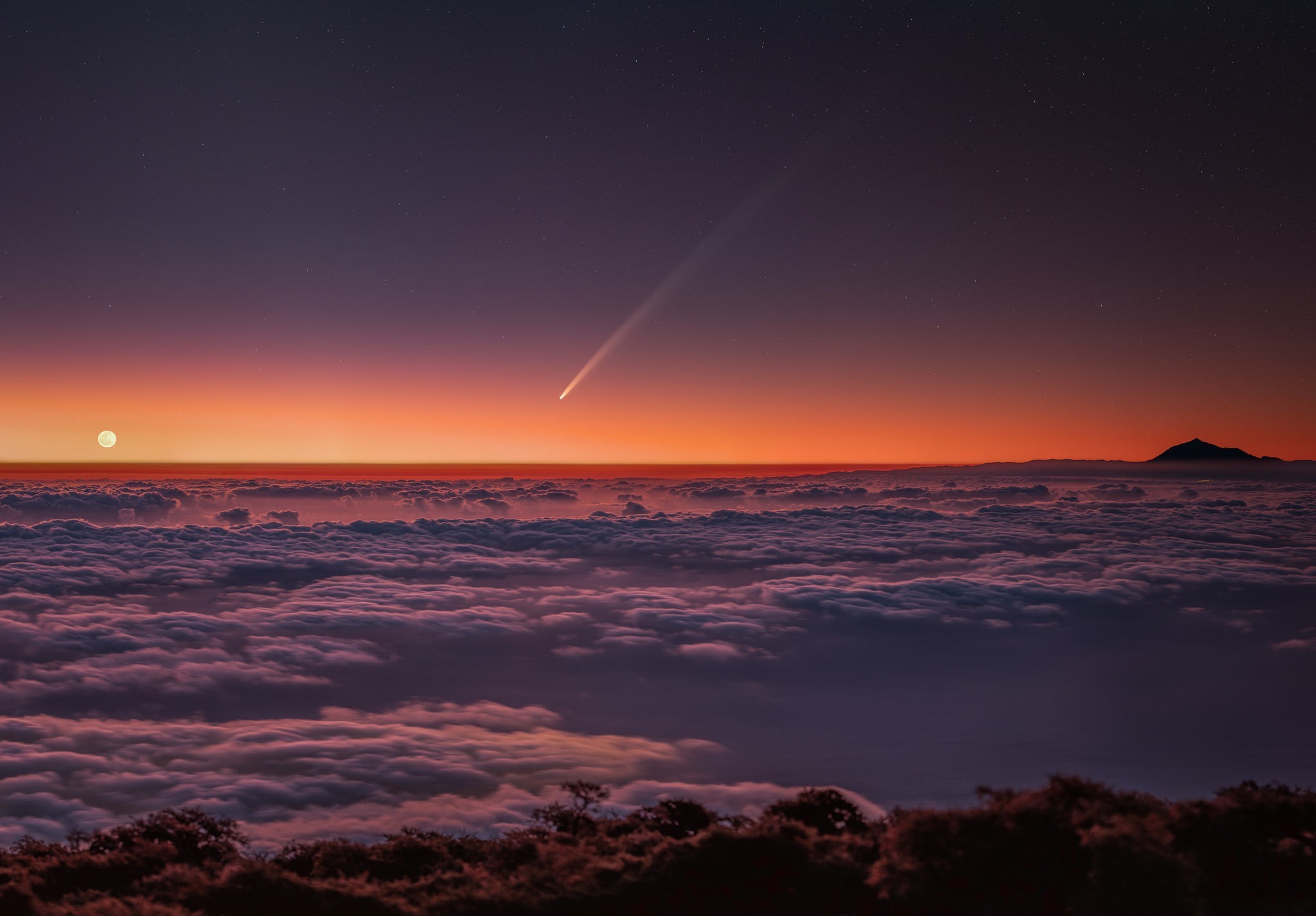
Advances in science have greatly expanded our knowledge of comets. However, until recently, we did not know the most important thing: what they actually look like. The fact is that although comets can have very impressive tails tens or even hundreds of millions of kilometers long, their nuclei are quite small. Their diameter is usually only a few kilometers, and they are surrounded by a luminous veil that even the most powerful telescope cannot penetrate.
Everything changed thanks to the spacecraft. So far, they have managed to photograph six comets, lifting the veil of mystery surrounding these mysterious visitors from deep space. Let’s talk about these comets.
Halley’s Comet
Halley’s Comet hardly needs any introduction. It is the most famous comet in history, approaching the Sun once every 76 years. Many of its visits have coincided with major historical events, such as the Battle of the Catalaunian Fields and the Norman conquest of England. It last visited the inner Solar System in 1986, and humanity was fully prepared for the event, sending an armada of five spacecraft to the comet.
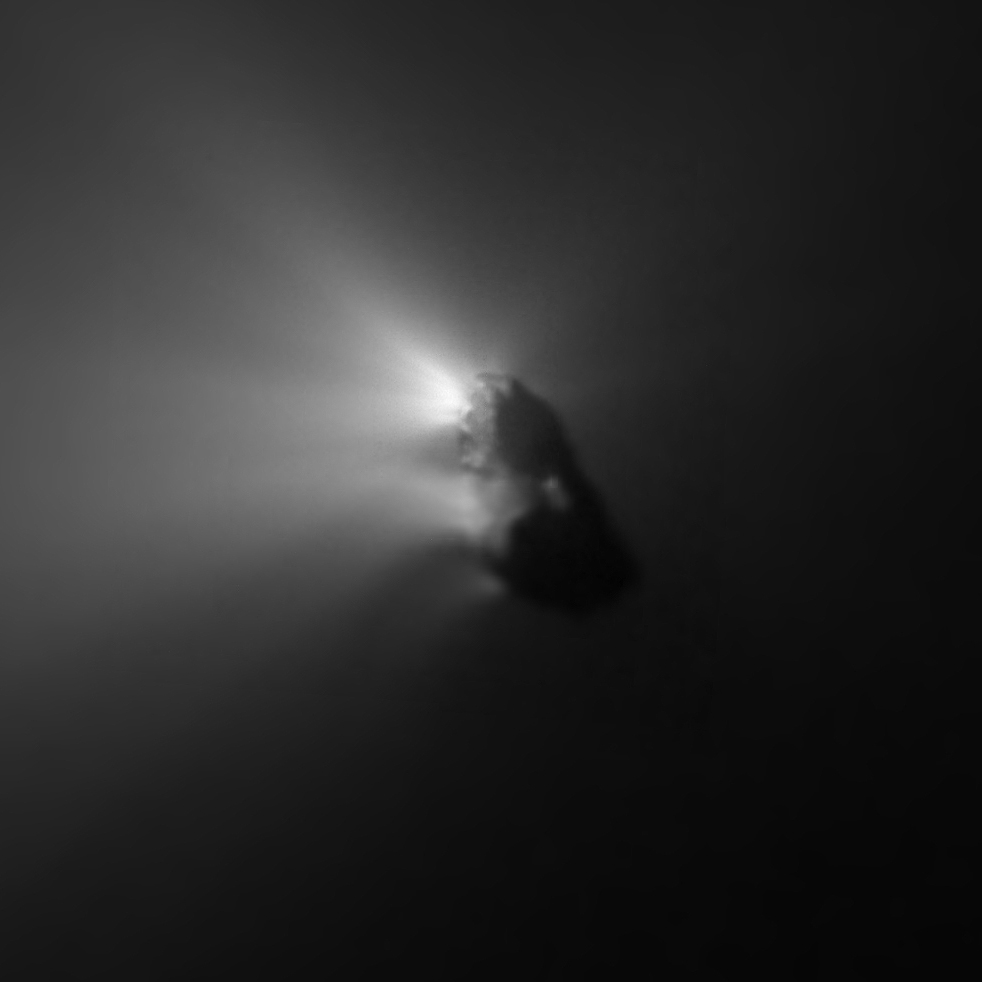
The European probe Giotto came closest to Halley’s Comet. On March 14, 1986, it flew past at a distance of 596 km from its nucleus, miraculously surviving the encounter (it was hit by several particles, causing significant damage to the spacecraft).
The images showed that Halley’s Comet resembles a potato and measures 15×8×8 km. Although comets appear very bright to us, in reality, they resemble a piece of coal rather than a snowball: comets reflect only 4% of the light that falls on them. Apparently, during its numerous approaches to the Sun, Halley lost most of its volatile substances. At the time of Giotto’s visit, only 10% of its surface was active. Because of this, some scientists figuratively compared it to a lump of mud with snow mixed in.
Comet Borrelly
The second comet in history whose nucleus we saw in close-up was 19P/Borelly. This happened in 2001, when the Deep Space 1 probe flew past it. The minimum distance of approach was 2,170 km.
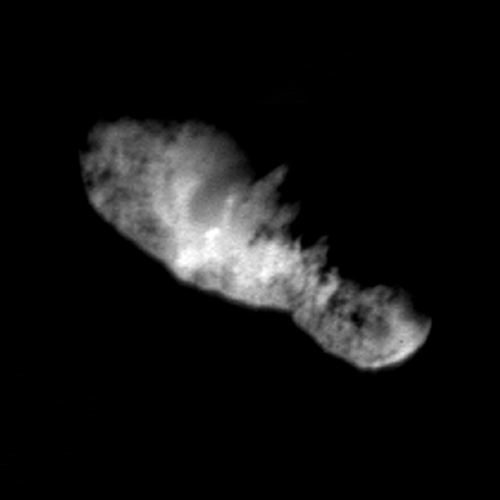
It turned out that the nucleus of Comet Borrelly has an irregular shape resembling a skittle. Its dimensions are 8×4 km. The probe managed to record a sharply defined jet of gas escaping from under the comet’s surface to a height of about 60 km in the direction of the Sun. As it got closer to the nucleus, Deep Space 1 found that this jet was actually three separate jets shooting out from bright, smooth spots on the nucleus’s surface. The photos show that they run along the comet’s axis of rotation. Eventually, this could lead to its destruction.
Comet Wild
While the Giotto spacecraft nearly perished as a result of colliding with comet particles, for the Stardust spacecraft, these particles were the main objective of the mission. On February 2, 2004, it flew 240 km from comet 81P/Wild, collecting samples of its dust using a special trap. The probe also took several dozen photographs of the comet’s nucleus, which turned out to have a diameter of 5 km.
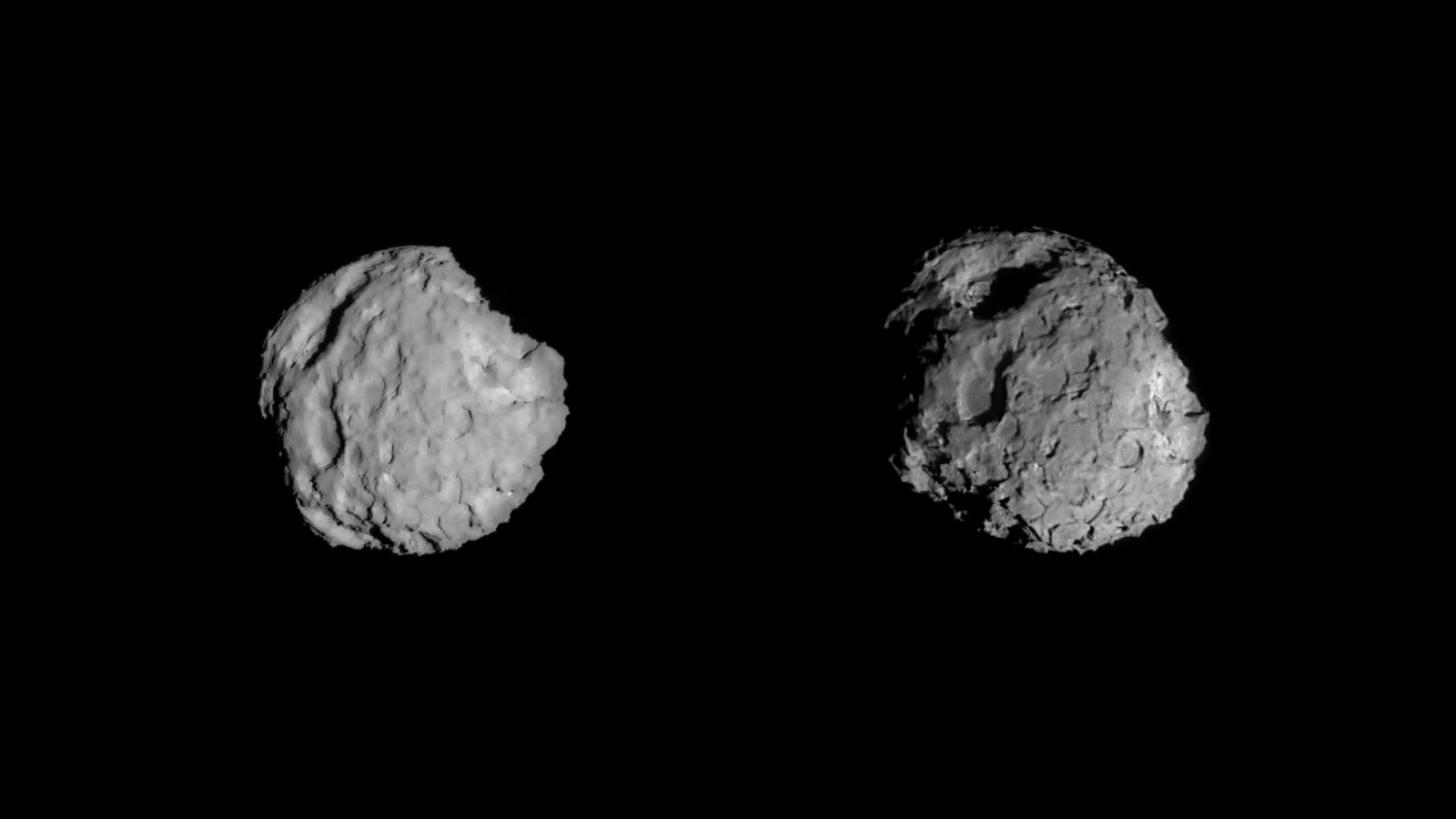
The images revealed a surface dotted with flat-bottomed depressions, steep walls, and other relief features up to 2 km across. These structures are believed to be impact craters or vents through which evaporating gases escaped. At the time of Stardust’s flyby, at least 10 such gas vents (jets) were active.
Comet Tempel
Comet 9P/Tempel holds a special place in the history of science. To date, it is the only comet in history to have been visited by two different space missions several years apart.
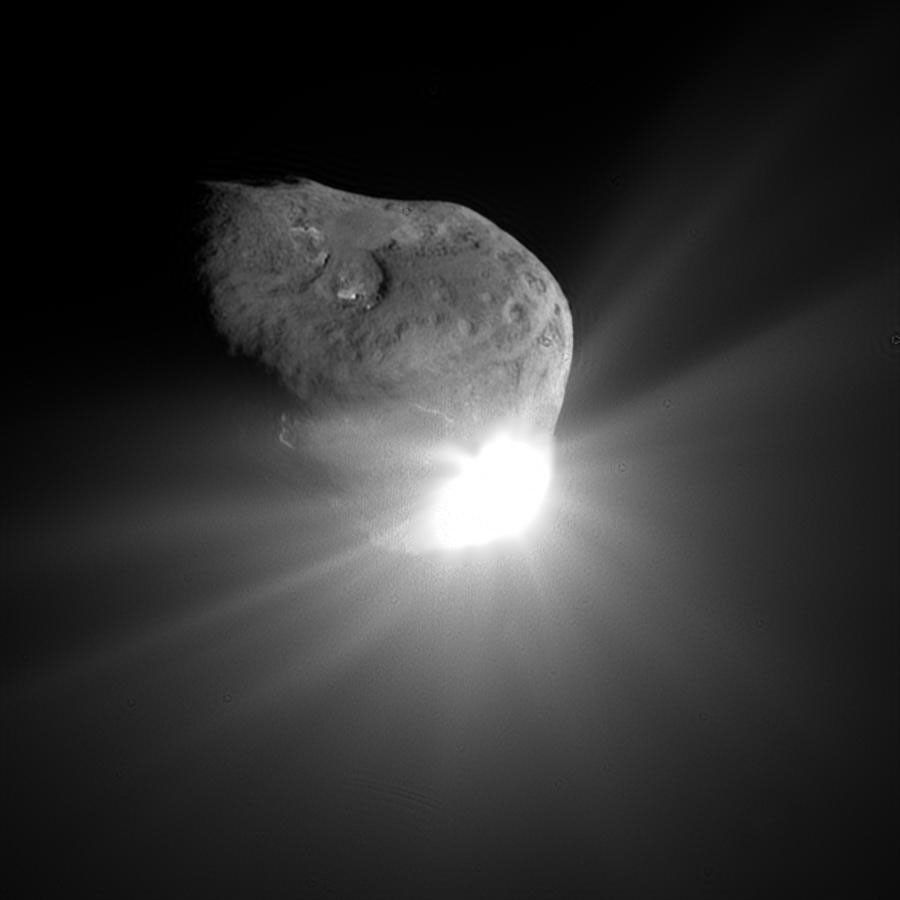
The first was the Deep Impact mission. In July 2005, it launched a 370-kilogram copper-core impactor into the comet. This experiment aimed to study the inner layers of the nucleus and estimate the time of its formation. The consequences of the bombardment significantly exceeded the scientists’ expectations. The impact released energy equivalent to the explosion of 4.8 tons of TNT, and the comet’s brightness increased sixfold.
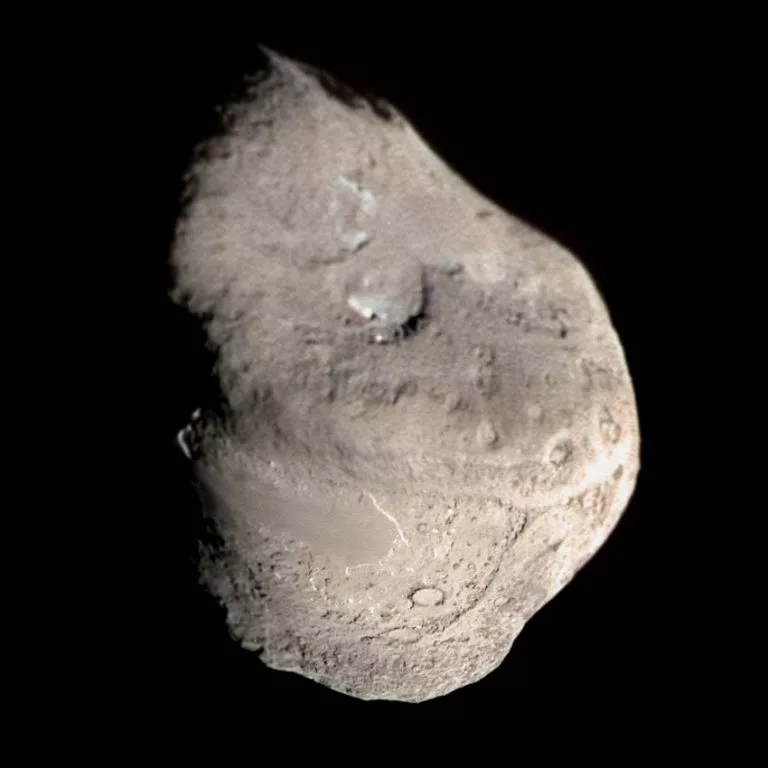
The results of studying the composition of the ejected material presented several surprises. The comet’s nucleus contained much more dust and less ice than expected. Water ice was found one meter below the surface. The nucleus was found to contain clays and carbonates, which form in the presence of liquid water, as well as crystalline silicates and sodium, which is rarely found in space. In addition, it was determined that the outer layers of the comet are 75% space.
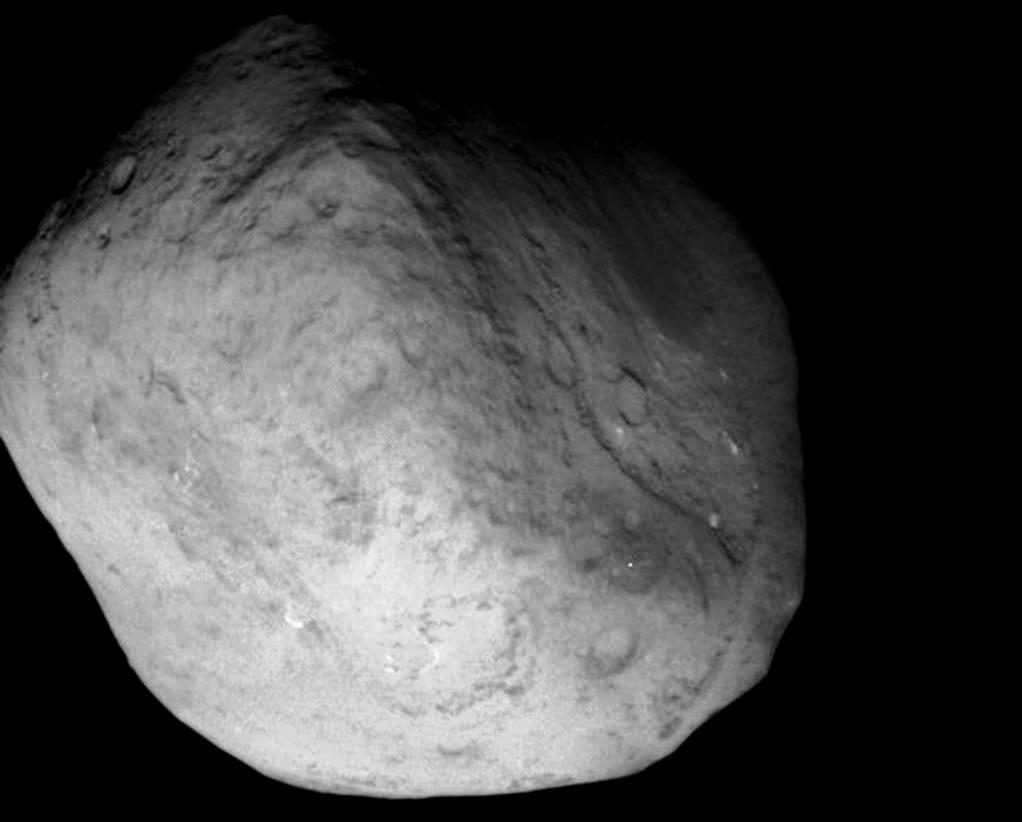
However, Deep Impact failed to capture the crater formed by the impact. To photograph it, NASA decided to send the Stardust mission, which we are already familiar with, to the comet. On February 15, 2011, the spacecraft flew 181 km from the comet’s nucleus. As it turned out, the crater formed as a result of the impact was about 150 meters in diameter and up to 28 meters deep. The spacecraft also managed to more accurately estimate the size of the comet’s nucleus. It measures 7.6×4.9 km.
Comet Hartley
After successfully bombing comet 9P/Tempel, NASA experts decided to extend the Deep Impact spacecraft’s mission and find a new target for it. Comet 103P/Hartley was chosen. The spacecraft flew past it in November 2010. The minimum approach distance was 700 km.
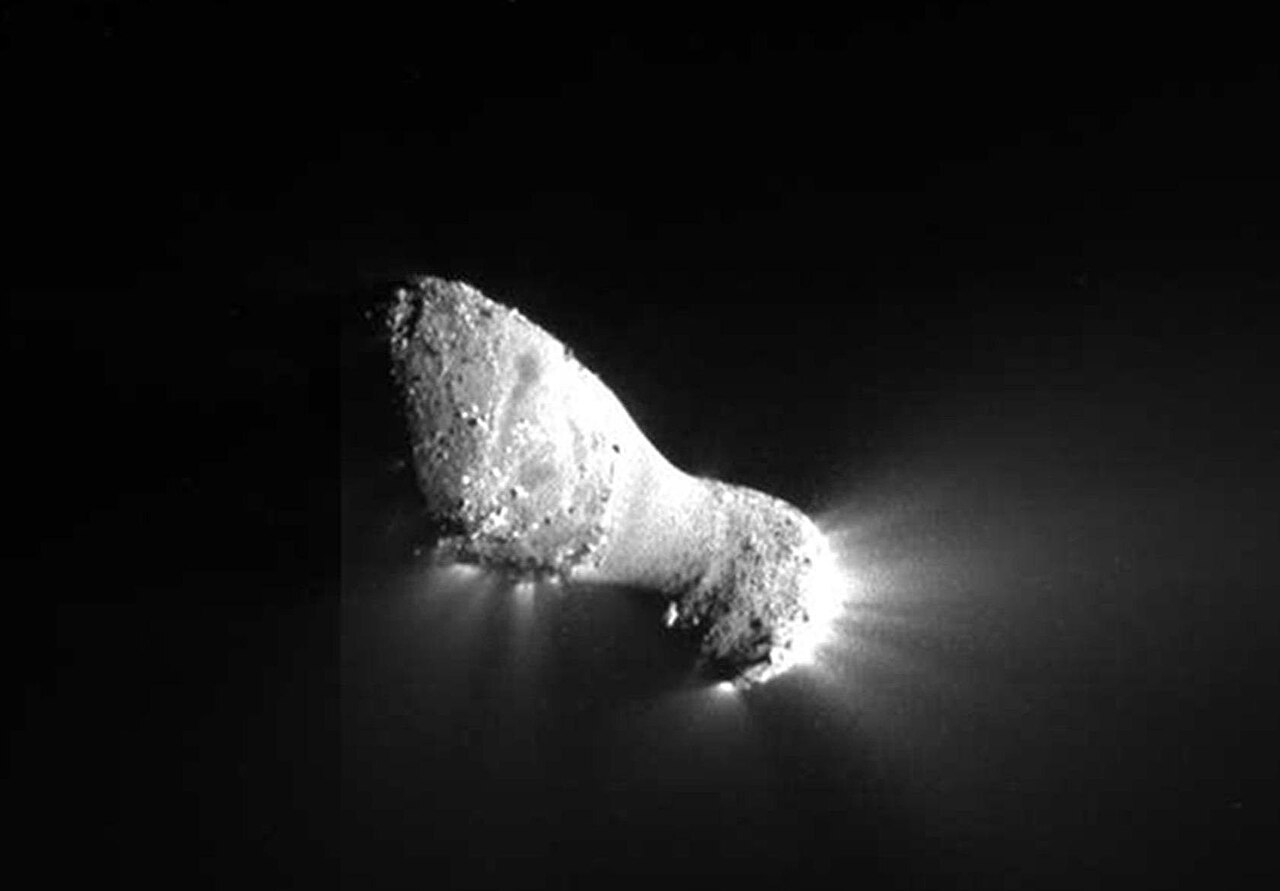
103P/Hartley became the smallest comet ever studied by a spacecraft at close range. Its nucleus measures only 2.25×0.57 km. Its shape resembles a peanut. The comet’s nucleus rotates along an extremely complex trajectory, which is due to its unusual shape and the uneven heating of different parts by the sun’s rays. The surface relief also turned out to be very heterogeneous. The fairly flat bridge of the “peanut” is adjacent to the hilly surface on the halves of the comet, which are dotted with large bright boulders, ranging in size from 16 to 80 meters, with an albedo two to three times higher than the surrounding surface.
Another interesting feature was the comet’s activity. Despite its small size, it was much higher than that of Comet 9P/Tempel. Deep Space managed to capture trails of material ejected to a height of up to 1.2 km.
Comet Churyumov-Gerasimenko
The famous comet 67P/Churyumov-Gerasimenko rounds out our list. So far, it is the only comet in history that has been studied by a spacecraft not during a flyby, but from orbit. This was done by the Rosetta mission between 2014 and 2016. Moreover, it is the only comet in history that has been landed on by an Earth messenger – the Philae probe. The most interesting thing is that 67P/Churyumov-Gerasimenko was not even the original target of the mission. It was supposed to be sent to comet 46P/Wirtanen, but due to a postponement of the launch date, scientists had to find an alternative target.
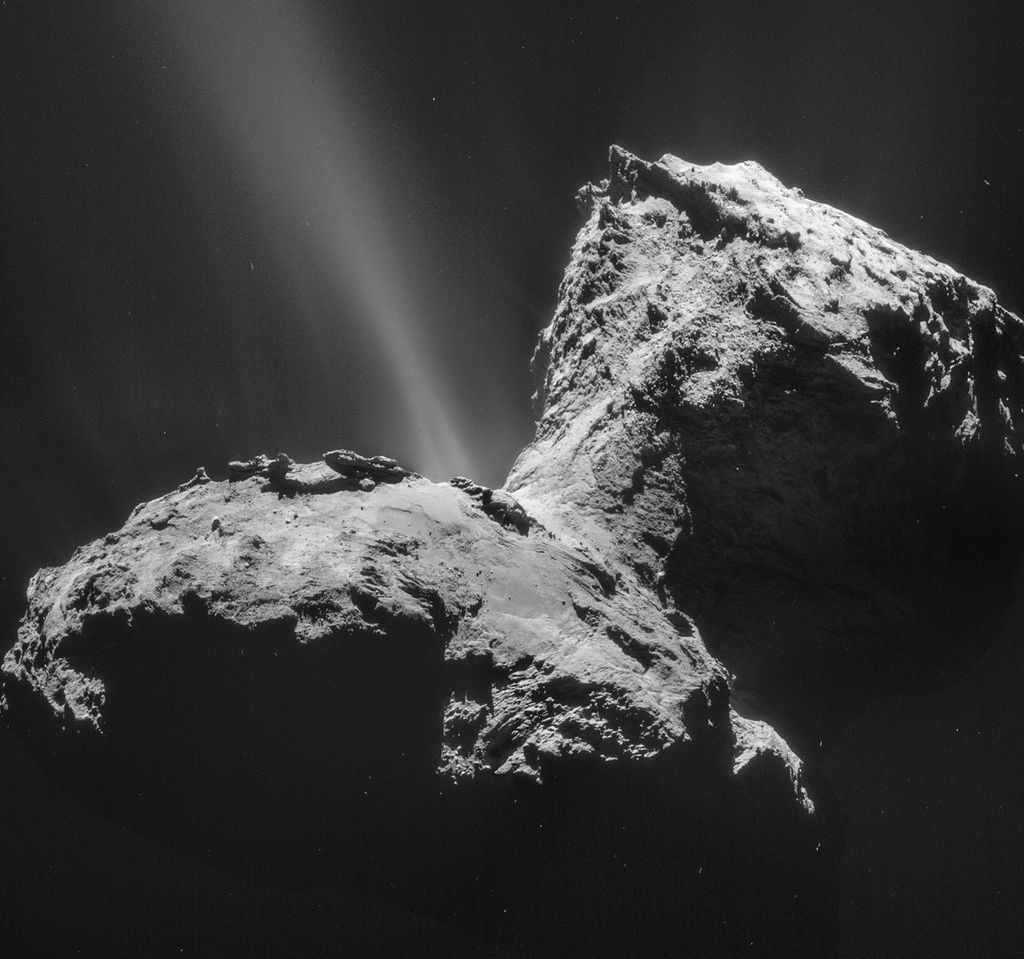
The nucleus of 67P/Churyumov-Gerasimenko is a so-called contact object consisting of two parts connected by an isthmus. The larger part measures 4.1×3.2×1.3 km, while the smaller part measures 2.5×2.5×2.0 km. According to scientists, the nucleus was formed as a result of a low-speed collision between two comets, which subsequently merged into a single object.
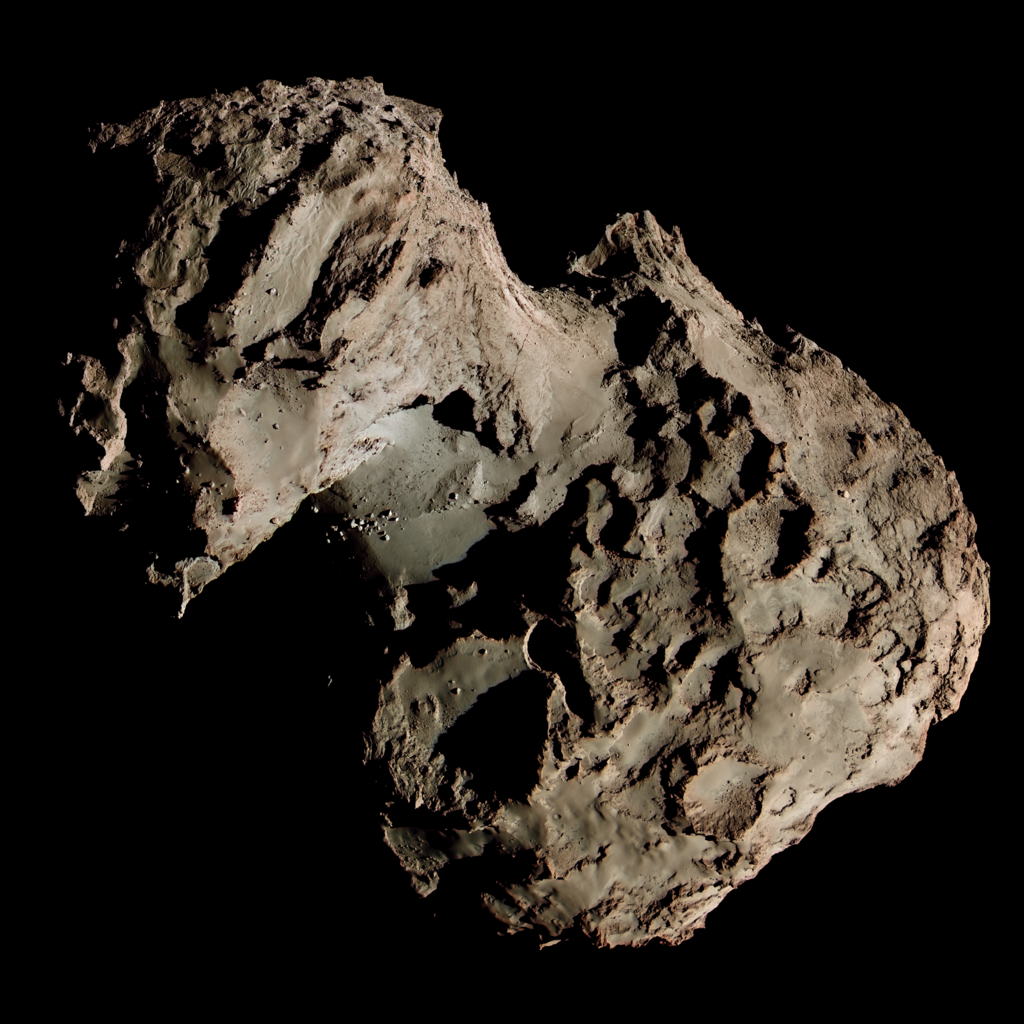
In total, geologists have identified 26 distinct regions on the comet’s surface. Some are relatively flat areas, others are depressions, and still others are covered with dust and rocks. The largest boulder on the comet’s surface has a diameter of 45 meters. Scientists have even given it its own name – Cheops.
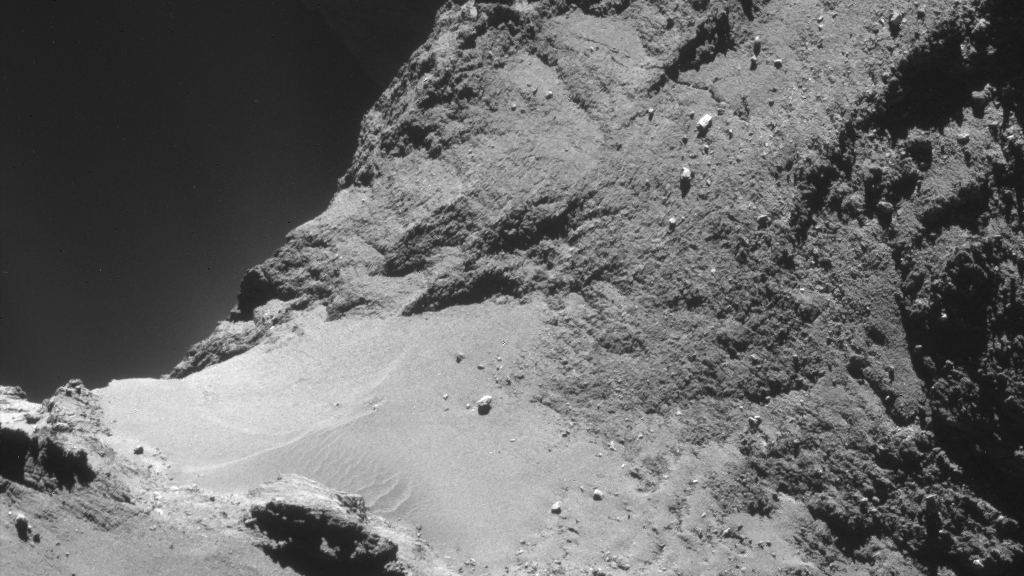
Source: ESA/Rosetta/NAVCAM, CC BY-SA 3.0 IGO
During its mission, Rosetta recorded numerous changes on the comet, especially when it passed through the perihelion of its orbit. These included changes in the surface patterns of 67P/Churyumov-Gerasimenko, an increase in cracks in the isthmus region, the movement of boulders, ejections of material and rocks, cliff collapses, and the resulting landslides.
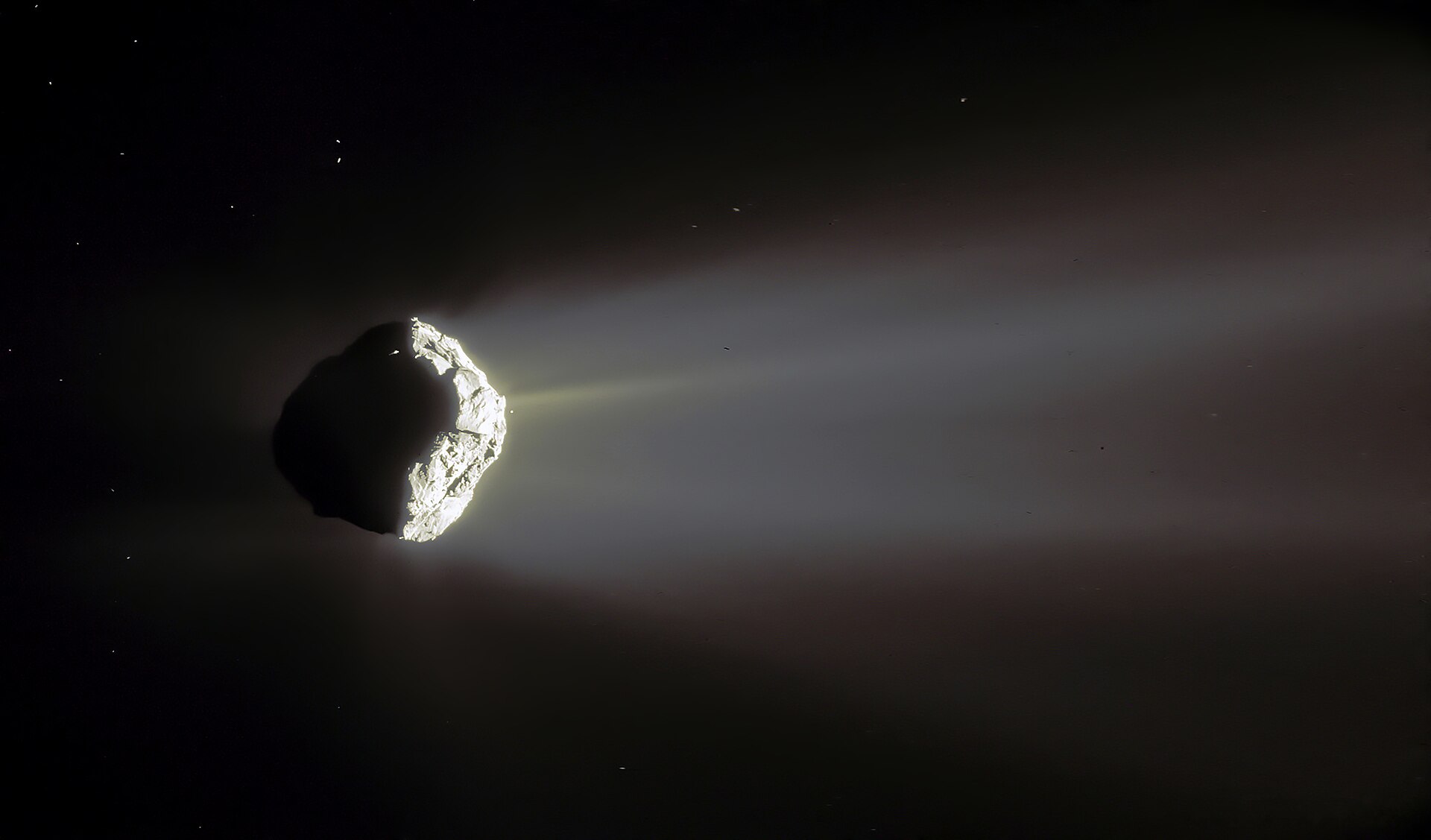
Source: ESA/Rosetta/NAVCAM
According to scientists, as the comet approaches the Sun, the cracks in its icy neck will grow larger. At some point, they will reach a critical point, after which Churyumov-Gerasimenko will break into two separate fragments.

