

We are all used to the idea that the Sun is the primary source of energy sustaining life on our planet. But imagine if the Sun in the sky were tiny and, instead of soft light, emitted invisible rays of death. This is not dark fantasy, but the reality of pulsar planets.
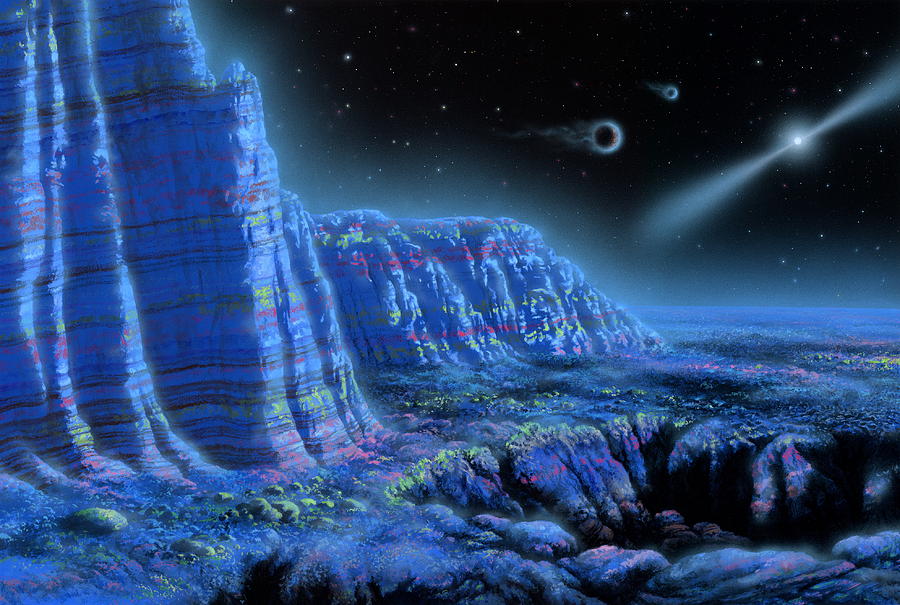
Pulsar planets
The first two planets outside the Solar System were discovered 34 years ago. And they remain among the most exotic known to astronomers. The fact is that both of them, along with another one discovered later, orbit the pulsar PSR B1257+12.
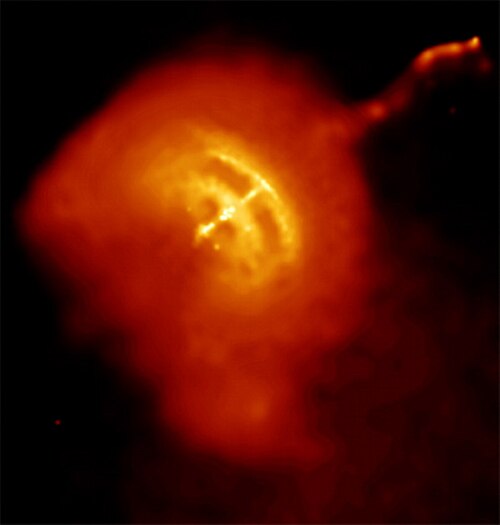
To understand what is remarkable about this case, we need to recall what pulsars are. This is the name given to sources of extremely powerful radiation in the form of a repeating signal with a constant period. Physically, these are neutron stars – objects that form when a mass comparable to that of the Sun is compressed to the size of a planet similar to Earth. In the process, it retains its angular momentum, resulting in incredible density and an extremely powerful magnetic field.
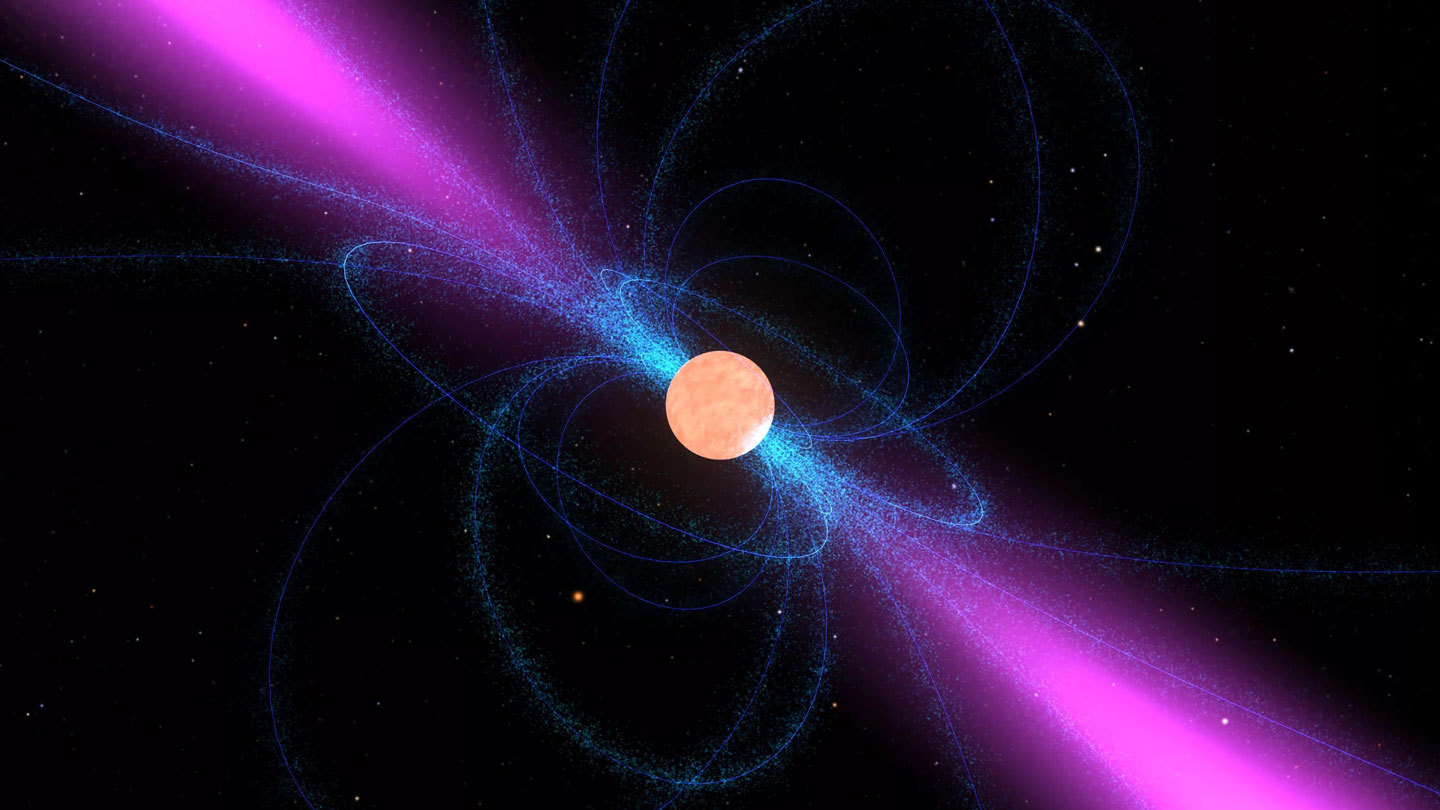
It is the magnetic field that accelerates the particles around the pulsar. This occurs most intensely near its magnetic poles, which do not usually coincide with the axis of rotation. As a result, two beams of radiation are produced that rotate along with the star.
So, pulsar planets are unusual in that no thermonuclear reactions occur on their stars. Some of them are formed as a result of supernova explosions. Others are formed as a result of white dwarf mergers. In any case, these objects shine exclusively with the residual light of an extremely hot body. And there is relatively little of this light. But the planets are literally bathed in radiation.
PSR B1257+12 system
The PSR B1257+12 system, which hosts the first discovered exoplanets, stands out even among other similar systems. This is because the dead star at its center belongs to the class of so-called millisecond pulsars. It completes one rotation in 6.2 milliseconds. This means that it manages to make approximately 180 rotations per second.
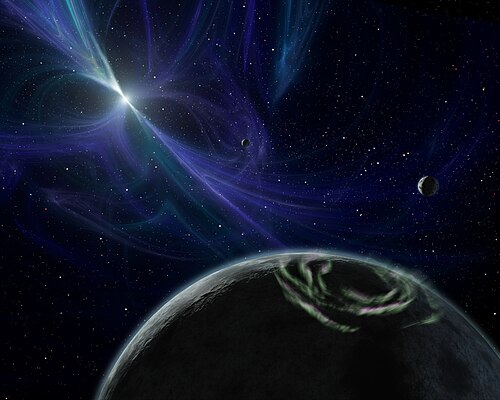
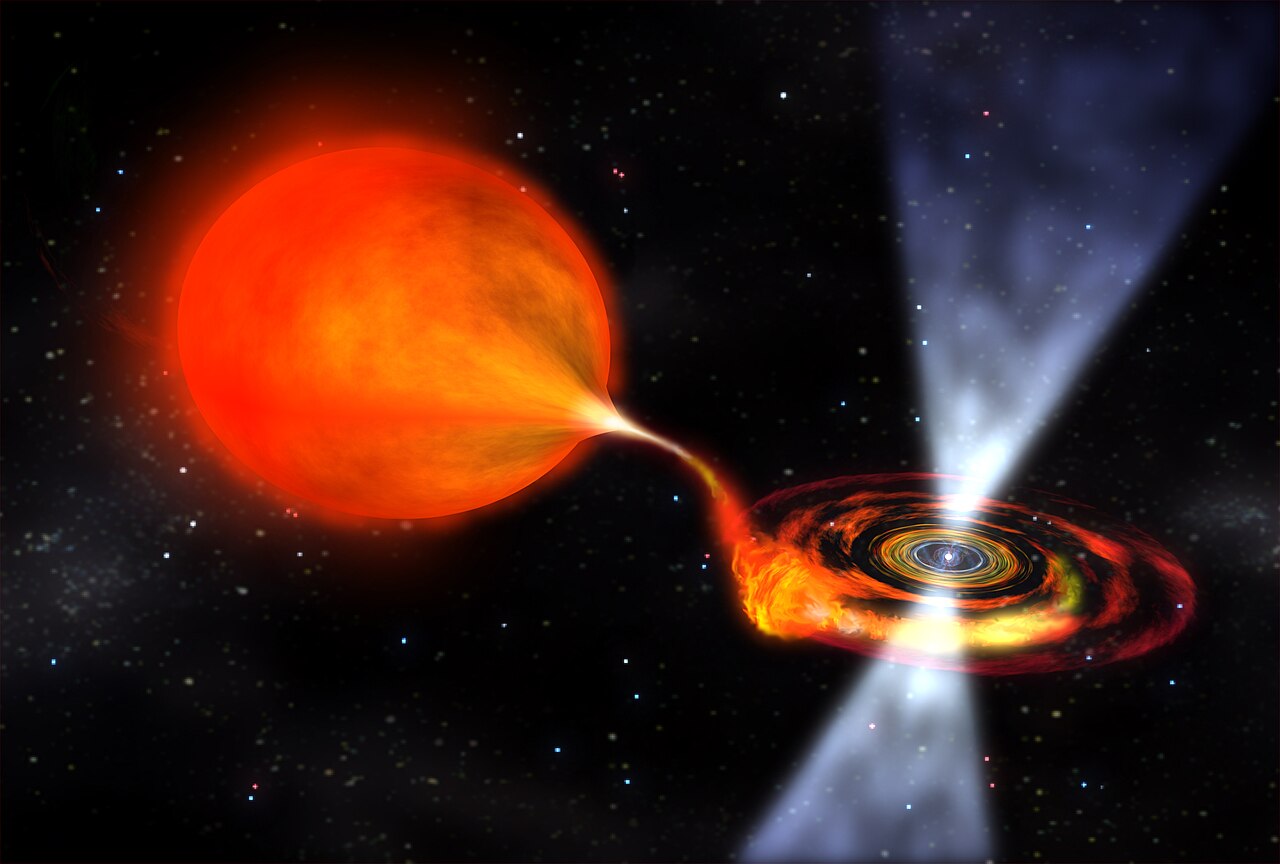
Millisecond pulsars are typically found in binary systems. Material from the companion star falls onto the neutron star, forming an accretion disk, which powers the radiation emitted from the poles.
However, PSR B1257+12, located 2,300 light-years away from us, is a single pulsar. So where does its high rotation speed come from? The fact is that it was not born as a result of a supernova explosion, but rather as the product of the merger of two white dwarfs approximately 3 billion years ago.
And that is precisely what makes his planets so intriguing. There are three of them: Draugr (named after the monsters from Norse mythology that resemble vampires), Poltergeist (an invisible spirit from German mythology that causes chaos), and Phobetor (a character from Greek mythology who appears in dreams in the form of monsters).
The names clearly evoke the afterlife, and for good reason, since scientists have long been puzzled by the question: how can they even exist near such an object? Because if they formed after the pulsar was born, where did the material for their formation come from? And if they existed from the very beginning, how did they survive the transformation of one star into a red giant and the shedding of its outer layers, then the same thing had to happen with the second star, and then somehow they had to survive the merger itself and the gravitational chaos it generated.
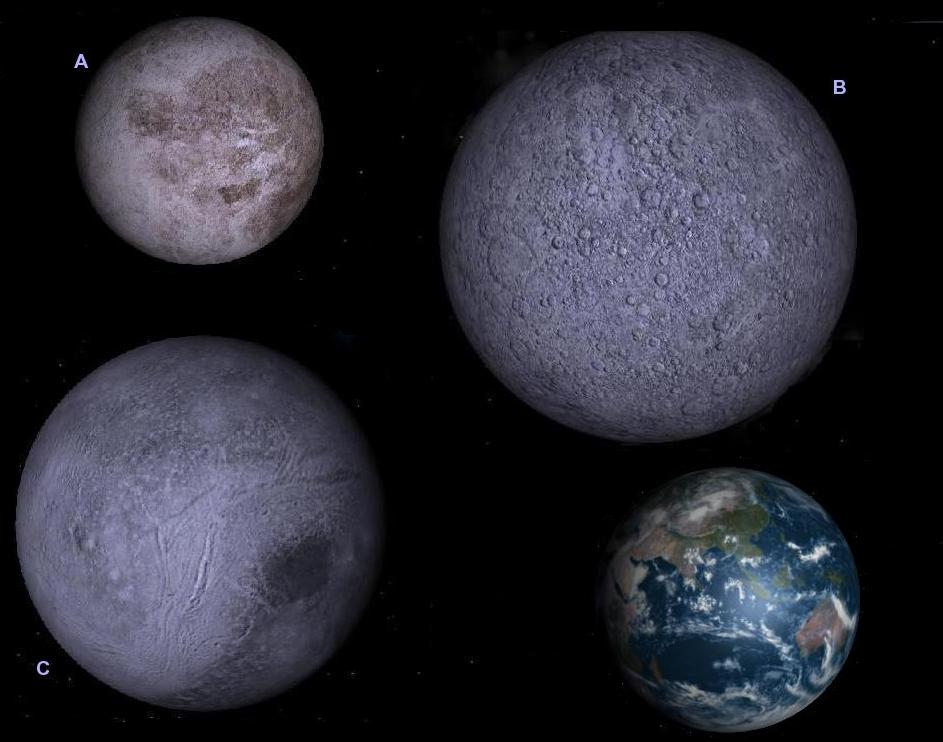
We cannot see the planets themselves using traditional methods, but by analyzing how they affect the pulsar’s signals, we can determine their characteristics with a high degree of accuracy. For example, Draugr is a tiny world with a mass of only about 2% that of Earth, which completes one rotation in 25 days. Poltergeist is 4.3 times more massive than Earth and orbits the pulsar in 66.5 days, while Phobetor has a mass of 3.9 times that of Earth and a year lasting 98 days.
All of this looks like a cluster of rocky planets or sub-Neptunes that remained in their original positions after all the upheavals, but in reality, that is not the case, because at the very beginning, there must have been two stars, and the orbits would have had to be much wider, at the very least. And during the red giant phase, they would have had to be moving inside it.
What makes this system even more intriguing is that nothing like it exists in other pulsar systems. While there are planets there, they are usually solitary and located much farther from the star. No one yet knows why the PSR B1257+12 system is so unique.
The generation of pulsar planets
In general, the origin of pulsar planets is a topic of its own, and astronomers debate it extensively. Three generations of such bodies are distinguished. The first consists of planets that formed alongside a star that later became a neutron star, usually as a result of a supernova explosion. They are quite similar to those we see in main-sequence celestial bodies.
The problem is simply that during a supernova explosion, the worlds that survive are mostly those orbiting at a great distance from the star. To a large extent, they may lose their atmospheres or undergo other changes.
Second-generation pulsar planets are worlds that formed after the star had already turned into a pulsar. It is believed that they may have originated from material ejected into space during a supernova explosion. In theory, there should be enough of this material to form fairly large bodies, but there is a suspicion that it disperses too quickly for planets to form from it.
Finally, there may also be third-generation pulsar planets. These can form when a pulsar is part of a binary system. In such cases, the neutron star draws matter from the surface of its companion, resulting in the formation of an accretion disk. It is within this disk that new planets could theoretically form. Other, even more exotic scenarios for the formation of pulsar planets are also possible. For example, a neutron star could gravitationally capture a wandering planet.
Could a pulsar planet be habitable?
It might seem that the planets orbiting a pulsar are the very embodiment of a world of death. However, scientists are not entirely sure that life there is completely impossible. The main problem there is not radiation itself. Many microorganisms on Earth can easily withstand the levels of radiation found near a pulsar.
Liquid water is another matter – one of the key criteria for a planet’s habitability, since most of the biochemical processes we know of take place in such an environment. Pulsars emit too little light to heat a planet sufficiently for life to exist, unless it is almost touching them. However, in many cases, such proximity to a neutron star would be fatal: its gravity would simply tear the planet apart.
In the aforementioned PSR B1257+12 system, the planets are located fairly close to the local “habitable zone.” However, in this case, other problems arise, and this time they are indeed related to radiation. To prevent the stream of charged particles from stripping away the atmosphere and hydrosphere, the planet must be at least ten times more massive than Earth and, at the same time, possess a powerful magnetic field. Therefore, it is still too early to draw definitive conclusions about its potential habitability.

