

Analysis of interstellar comet 3I/ATLAS shows that this mysterious body may be covered with erupting ice structures called cryovolcanoes. Researchers have also discovered that it has a metal-rich internal composition. This could challenge our understanding of how comets formed in our own Solar System.
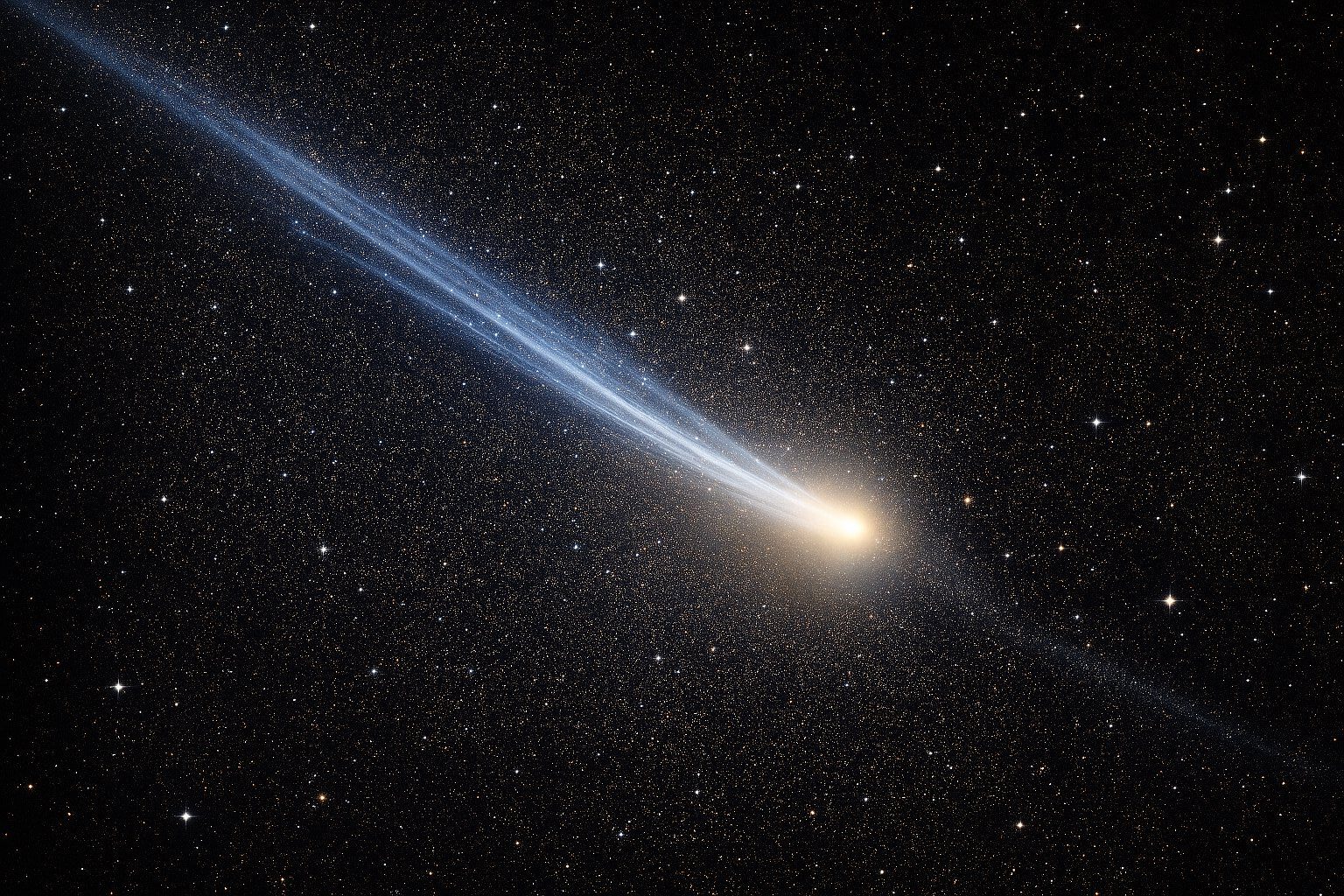
Scientists tracked comet 3I/ATLAS from July to November 2025 as it raced toward our sun. This provided a rare opportunity to study an object that formed in another star system. What makes it so valuable is that it is untouched, as it has never flown close enough to a star to heat up, melt, or otherwise change under the influence of radiation. This means that it is almost the same as it was billions of years ago when it formed in its home system.
In their study, published on the arXiv preprint server, an international team of scientists described how photometric observations showed a sharp and prolonged burst of brightness in the comet when it was 2.5 AU from the Sun. It was not explosive in nature, but rather gradual.
Scientists interpreted this event as cryovolcanic activity. Unlike comets in our Solar System, 3I/ATLAS does not have a protective dust mantle, which makes such “activation” of the water ice layer entirely possible.
When researchers studied the light reflected from the comet’s surface and compared it to the spectrum of meteorite samples found on Earth, they discovered that it corresponded to a rare type called carbonaceous chondrite. These are ancient, primitive objects rich in metals such as iron and nickel. Therefore, scientists concluded that Comet 3I has the same composition.
According to the authors of the study, this metal-rich composition helps explain the comet’s powerful cryovolcanic activity. They suggest that as the surface heated up and ice turned into water, the liquid began to corrode the small metal grains inside the comet. This chemical process releases additional energy and gases, such as CO2, which help sustain cryovolcanism.
This unusual combination of metal-fed activity and ice volcanoes differs significantly from our current understanding of comet formation. Standard models assume that comets consist of ice, rock, and low concentrations of metals, and are powered by the Sun heating the surface ice. According to the researchers, 3I/ATLAS challenges our current understanding of planetary system formation and the chemical evolution of small bodies.
According to Phys.org

