

China has become the second country in the world to implement a sea platform for returning reusable rockets. Private company iSpace has unveiled the Xingji Guihang (“Interstellar Return”) droneship, which is designed to recover the first stages of rockets after they land at sea. The introduction of this vessel is intended to reduce launch costs and accelerate the transition of Chinese private launch companies to full/partial reusability.
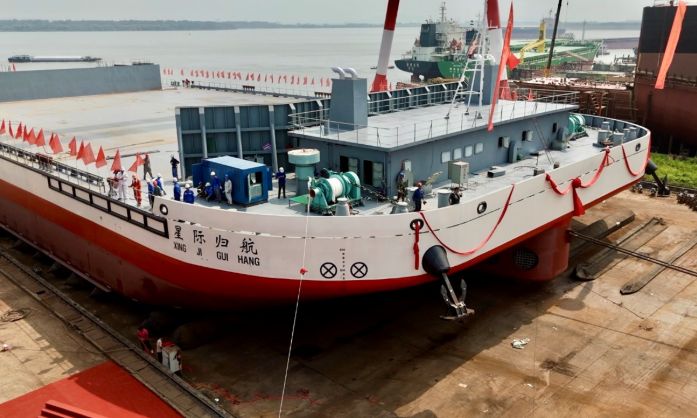
According to the developers, the platform is approximately 100 m long and 42 m wide, and the landing deck is approximately 40×60 m. The vessel is equipped with a DP2 dynamic positioning system for precise positioning at a specified point during cargo reception. ISpace reports that Xingji Guihang is expected to support the return test of the first stage of the SQX-3 (Hyperbola-3) rocket from orbit at the end of 2025.
Independent media sources add that the vessel left the shipyard for retrofitting and is preparing for sea trials near Hainan in September. It is slightly longer than SpaceX platforms and, thanks to its large deck, has enough space for more massive stages. This is another indication that Chinese private rocket and space companies are accelerating the transition to reusable stages.

The sea landing of the first stages is the key to reducing the cost of regular launches of scientific equipment: telescopes, interplanetary probes, small satellites for astronomy and space weather. Each restored stage reduces the cost of the launch series and allows for more frequent missions, testing of new instruments, and faster upgrades to orbital observatories. For researchers, this means more “windows” for observations, more flexible schedules, and greater participation by university and startup teams in space programs.
If you are interested in how China is developing reusable rockets and sea infrastructure for landing stages, the next logical step is to see what is already operating in orbit. China’s Heavenly Palace: Tiangong Space Station is a modular station where crews conduct dozens of experiments in microgravity, test new technologies, and prepare the groundwork for more ambitious missions. Want to understand why China needs its own orbital laboratory and how it works? Read the article about Tiangong — there you can find all the facts and vivid examples.
According to globaltimes, nasaspaceflight, interestingengineering

