

An international team of astronomers used the James Webb Space Telescope (JWST) to observe a nearby red dwarf known as TWA 20. They managed to detect a debris disk surrounding it.
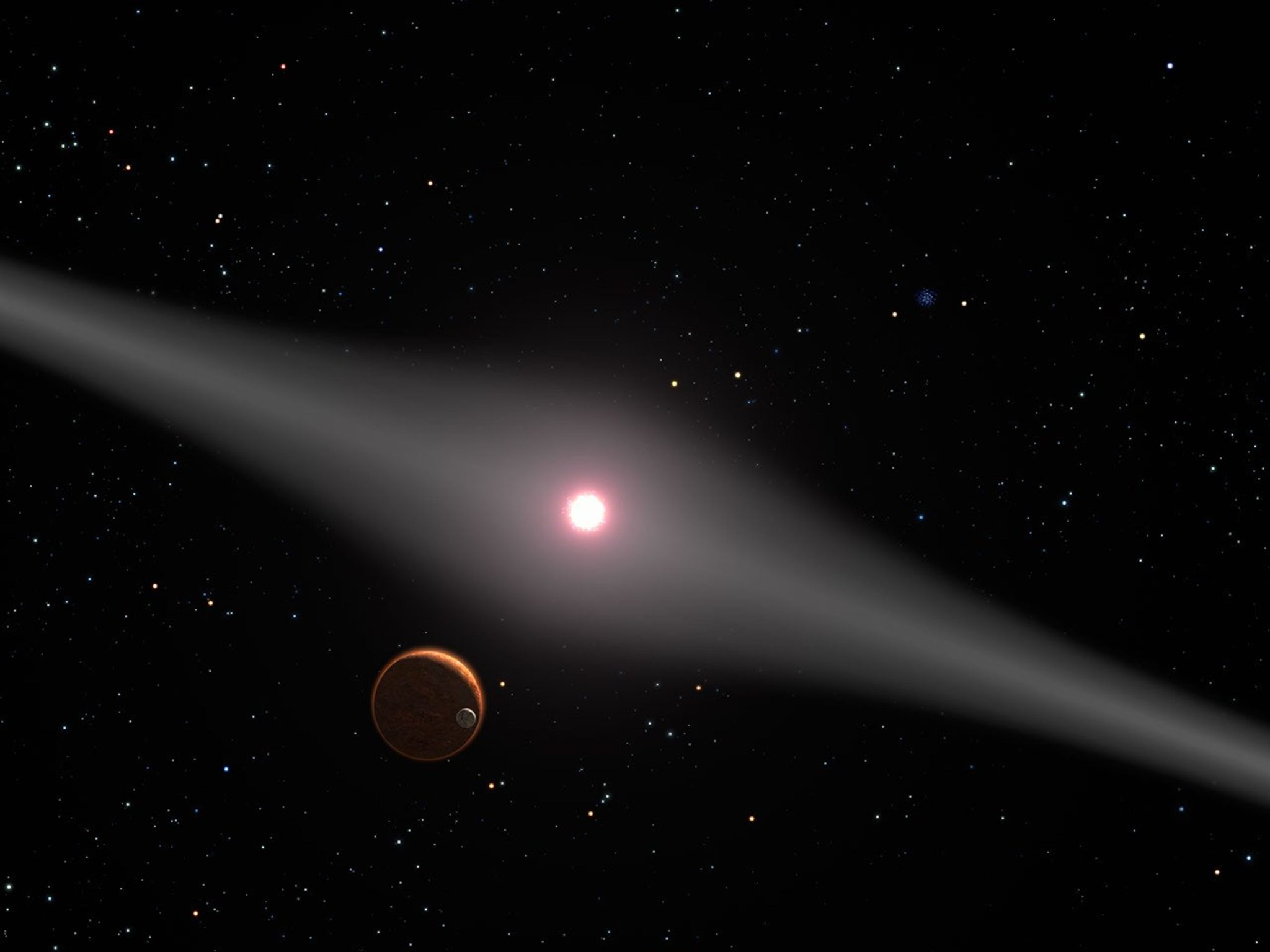
Debris disks represent the late stage of evolution of a gas and dust disk around a young star, when the planet formation process is nearing completion and the disk is poor in gas but rich in dust, and also contains debris of various sizes. These can be asteroids, comets, and objects similar to those in the Kuiper belt. Studying debris disks is important for scientists because it helps them better understand the evolution of planetary systems.
In June 2024, a group of astronomers from the University of California, Santa Barbara, used the near-infrared camera installed on the JWST to observe TWA 20. It is a dim brown dwarf located 261 light-years from Earth. The star formed quite recently. Its age is estimated at 10 million years.
JWST discovered that TWA 20 is surrounded by debris disks. Its radius is 64.7 AU, and its inclination is 70.1 degrees. It has a comparable radius and brightness to debris disks found around other red dwarfs.
Scientists also attempted to find disturbances in the disk that could have been left by massive companions, but were unsuccessful in their search. The JWST data collected rules out the presence of objects with a mass similar to Jupiter at a distance greater than 48 AU.
The discovery once again demonstrates the JWST’s exceptional capabilities in searching for such objects. Due to their faintness and coldness, debris disks are extremely difficult to detect with ground-based telescopes.
Earlier, we reported on a super-Earth orbiting another red dwarf, which may be the best place to search for extraterrestrial life.
According to Phys.org

