

A team of astronomers from Pennsylvania State University has announced the discovery of an exoplanet whose orbit lies within the habitable zone close to the star’s sun. It may be the best candidate for the search for extraterrestrial life.
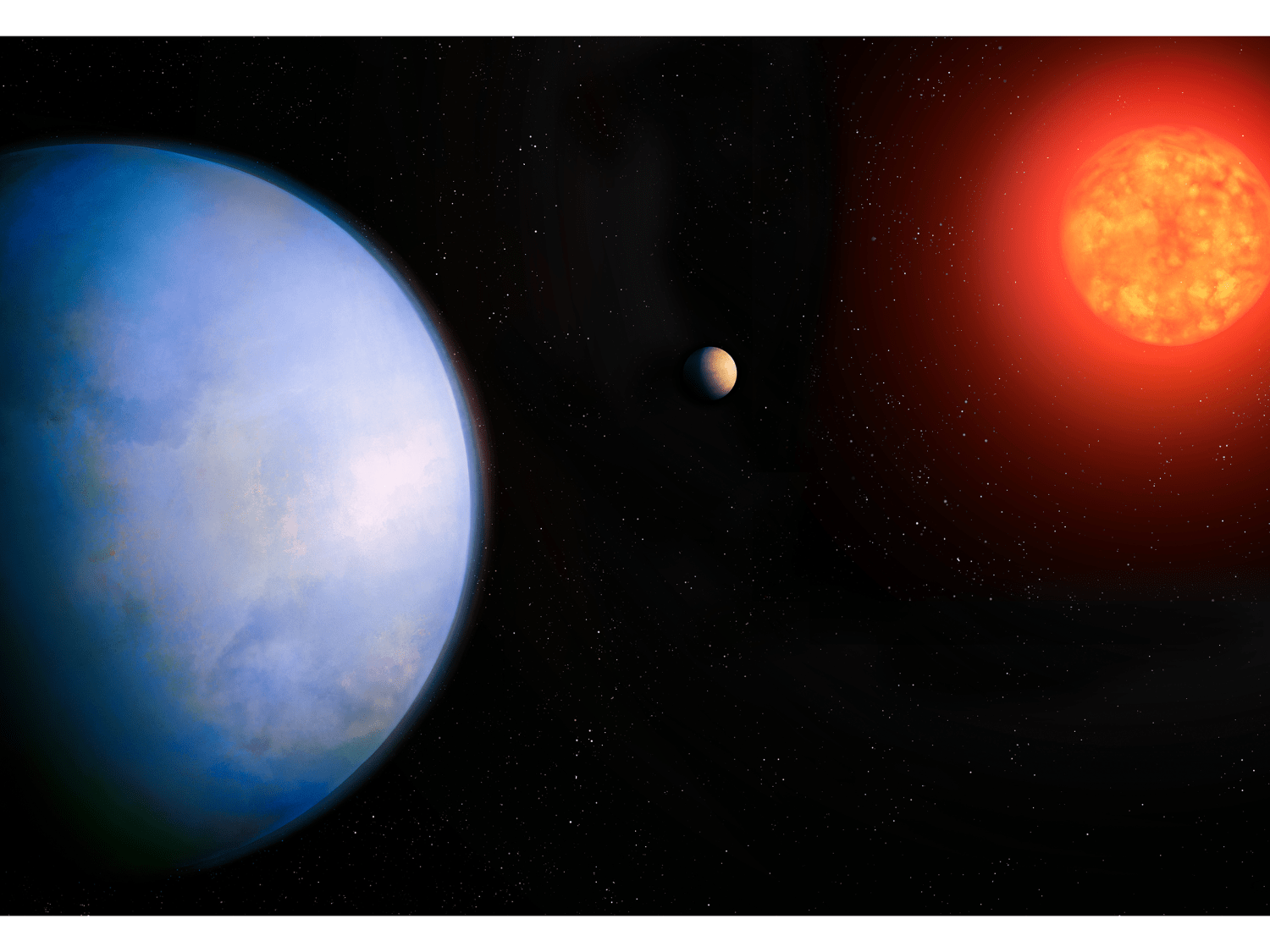
The newly discovered exoplanet has been designated GJ 251c. It was found as a result of analyzing data collected over more than 20 years using various telescopes around the world. The ultra-precise Habitable-Zone Planet Finder spectrograph played a key role. It managed to detect changes in the radial velocity of the star Gliese 251, indicating the presence of an invisible companion.
Gliese 251 is a red dwarf located just 18 light-years from Earth. In 2020, scientists already found an exoplanet in this system. However, its orbit is too close to the star for water to exist on its surface.
GJ 251c has much more favorable conditions for sustaining life. It is a super-Earth with a rocky surface, whose mass is four times that of Earth. Its orbital period is 54 days, and its orbit passes at a distance of 0.196 AU (29.3 million km) from its parent star.
According to astronomers’ estimates, the orbit of GJ 251c is located in the middle of the habitable zone of Gliese 251. This means that its surface receives just enough heat for liquid water to exist there. An additional important factor is that Gliese 251 is hotter than most important dwarfs. Therefore, its habitable zone is located at a greater distance than in most red dwarf systems. This gives hope that its powerful stellar winds did not blow away the atmosphere of GJ 251c, as happened with exoplanets in the habitable zone of the star TRAPPIST-1. In addition, the super-Earth may not be in tidal lock, which is also an important factor for its habitability.
At present, astronomers do not know whether GJ 251c has an atmosphere — existing instruments are not powerful enough to answer this question. However, in just a couple of years, the situation will change. Due to its proximity to Earth, GJ 251c will be an ideal candidate for next-generation observatories, such as the Extremely Large Telescope being built in Chile. It will be able to obtain direct images of it and analyze its atmosphere in search of biosignatures. Their discovery would be a crucial argument in favor of the idea that we are not alone in the Universe.
According to Psu.edu

