

Using the James Webb Space Telescope, astronomers have discovered striking contrasts between the dawn and dusk zones on the surface of the ultra-hot gas giant WASP-121 b. These transitional boundary zones, known as terminators, separate the hemispheres of perpetual light and perpetual darkness. That is, the terminator is the boundary between the illuminated and darkened parts of the planet. The data obtained provided the first indisputable evidence that morning and evening on this exoplanet differ drastically in terms of temperature and atmospheric composition, fully confirming previously existing theoretical models.
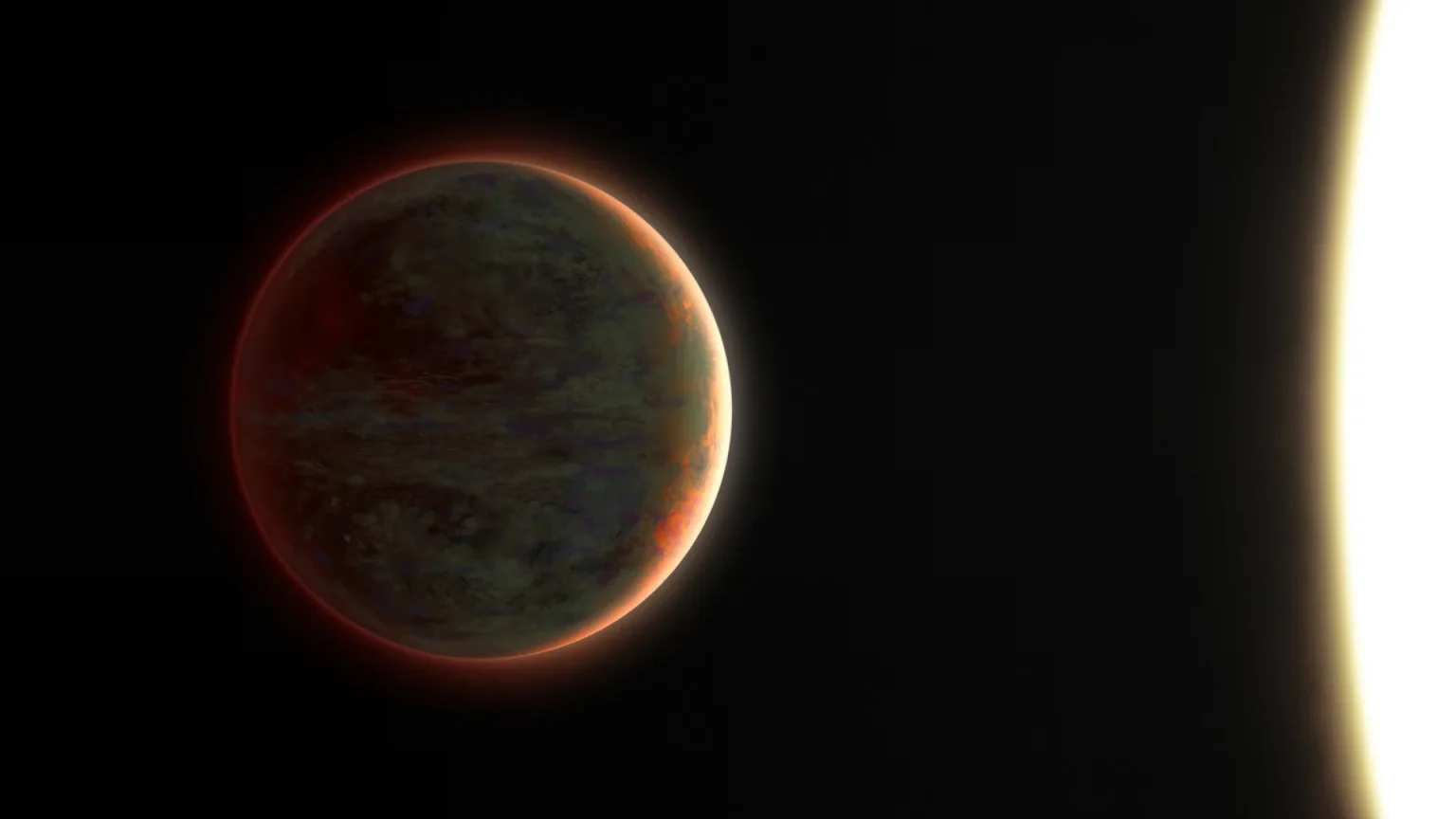
The discovery, published in the journal Nature Astronomy, was made possible by analyzing the infrared radiation from the host star. When WASP-121 b passes in front of its star, the star’s light is filtered through the planet’s atmosphere. The researchers observed a distinct, uneven pattern of absorption of this light.
According to Cyril Gapp of the Max Planck Institute for Astronomy (MPIA), the James Webb Space Telescope’s unprecedented sensitivity has made it possible to measure the slightest changes in light absorption as the planet moves. Observations have shown that the evening terminator absorbs significantly more light than the morning terminator. This is fully consistent with hypotheses about powerful easterly winds that carry enormous heat from the heated daytime side. Due to this extreme heating, the evening atmosphere expands, creating a larger surface area to intercept starlight.
Chemical anomalies
The NIRSpec instrument aboard the observatory detected not only temperature contrasts but also intriguing chemical changes. Toward the end of the transit, scientists recorded a stronger signal of carbon monoxide (CO), which is attributed to the effects of high temperatures.

However, the most interesting finding concerned water (H₂O). The data show that in the hottest regions of the evening zone, the number of water molecules drops sharply. Scientists explain this simply: the temperature in the upper layers of the atmosphere there is so high that water molecules literally break down into individual atoms. This provided further compelling evidence that the evening terminator is heated by powerful hot winds.
A world of eternal daylight and mineral clouds
WASP-121 b is a typical gas giant in a close orbit that has long since synchronized its rotation due to the star’s powerful tidal forces (the time it takes for a planet to rotate around its axis coincides with the time it takes for the planet to rotate around the star). One of its hemispheres is always illuminated by the star and heats up to a scorching 2500°C (2770 K), while the other is perpetually shrouded in darkness with a temperature of about 725°C (1000 K).
During a full transit, the planet rotates approximately 30° on its axis. This is enough for astronomers to scan different sections of its atmosphere and distinguish the lines of dawn and dusk with high precision.
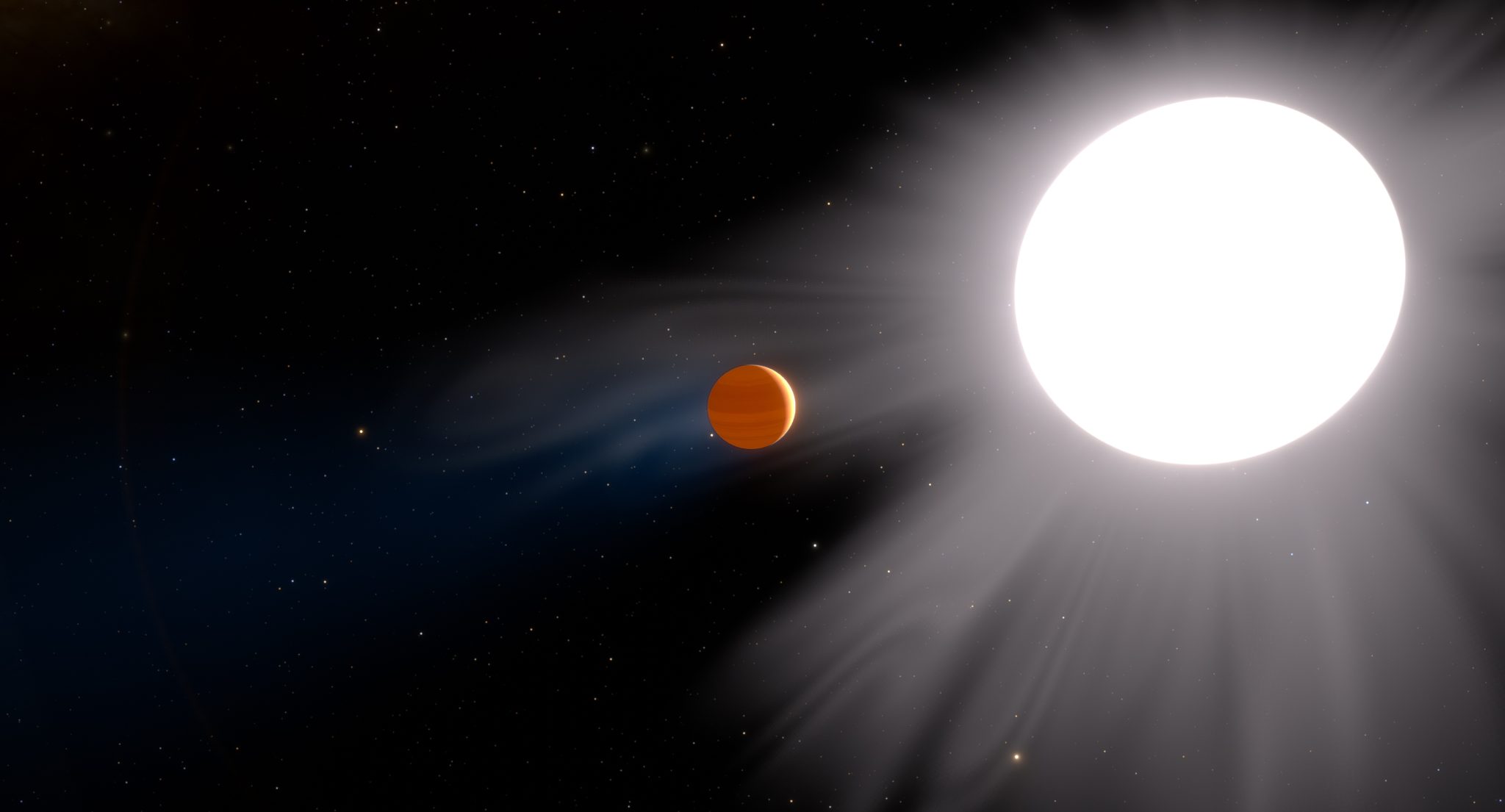
Interestingly, while computer simulations of heat transfer predicted a temperature difference, the actual effect turned out to be much stronger. Scientists suggest that the morning terminator may be further cooled by clouds. But unlike Earth’s clouds, these are composed of minerals (such as silicates). They block infrared radiation from deeper, hotter layers, making this part of the atmosphere appear cooler.
A new tool for exploring the Universe
Modeling the formation of exoplanetary clouds under such rapidly changing conditions remains an extremely challenging task for modern science. However, this new research method opens up previously unseen possibilities. Astronomers are already planning to apply it to other super-hot gas giants to understand how weather conditions form on the most extreme worlds in our galaxy and to create detailed three-dimensional models of them.
We previously reported on the massive storms raging in the atmosphere of the “hot Jupiter” WASP-121b.
According to sciencedaily.com

