

The Moon played a key role in the formation of Earth—it stabilized the planet’s axis of rotation and, according to some theories, may have contributed to the emergence of the first forms of life through tidal heating. Astronomers are now searching for a similar “planet-moon” pair in another star system. A team of researchers from the Massachusetts Institute of Technology, Harvard University, and the University of Chicago has trained the James Webb Space Telescope on the most promising candidates.
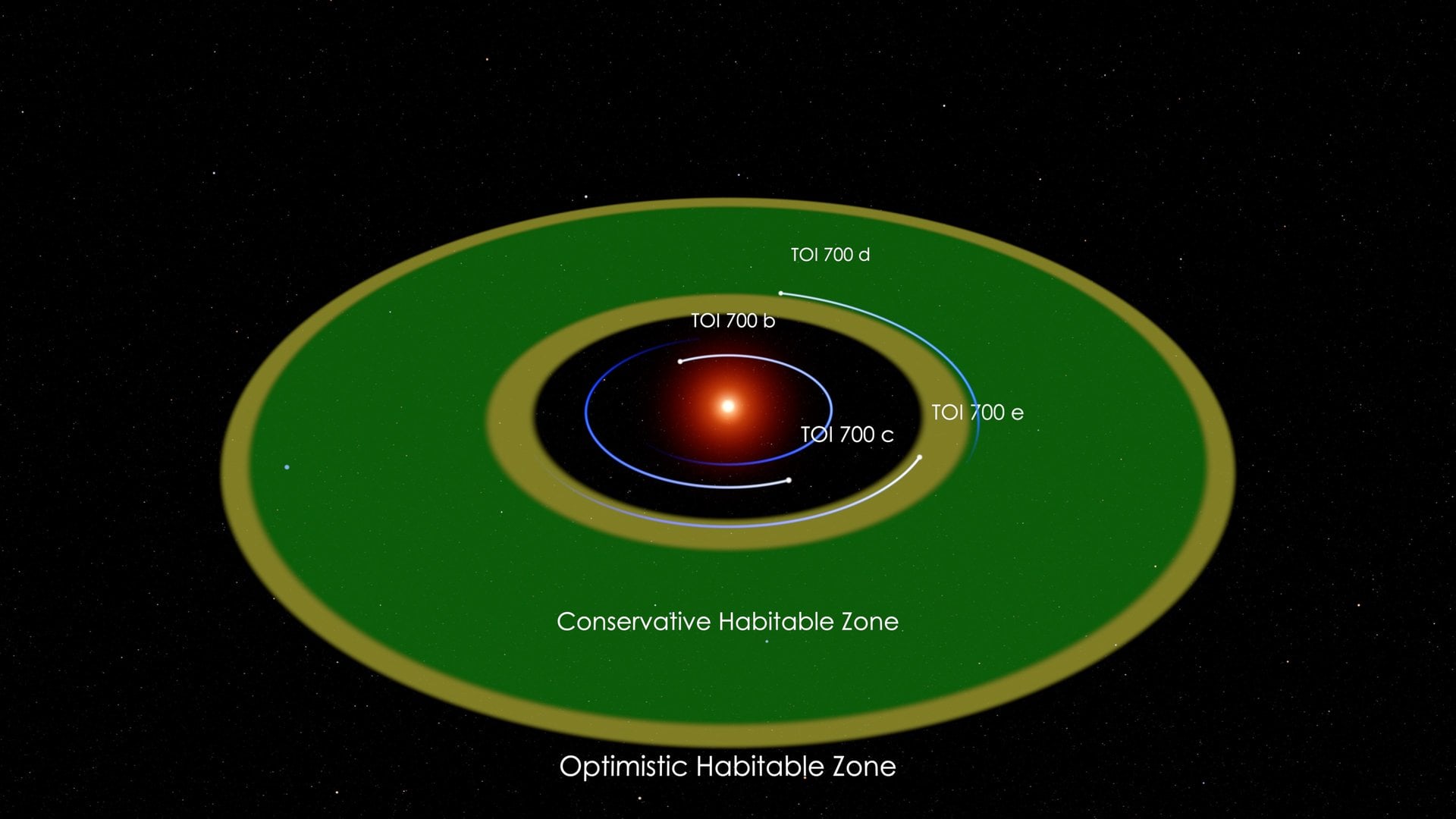
Two planets in the habitable zone
The TOI-700 system is located about 100 light-years away. At its center is a small M-dwarf star, orbited by at least two Earth-sized planets: TOI-700 d and TOI-700 e. Both are located in the “habitable zone”—the range of distances from a star where liquid water could theoretically exist. According to the study’s authors, these stars are the best known candidates for finding a stable natural moon.
Observations by the James Webb Space Telescope have significantly refined the data on both planets: their orbits have been determined with ten times greater precision, and their sizes with two to three times greater precision. TOI-700 d is approximately 15% larger than Earth, while TOI-700 e is 8% smaller.
Sensitivity limit
To detect a moon the size of our own, the telescope would need to detect a 20-ppm decrease in the stellar flux—and technically, it is capable of doing so. However, while analyzing the data, the researchers encountered an obstacle known in the scientific literature as “red noise.” It is caused by granulation—the constant bubbling of plasma on the star’s surface.
This background fluctuated with a period of 16 minutes and an amplitude of about 46 parts per million, completely masking the fainter signal from the hypothetical moon. In the end, the researchers could only conclude that if these planets have a moon, it is definitely smaller than Ganymede—the largest moon in the Solar System—or it orbits within a period of less than two days.
Dataset is available—we just need an algorithm
However, there is some good news. The authors of the study concluded that if someone were to develop an algorithm for filtering out “red noise,” and if a natural moon really exists, the necessary information is already contained in the collected dataset.
In other words, the first confirmed discovery of an exomoon in history may already be waiting for us in these records. So far, no one has been able to distinguish the useful signal from the stellar background, but the search for a mathematical tool to do so is already underway.
Challenges for the future
The problem of stellar noise has long plagued exomoon hunters. Previous candidates for this discovery turned out each time to be either a transit of a planet across a sunspot on the star’s disk or a statistical artifact.
Some astronomers are already actively searching for moons orbiting exoplanets that orbit quieter stars—in order to minimize this type of interference. The first true exomoon remains elusive for now.
The preprint was published on arXiv on April 25, 2026.
According to universetoday.com

