

Astronomers used the James Webb Space Telescope (JWST) to study a nearby white dwarf. Observations have revealed the chemical composition of the disk surrounding it.
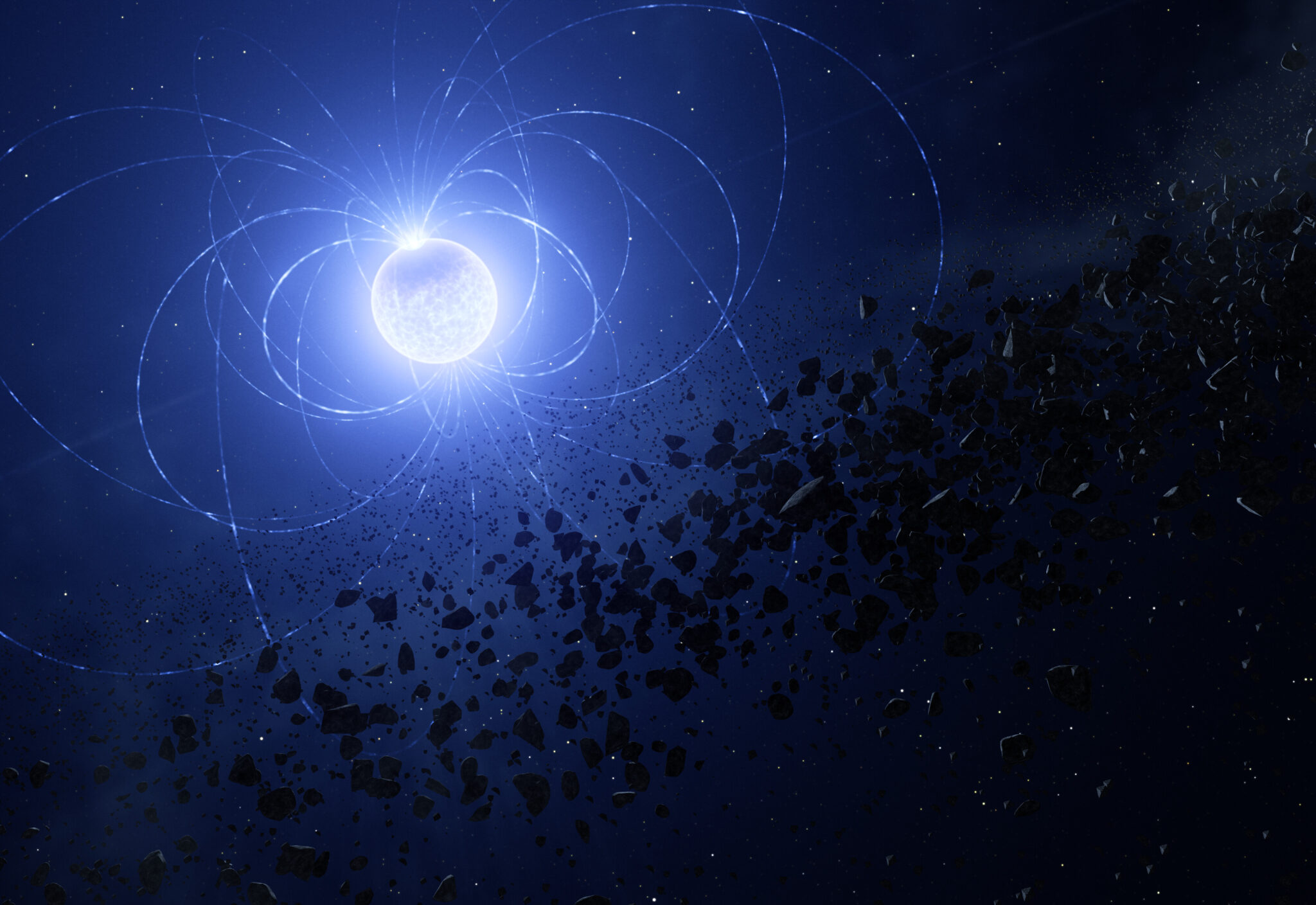
White dwarfs are the remains of sun-like stars that have exhausted their hydrogen fuel reserves and shed their outer layers, leaving behind a gradually cooling core. With dimensions comparable to those of our planet, they have masses that can exceed the mass of the Sun.
Due to their extremely high density, any heavy elements on the surface of white dwarfs quickly “sink” deep into the interior. This, in turn, means that if there are any elements in the spectrum of such a body other than hydrogen and helium, they were brought in from outside, through the accretion of planetary debris, some of which once orbited the star and were destroyed during the red giant stage. Research into such “contaminated” white dwarfs is important because it gives scientists a better understanding of how planets form and evolve, and what they are made of.
Recently, JWST has been involved in the study of such objects. Its target was GD 362, also known as WD 1729+371 — a white dwarf located 183 light-years from Earth. Its radius is 8,790 km, its mass is approximately 0.57 times that of the Sun, and its effective surface temperature is estimated at 9,500 °C.
Previous observations of GD 362 have shown that it is one of the most polluted white dwarfs known to science. Its atmosphere is characterized by a predominance of helium with a high metal content, as well as an abnormally large mass of hydrogen. In addition, a surrounding dust disk was discovered, located at a distance of 1.2–12 million km from the dwarf.
Thanks to the high spectral resolution and sensitivity of its instruments, JWST was able to measure the composition of the dust disk around GD 362. This proved to be a mixture of amorphous and crystalline olivines and pyroxenes, as well as amorphous carbon. It was found that the content of carbon, oxygen, magnesium, aluminum, and iron was twice that of silicon.
JWST failed to find any traces of water or other hydrogen-containing substances in the spectrum. This suggests that the dust in the disk is drier and contains less hydrogen than in chondritic meteorites.
“Overall, the results indicate that GD 362 is surrounded by a disk with solids having elemental abundances approximately matching those seen in the atmosphere of the white dwarf, supporting the connection between disk and atmosphere arising from accretion of planetary material,” the authors of the article concluded.
Earlier, we reported on how the theory of relativity resolved the issue of life in white dwarf systems.
According to Phys.org

