

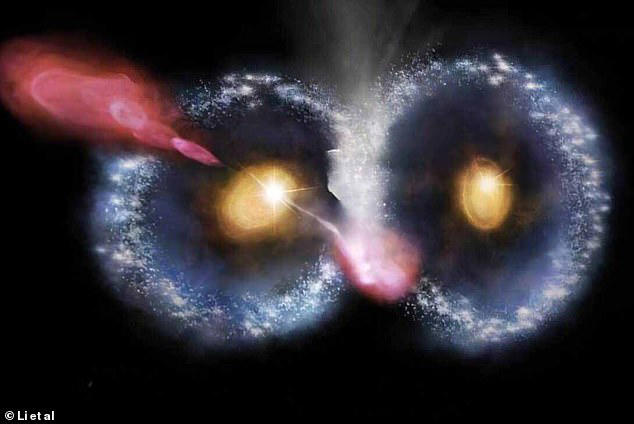
Using the James Webb Space Telescope (JWST), scientists have discovered a rare object about 11 billion light-years away — the “Cosmic Owl.” This formation is unique not only in its shape, but also due to the fact that, according to Mingyu Li of Tsinghua University, who led the study, it serves as a natural laboratory for studying the processes of galaxy evolution.
Galaxies can have different shapes: from spiral, like our Milky Way, to elongated cigar-shaped, like M82. There are also ring galaxies, such as the Hogg Object. In general, ring galaxies are a very rare type of cosmic object (only 0.01% of all known ones). Such objects arise when a smaller galaxy passes through a larger one, ejecting stars and gas in the form of a ring.
The “Cosmic Owl” is a pair of ring galaxies that collided and formed a symmetrical structure resembling an owl’s face.
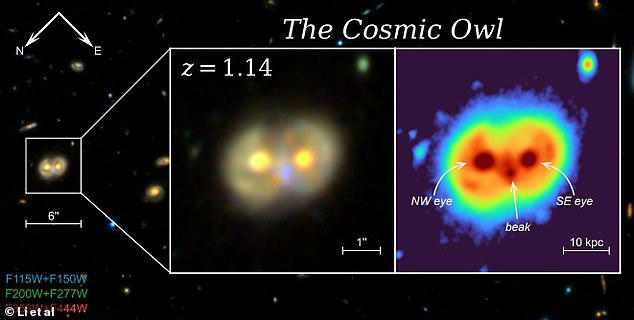
Both galaxies involved in the collision have a diameter of about 26,000 light-years. This is about a quarter of the diameter of the Milky Way. Their cores, with supermassive black holes at their centers, form the “eyes” of the owl. They are active galactic nuclei, meaning they intensively absorb matter.
The owl’s “beak” is also special, as it serves as a veritable “star nursery.” This is the collision zone of galaxies, where a huge cloud of molecular gas is located. According to data from the ALMA telescope (Chile), this is the so-called “raw material” for the birth of new stars, compressed by a shock wave from the collision of galaxies. Radio observations confirm that the jet of charged particles from the black hole of one of the galaxies additionally compresses the gas, causing a powerful stellar explosion in this area.
According to scientists’ estimates, the collision occurred about 38 million years ago, so the “owl face” will remain visible for a long time.
This discovery helps us better understand how quickly and efficiently gas is converted into stars in the early universe. Scientists plan to continue studying the “Cosmic Owl” to gain a more detailed understanding of how such rare double ring galaxies are formed.

