

Astronomers have captured a rare moment in the formation of a planetary system, directly observing how massive objects accrete material from the protoplanetary disk. This discovery provides a clear view of the process of gravitational interaction, which creates distinct gaps in the disk and determines the future appearance of the system.
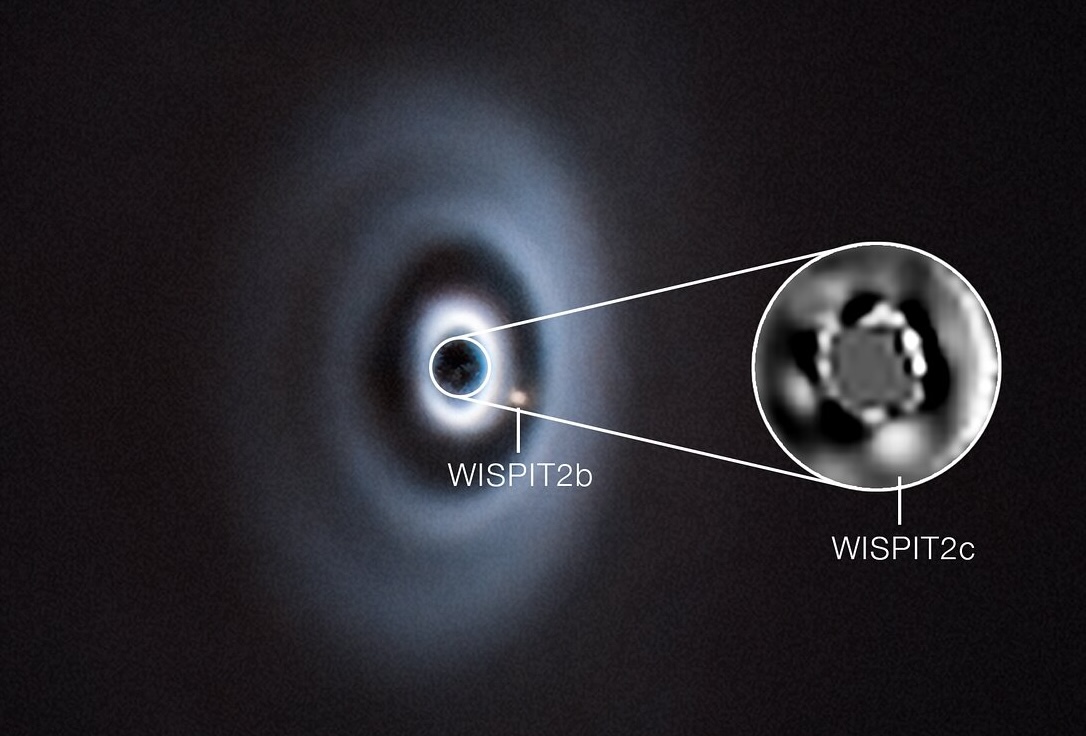
Around the star WISPIT 2, which is only 5 million years old (by comparison, the Sun is 4.6 billion years old), researchers have discovered two planets in their early stages of formation. In this system, located 435 light-years away, the formation of the gas giants WISPIT 2b (5 times the mass of Jupiter) and WISPIT 2c (10 times the mass of Jupiter) from an accretion disk has been observed.
This is only the second such case recorded in the known universe. The findings were published on March 24, 2026, in The Astrophysical Journal Letters.
How the second planet was discovered
The first celestial body, WISPIT 2b, was discovered last year. It is five times more massive than Jupiter and orbits the central object at a distance roughly 60 times greater than the distance from Earth to the Sun—which is significantly farther than Neptune’s orbit. Signs of another companion appeared later, and then the European Southern Observatory (ESO) instruments were brought in to assist with the observations.
The images were obtained using the SPHERE instrument on the Very Large Telescope (VLT), and the planetary nature of the discovery was confirmed using GRAVITY+ on the VLTI interferometer.
“Without the recent update to GRAVITY+, we wouldn’t have been able to detect a planet so close to its star with such precision,” notes Guillaume Bourdarot of the Max Planck Institute for Extraterrestrial Physics.
Scale of New Worlds
The new planet has been designated WISPIT 2c. It is four times closer to its star than WISPIT 2b and twice as massive. Both planets are gas giants, similar to the massive planets in our Solar System.
They occupy distinct regions within the shell of dust and gas surrounding WISPIT 2. These are so-called voids formed as a result of the gradual absorption of the surrounding material.
Structure of the protoplanetary disk
The circumstellar medium has a distinctive structure—several rings and at least one more gap farther from the center, which cannot yet be explained by the presence of known objects.
“We suspect that a third planet may be forming there,” says Chloe Lawlor, a PhD student at the University of Galway and the study’s lead author. “It could be a body with a mass comparable to Saturn’s, since the cavity is significantly narrower and less pronounced.” To observe it directly, we may need ESO’s future Extremely Large Telescope (ELT), which is currently under construction.
Window into the past of the Solar System
Until now, PDS 70 had been the only system in which two planets had been directly photographed during their formation. WISPIT 2 has become the second such case. However, unlike its predecessor, this disk is significantly larger and more structured, which suggests that the process of world formation here is far from complete.
“WISPIT 2 isn’t just a laboratory for studying a single object; it offers the opportunity to observe the formation of an entire planetary system,” emphasizes Christian Ginski, a co-author of the study.
According to www.eso.org

