

Researchers from Northumbria University used the most powerful space telescope ever built to solve one of the oldest mysteries in planetary science: why does Saturn appear to rotate at different speeds depending on how you measure it?
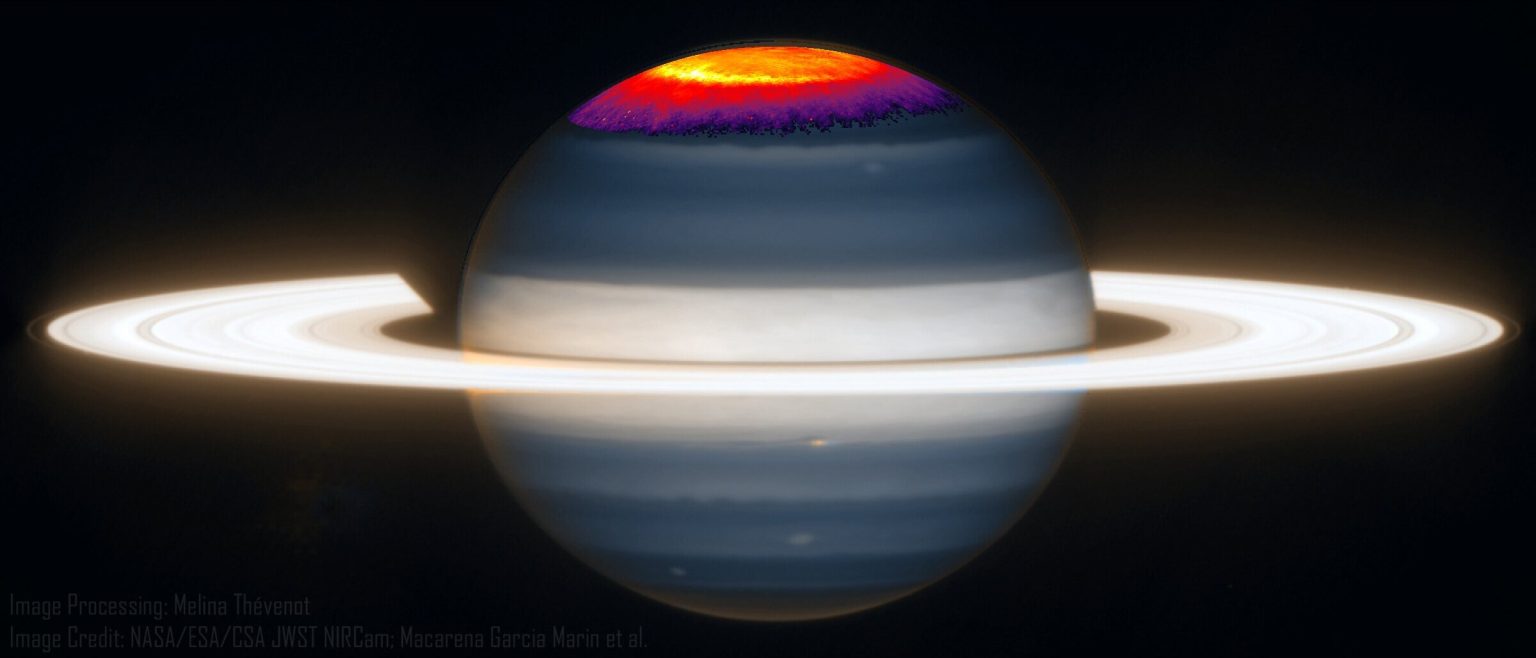
Signals from Saturn’s auroras
Saturn has remained a mystery to scientists for many years. Data collected by NASA’s Cassini spacecraft in 2004 indicated that the planet’s rotation speed was slowly changing over time—but this is impossible, since a planet cannot simply speed up or slow down its rotation.
In 2021, a study led by Tom Stallard, a professor of planetary astronomy at Northumbria University, showed that this mystery did not actually have anything to do with Saturn’s rotation. The visible changes were caused by winds in the planet’s upper atmosphere, which generated electrical currents that produced a false aurora signal.
However, these findings raised another question for the research team: if atmospheric winds were the cause of this effect, what caused those winds? A new study conducted by Professor Stallard and his colleagues from the UK and the US has finally provided the first direct evidence to answer this question.
Using the James Webb Space Telescope, the team continuously observed Saturn’s northern polar region—the equivalent of Earth’s northern lights—for an entire Saturnian day, obtaining detailed measurements that would have been impossible with any previous instrument.
Detailed temperature maps of the polar regions
By analyzing the infrared radiation emitted by a molecule known as the trihydrogen cation—which forms in the upper layers of Saturn’s atmosphere and acts as a natural thermometer—scientists were able to create the first high-resolution maps showing both the temperature and particle density in the auroral zone.
The level of detail was extraordinary. Previous measurements had an error margin of about 50 degrees Celsius, which was roughly equal to the difference the scientists were trying to detect, and were obtained by combining large areas of the hot aurora. The new data from the telescope proved to be ten times more accurate than previous measurements, enabling the team of scientists to map the finest details of heating and cooling in Saturn’s aurora for the first time.
The team found that these temperature and density characteristics match very closely with predictions made using computer models more than a decade ago, but only on the condition that the heat source is located precisely where the main emissions from the aurora enter the atmosphere.
Planetary heat pump
This means that Saturn’s aurora is not merely a visual phenomenon, but an active heating of the atmosphere in a specific location. This localized heating causes winds, which in turn generate the electric currents responsible for the aurora. The aurora then heats the atmosphere again, sustaining the entire cycle.
Lead researcher Professor Tom Stallard noted: “What we are seeing is essentially a planetary heat pump. Saturn’s aurora heats its atmosphere, the atmosphere drives winds, the winds produce currents that power the aurora, and so it goes on. The system feeds itself.”
For decades, scientists knew that something strange was happening with Saturn’s apparent rotation, but they couldn’t explain it. Later, they demonstrated that this was caused by atmospheric winds, but they still didn’t know why these winds existed. These new observations, possible thanks to the James Webb Space Telescope, finally provide us with the evidence needed to close the loop.
Interaction between the atmosphere and the magnetosphere
These findings have broader implications. Research indicates that processes occurring in Saturn’s atmosphere directly influence conditions in the surrounding magnetosphere—a vast region of space shaped by the planet’s magnetic field—which, in turn, feeds energy back into the system. This two-way interaction between the atmosphere and the magnetosphere may help explain why this effect is so stable and long-lasting.
Professor Stallard added: “This result changes how we think about planetary atmospheres more generally. If a planet’s atmospheric conditions can drive currents out into the surrounding space environment, then understanding what is happening in the stratospheres of other worlds may reveal interactions we have not yet even imagined.”
The James Webb Space Telescope is the world’s leading observatory for space research. Webb unravels the mysteries of our Solar System, looks beyond its boundaries to distant worlds orbiting other stars, and explores the enigmatic structures and origins of our Universe and our place within it. The James Webb Space Telescope is an international program led by NASA in collaboration with its partners: the European Space Agency (ESA) and the Canadian Space Agency (CSA).
According to phys.org

