

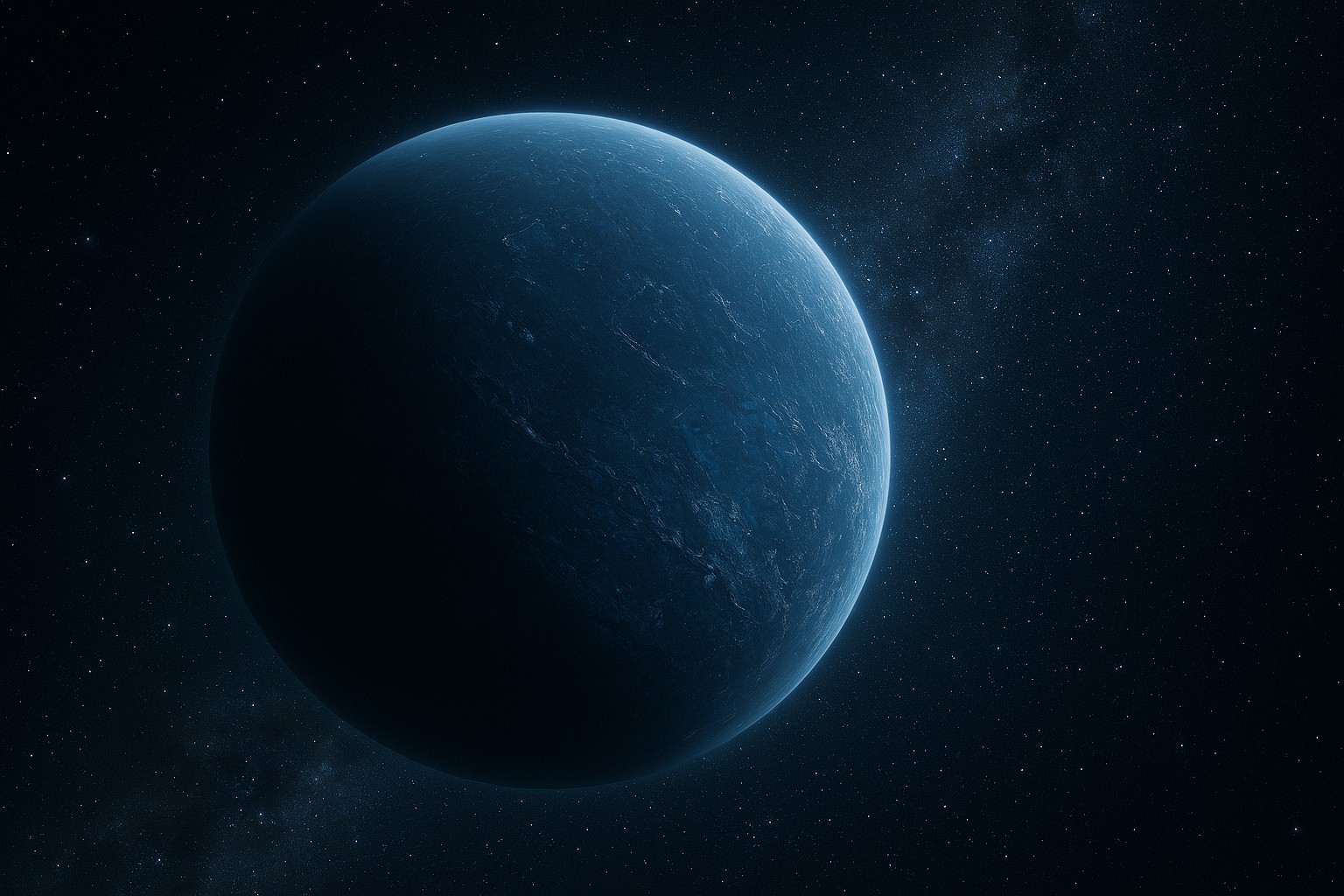
The outer boundaries of our Solar System conceal many secrets. Recently, astrophysicists from Princeton University discovered a strange curvature in the orbits of objects in the outer Kuiper belt. The most plausible explanation for this anomaly may be the existence of a previously unknown planet, smaller than Earth but larger than Mercury, hidden in darkness beyond Neptune’s orbit.
The Kuiper Belt is a vast ring of icy bodies extending beyond Neptune’s orbit. While studying the orbits of 154 objects in this region, scientists noticed an unexpected pattern. It turns out that objects at a distance of 80 to 200 AU from the Sun have a collective inclination of their orbits of approximately 15° relative to the common plane of the Solar System. The statistical certainty of this discovery reaches 96-98%, which makes it extremely important.
Planet Y
Such a stable orbital curvature cannot arise by chance. It has to be caused by the gravitational influence of some massive object. After conducting computer simulations, researchers concluded that the best explanation was the presence of an unknown planet. The hypothetical world they propose to call “Planet Y” would have to be between the size of Mercury and Earth and orbit in the same distant region with its own orbital inclination.
Still hunting
It is important to emphasize that the work is not a direct discovery of a new planet, but rather an indication of its possible existence. Finding such an object in deep space is an incredibly difficult task. It is tiny, dark, and very far away. However, astronomers now have a more specific clue — an area where they should look. It’s similar to the story of the discovery of Neptune. It was once found precisely because of anomalies in the orbit of neighboring Uranus.
The discovery of “Planet Y” would be a sensation that would change our understanding of our own star system. In addition to solving the mystery of the Kuiper Belt, it would also represent a significant new achievement in space exploration. The hunt for this hidden world has already begun, and it promises to reveal new pages in the history of our cosmic home.
Earlier, we explained whether the ninth planet really exists.
According to sciencealert.com

