

Psyche is the largest of all metallic asteroids. By mass, it ranks among the ten largest bodies in the Main Asteroid Belt. Recently, scientists attempted to determine how this object might have formed by simulating its formation.
Hypotheses regarding the origin of the asteroid Psyche
Even 200 years after the discovery of asteroid 16 Psyche, astronomers continue to speculate about its formation. Psyche is the 10th-largest asteroid in the main belt between Mars and Jupiter, and also the most famous metallic asteroid, with a diameter of 140 miles.
NASA’s Psyche mission will arrive in 2029 to determine its origin. Psyche may be a remnant building block of an early planet, shattered by violent collisions, or a fragment of a planet that once broke apart into layers before losing its rocky outer mantle.
Other hypotheses suggest that Psyche is an ancient remnant, one that was either originally rich in metals or became a mixture of rock and metal following numerous collisions with other asteroids. Each scenario has different implications for the formation of planets in the early Solar System.
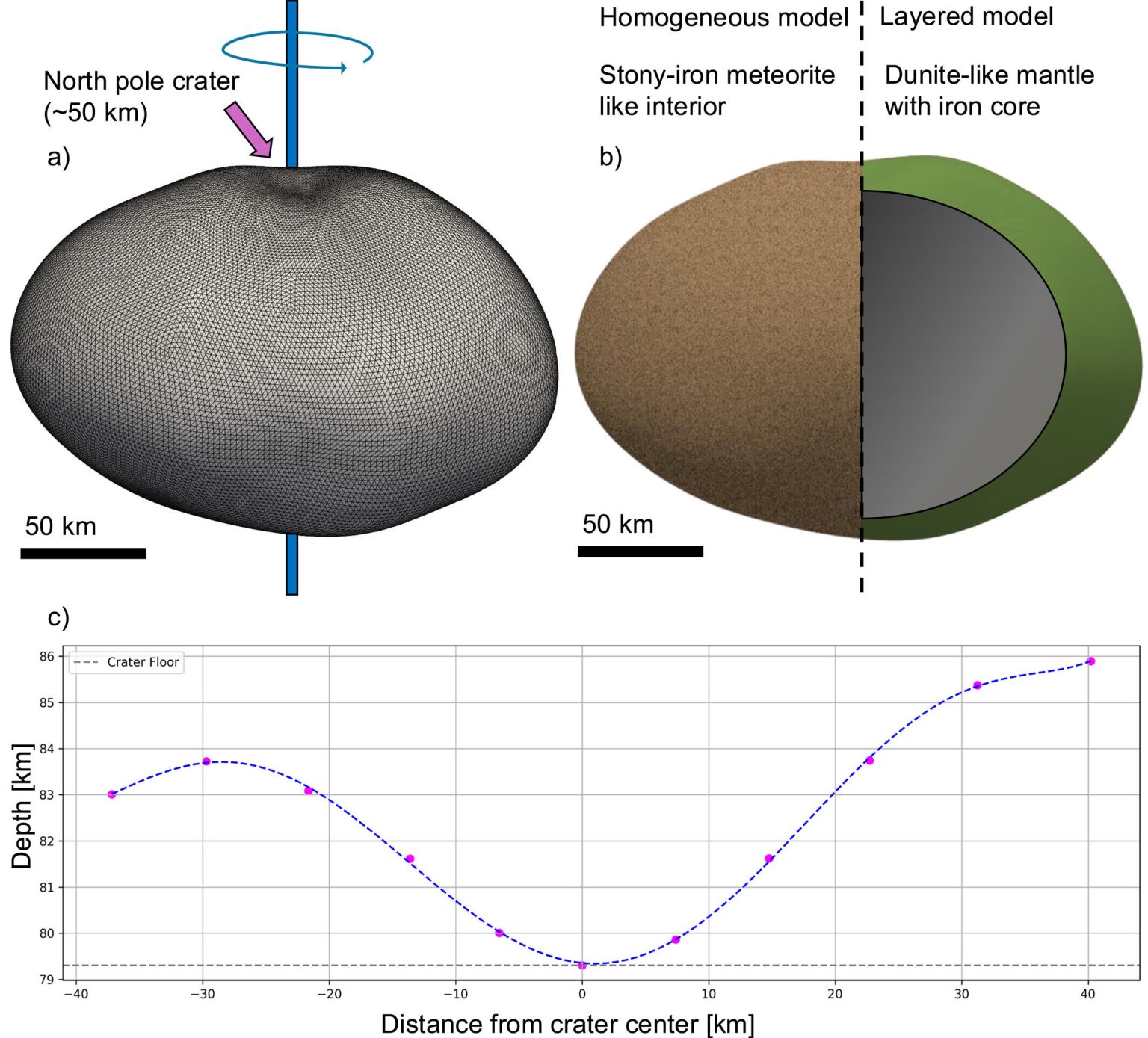
To explore these possibilities, researchers at the University of Arizona’s Lunar and Planetary Laboratory (LPL) conducted simulations to determine how a large crater near Psyche’s north pole might have formed in accordance with these conflicting theories.
Clues from craters
In a study published in JGR Planets, the team describes models developed to help scientists interpret the data that NASA’s Psyche mission will collect upon its arrival in 2029. Combined with observations from the spacecraft, these predictions may help finally unlock the mystery of Psyche’s composition.
“Large impact basins or craters excavate deep into the asteroid, which gives clues about what its interior is made of,” said Namya Baijal, a graduate student at LPL and the paper’s first author. “By simulating the formation of one of its largest craters, we were able to make testable predictions for Psyche’s overall composition when the spacecraft arrives.”
Less than 10% of the asteroids in the main belt are metal-rich, and Psyche is the largest of them. However, to learn more about how this metal is distributed within the asteroid, scientists will have to wait for the arrival of the Psyche spacecraft.
One of the researchers’ main conclusions was that porosity—the amount of empty space inside an asteroid—plays a significant role in crater formation. Porosity is often neglected because it is difficult to account for in models, but new simulations show that it can significantly influence the impact process and the shape of the resulting craters.
By comparing these simulated craters with what the spacecraft will observe, scientists will be able to determine whether the interior of Psyche is divided into layers of rock and metal, or whether it is, in fact, a mixture of various materials.
The impact origin of Psyche
If it turns out that Psyche is an exposed planetary core where most of the rocky crust has been stripped away, this will provide a window into the violent stage of planetary formation that scientists cannot otherwise observe.
“We tested two main interior structures for Psyche,” said Baijal. “One is a layered structure with a metallic core and a thin, rocky mantle, which likely formed if a violent collision stripped away the outer layers. The other is a uniform mixture of metal and silicate, created by a more catastrophic impact that mixed everything together, like some metal-rich meteorites found on Earth.”
The researchers used the best model of Psyche’s shape, derived from telescopic observations, to create a 3D target. They reproduced the formation of a specific crater in the model, approximately 30 miles in diameter and three miles deep, as a simulated impact in which Psyche was struck at speeds typical of collisions in the asteroid belt—approximately three miles per second.
The team varied the size of the virtual impactors and tested two models (a metal core and a mixture of rock and metal) to see which one could reproduce the known crater sizes. Each scenario produced slightly different crater shapes and patterns of material ejection.
Unlike planets, many asteroids are not solid rocks. They may contain a large amount of empty space or fragmented material left over from past collisions. The team incorporated this porosity into their models and found that it has a significant impact not only on the depth and shape of craters, but also on the distribution of ejected material following an impact.
Waiting for Psyche’s arrival
The Psyche spacecraft is equipped with instruments designed to study the asteroid’s surface, gravitational field, magnetic field, and composition. In addition to crater shapes, which depend on internal structure and porosity, the simulations account for other observable patterns, including density variations that occur when impacts compress the asteroid’s interior, and the distribution of metallic debris ejected onto the surface.
“When the spacecraft arrives at Psyche in a few years, the geochemists, geologists and modelers on the team will all be looking at the same object and trying to interpret what we see,” said Erik Asphaug, a co-author of the study. “This work gives us a head start.”
According to phys.org

