

For the first time, German researchers from the Technical University of Munich (TUM) and the University of Bonn have directly tracked the Earth’s axial wobbles (precession and nutation) using a high-precision ring laser located in the underground complex of the Wettzell geodetic observatory in Bavaria. Previously, this required complex observations from the VLBI radio telescope network, but now a single inertial sensor can do it alone — with a temporal resolution of less than an hour.
The experiment lasted 250 days and showed that the installation was able to continuously and directly record all components of the axis oscillation, from long-period precession to small daily fluctuations. According to the authors, the accuracy of the new ring laser is two orders of magnitude better than that of previous gyroscopes in this class, and the results are available in near real time, without the lengthy calculations typical of VLBI methods.
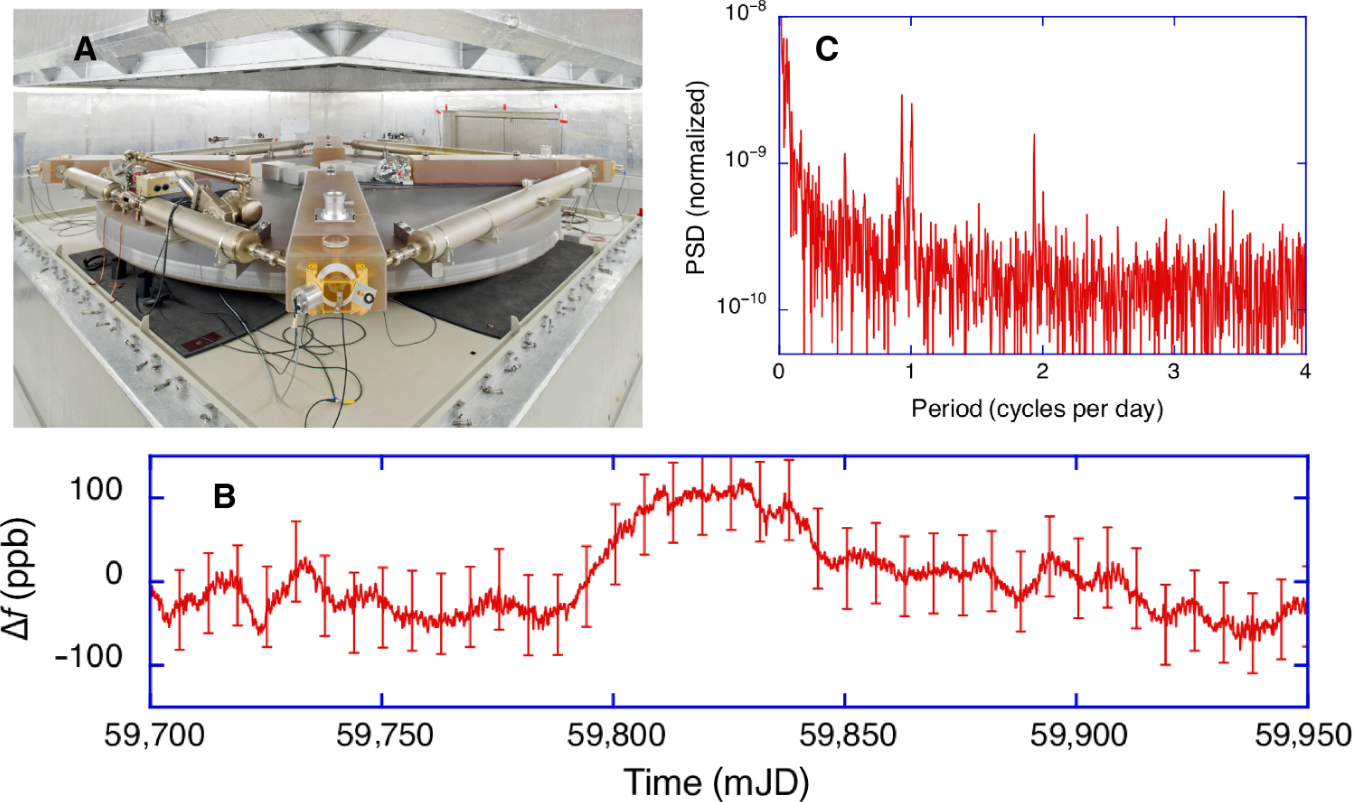
The photo shows the body of a large gyroscope mounted on a massive concrete pedestal that is firmly anchored in bedrock. The upper part of the ambient pressure stabilization vessel (A) is visible above the instrument. The illustration shows the residual difference between the ring laser measurements and the IERS calculation after performing a complete conversion between ICRF and ITRF. For long-term variation, a standard deviation of 48 ppb (B) was obtained. The measurement residue spectrum contains only a few very small signal components at a level of about 3 ppb in the daily and semi-daily ranges (C). mJD — modified Julian date; PSD — power spectral density. Source: Astrid Eckert / TUM
The team adds that a further increase in stability and accuracy by a factor of about 10 would open the way to testing the effects of general relativity directly from the Earth’s surface — in particular, to directly measuring the Lense-Thirring effect (the dragging of space-time by a rotating planet)*.
*In general relativity, space-time behaves like a very viscous fluid. If a massive body rotates (Earth, star, black hole), it slightly pulls this fluid around itself in the direction of rotation — as if a spoon slowly pulls honey around itself. This is called frame-dragging.
Accurate and timely Earth orientation parameters (EOP) are fundamental to deep space navigation, antenna pointing, satellite orbit correction, and global reference frame alignment (GNSS/SLR/VLBI). A local ring laser provides continuous measurement data without external signals: this increases infrastructure survivability, reduces delays in data processing for maneuver planning, and improves the accuracy of image alignment for telescopes and fundamental physics tests (day length, gravitational effects).
Would you like to take a look into the heart of the Red Planet? In the article “Inside Mars: Characteristics of the Red Planet’s Structure,” we examine what Mars is made of: from its fragile crust and mantle to its core, which hides clues about its past and the possibility of a former magnetic field. Learn how seismic data and meteorite evidence are changing our understanding of planetary evolution — and why this is important for future missions and the search for habitable worlds.

