

Korean scientists have studied the ancient Hapcheon impact crater and discovered stromatolites there. These ancient remains of living organisms indicate that at one point, this impact crater was a lake. It is possible that life on our planet originated in places like this.
Meteorite lakes and life on Earth
It is possible that life on our planet, if not originated, then took its first significant steps thanks to cosmic events. In any case, research by scientists from the Korea Institute of Geoscience and Mineral Resources suggests that lakes formed by meteorite impacts may have served as early hubs for the spread of living organisms on Earth.
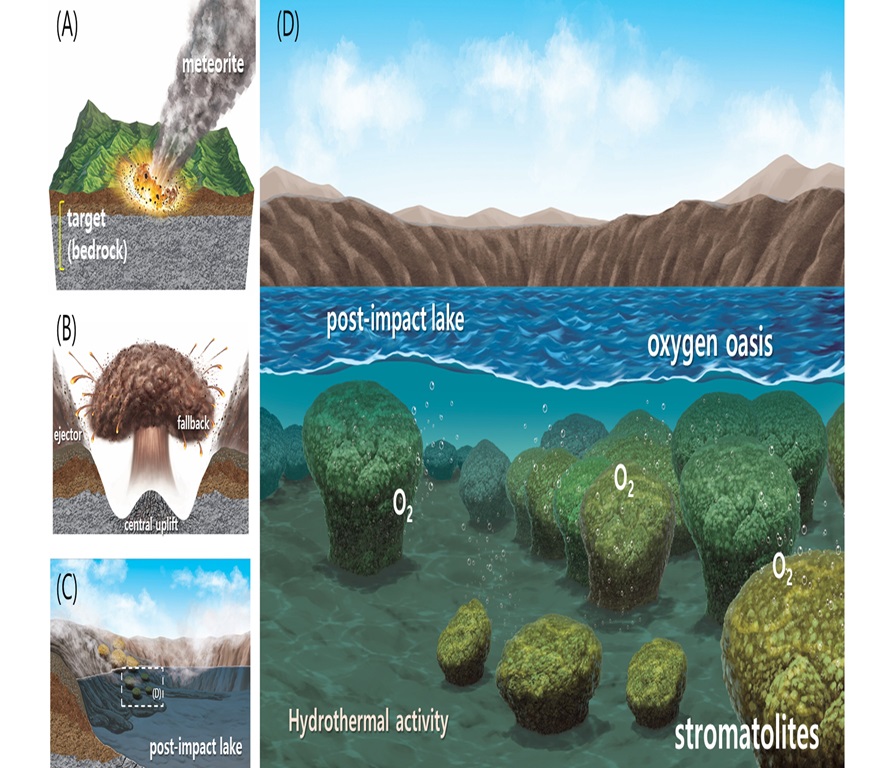
A study published in the journal Communications Earth & Environment reports the discovery of stromatolites in a lake that once existed in the Hapcheon Crater. It is the only large-scale geological structure in South Korea that is known for certain to have been formed by a collision with a celestial body. This was only confirmed in 2021.
The remains found in the Hapcheon crater date back 3.5 billion years. This leads scientists to conclude that similar crater lakes in other locations may have been the very places where living organisms actively evolved and transformed the planet.
Stromatolites
Stromatolites are a special type of rock column ranging in diameter from a few to several dozen centimeters. They are often found even in modern oceans, and were once perhaps the most common form of life in the seas.
In fact, they are the byproducts of the metabolic activity of colonial cyanobacteria, microscopic living organisms that form thin films. This structure lives by absorbing sunlight, then dies, and a new generation forms a layer of film on top of it; this process repeats itself hundreds and thousands of times until, micron by micron, the stromatolite column grows to a height of several dozen centimeters.
Stromatolites have been found in very ancient rocks that formed at a time when living conditions on our planet were significantly harsher than today. But the lakes that may have become geothermal as a result of the impact seem like the perfect place for them to develop and gradually enrich the atmosphere with oxygen.
According to phys.org

