

Astronomers have published a striking image of a celestial phenomenon captured by the James Webb Space Telescope (JWST). Outwardly, it resembles a double-sided lightsaber from the Star Wars saga. But in reality, the photo shows a jet of boiling gases ejected by a giant star.
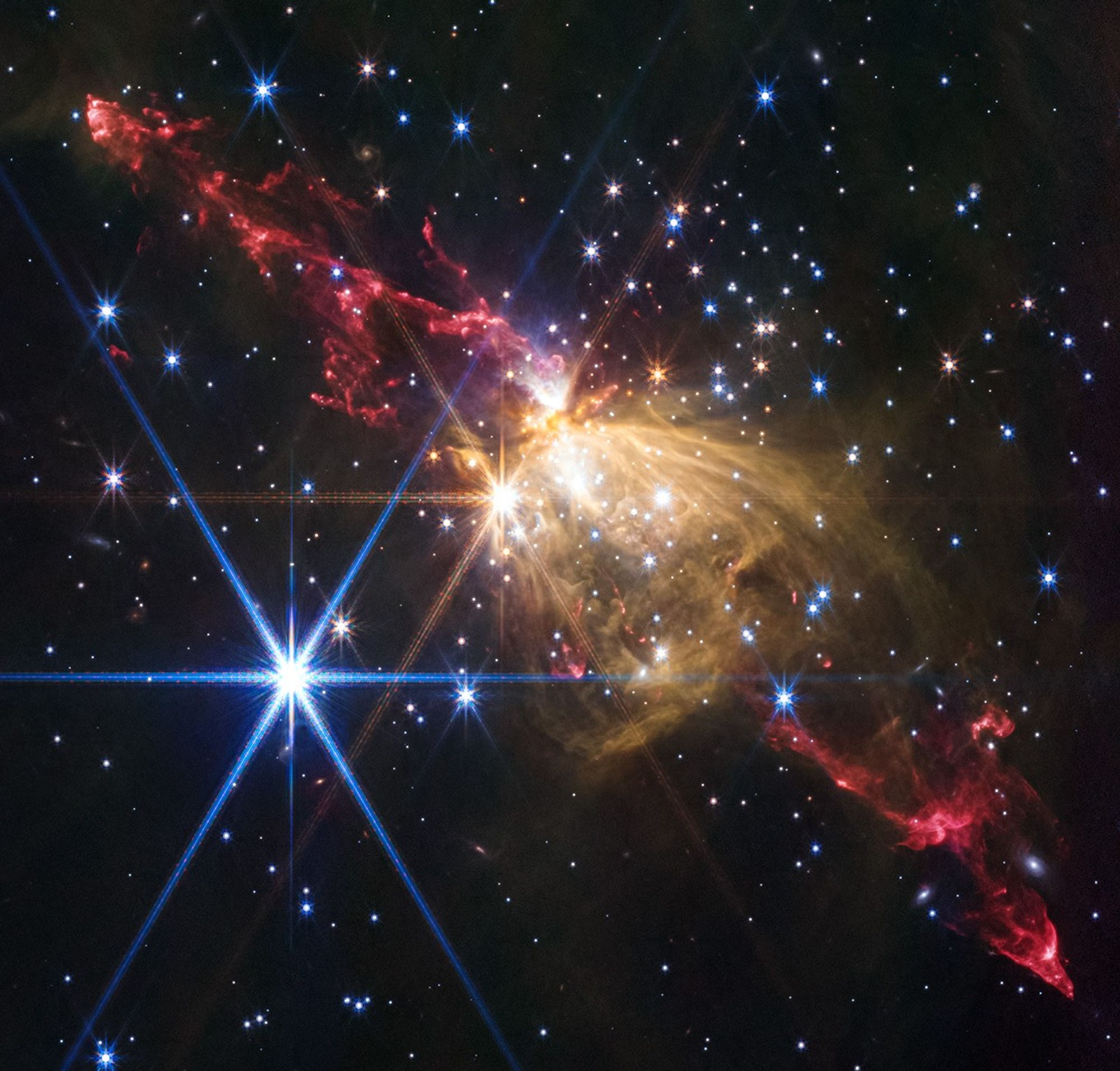
The JWST jet photographed is located in the Sh2-284 nebula. It is located 15,000 light-years from Earth on the edge of the Milky Way. Several hundred stars are forming inside it. Observations have shown that Sh2-284 contains few heavy elements. This makes it a local analogue of the early Universe, which was also metal-poor.
The jet is 8 light-years long. This is almost twice the distance between the Sun and Alpha Centauri. The discovery was accidental. Before the JWST observation, astronomers were unaware that Sh2-284 contained a massive protostar with such a powerful superjet.
Analysis of the JWST image confirms the assumption that protostellar jets are proportional to the mass of their parent stars: the more massive they are, the larger the jet. Its ends, located in opposite directions, reflect the history of the star’s formation. Initially, the ejected material was close to the star, but over the course of 100,000 years, the ends of the jet have spread outward, and the material behind them represents a younger stream.
The photo also shows the consequences of the jet colliding with interstellar matter. It created separate nodes, shock waves, and linear chains.
Earlier, we discussed how the James Webb telescope captures the birth of stars.
Provided by NASA

