

It may appear that the image of the James Webb Space Telescope (JWST) below shows a rocky, star-lit mountain peak covered by a thin cloud. But in reality, before us lies a cosmic landscape of dust, destroyed by strong winds and radiation from nearby massive young stars.
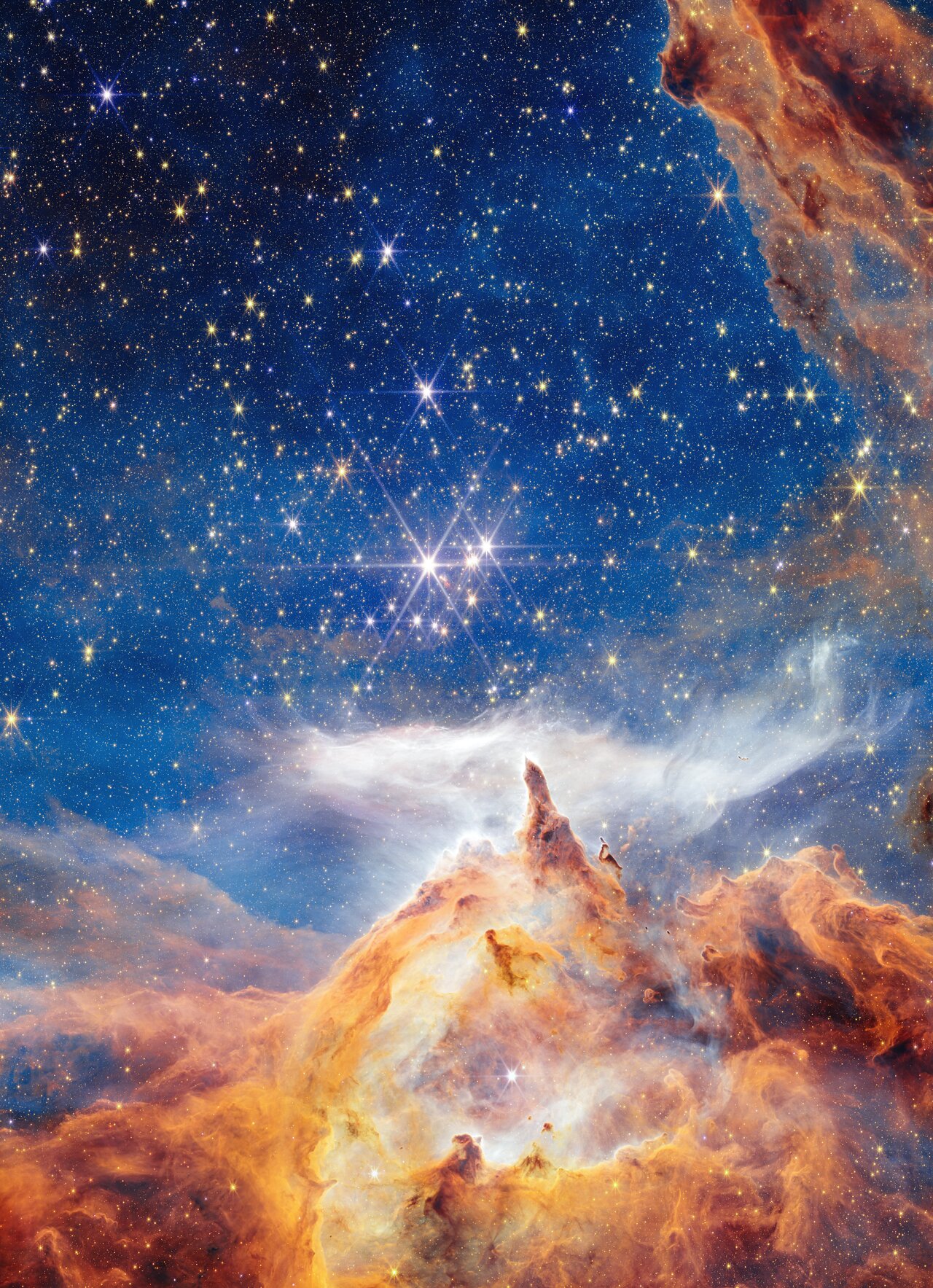
The object photographed by JWST is known as Pismis 24. It is a young star cluster located in the center of the Lobster Nebula, approximately 5,500 light-years from Earth. Pismis 24 is home to one of the closest stellar nurseries to us, where massive stars are being born right now. This makes it a unique natural laboratory, allowing scientists to study the processes of star formation.
At the center of Pismis 24 is the bright star Pismis 24-1. It is located in the center of a cluster of stars above jagged orange peaks, and the highest spire points directly at it. Pismis 24-1 looks like a giant single star, and it was once thought to be the most massive star known to us. Since then, scientists have learned that it consists of at least two stars, although they cannot be distinguished in this image. With masses of 74 and 66 solar masses, respectively, they are still among the largest stars.
The JWST image also shows thousands of other stars in the cluster, resembling precious stones of various sizes and colors. The largest and brightest of them, with six-ray diffraction peaks, have the greatest mass. Hundreds and thousands of smaller members of the cluster appear white, yellow, and red, depending on their spectral class and the amount of dust surrounding them. JWST also photographed tens of thousands of stars behind the cluster, which are part of the Milky Way galaxy.
Super-hot young stars (some of which have surfaces almost eight times hotter than the Sun) are the source of powerful winds that carve out cavities in the walls of star-forming nebulae. This nebula extends far beyond the JWST’s field of view. Only small parts of it are visible at the bottom and top right of the image. Streams of hot ionized gas flow down from the ridges of the nebula, while thin veils of gas and dust, illuminated by starlight, float around its towering peaks. Dramatic spires emerge from the glowing wall of gas, resisting relentless radiation and winds. They resemble fingers pointing to the hot young stars that formed them.
The powerful forces that shape and compress these spires lead to the formation of new stars inside them. The tallest spire extends 5.4 light-years from its top to the bottom of the image. More than 200 of our solar systems could fit within the width of Neptune’s top, which is 0.14 light-years.
In the JWST image, blue indicates hot or ionized hydrogen heated by massive young stars. Dust molecules, similar to smoke on Earth, are marked in orange. Red indicates colder and denser molecular hydrogen. The darker the red color, the denser the gas. Black indicates the densest gas, which does not emit light. White stripes are dust and gas scattering starlight.
According to Esawebb

