

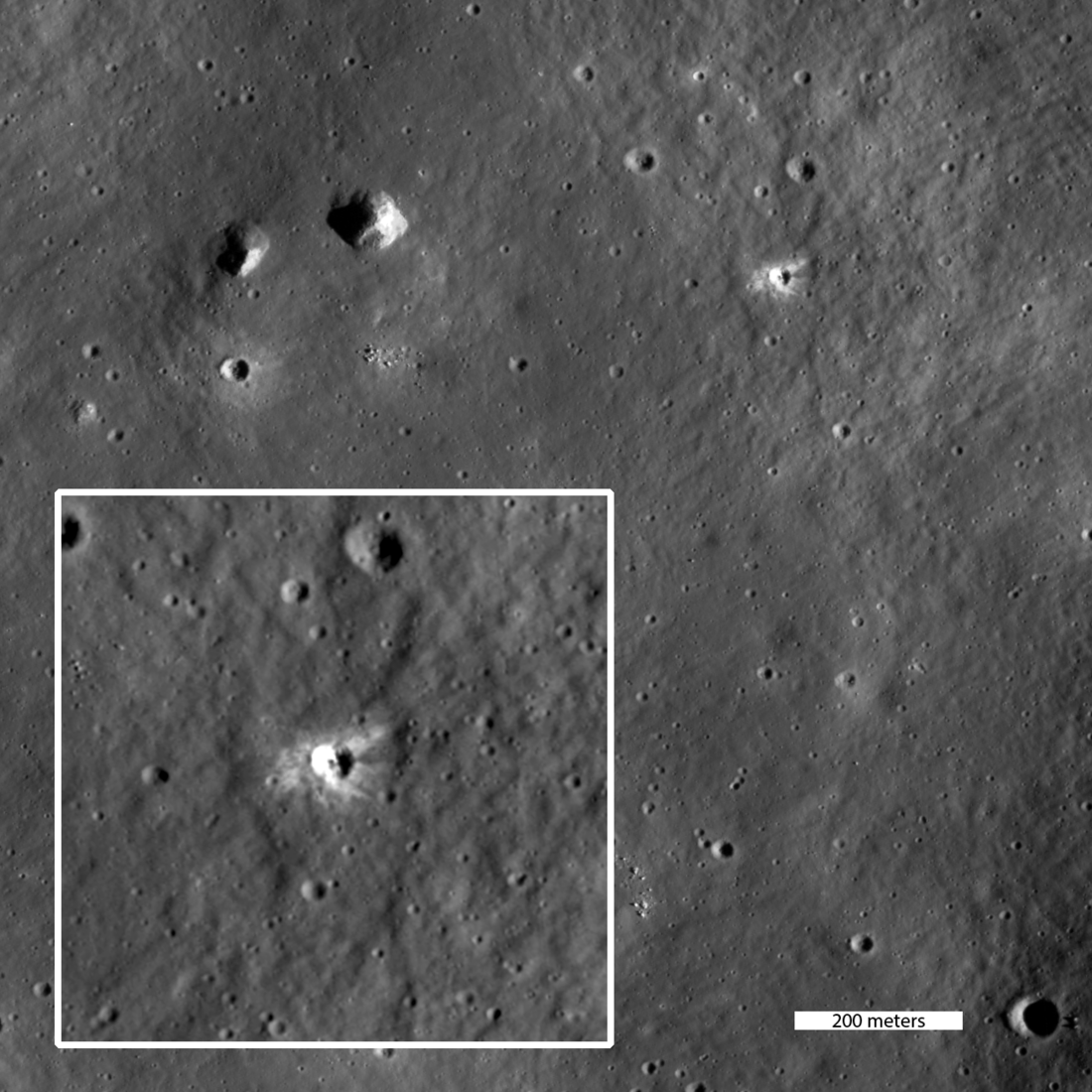
Participants in the LRO mission have published an image showing a young crater on the Moon. It formed after the spacecraft began operating.
Throughout its history, the Moon has been regularly bombarded by comets and asteroids. This bombardment was particularly intense during the first billion years after the formation of the Solar System. It was then that the Moon acquired its largest “scars.”
Although the frequency of collisions has decreased since then, they have not stopped completely. And since the Moon has no atmosphere, even small objects that would not be able to reach the Earth’s surface can reach the Moon’s surface unhindered.
It was precisely such an object, several meters in size, that formed the crater found by LRO. It is located north of the 44-kilometer-wide Römer crater. The 22-meter funnel formed between December 2009 and December 2012, when the spacecraft photographed this area again.

The crater discovered by LRO is surrounded by bright rays consisting of lighter subsurface material ejected during the impact. They extend tens of meters from the crater. Over time, under the influence of space weathering, the rays will darken to match the color of the surrounding regolith.
The discovery of new craters using LROC is important for understanding the frequency of impacts and the rate of crater destruction over time. Planetary scientists use this data to estimate the age of surface features on celestial bodies. This data is also important for future manned missions to the Moon.
The Moon is not the only object in the Solar System that is subject to cosmic bombardment. Earlier, we talked about known cases of asteroids and comets falling on other planets.
According to LROC

