

An international team from China and Italy has reported a possible space-based replication of a landmark 2017 discovery in the field of multi-messenger astronomy. In November 2024, the LIGO-Virgo-KAGRA observatories detected gravitational waves from the merger of a binary black hole, designated S241125n. Notably, just a few seconds later, satellites detected a short gamma-ray burst (GRB) from the same region of the sky.
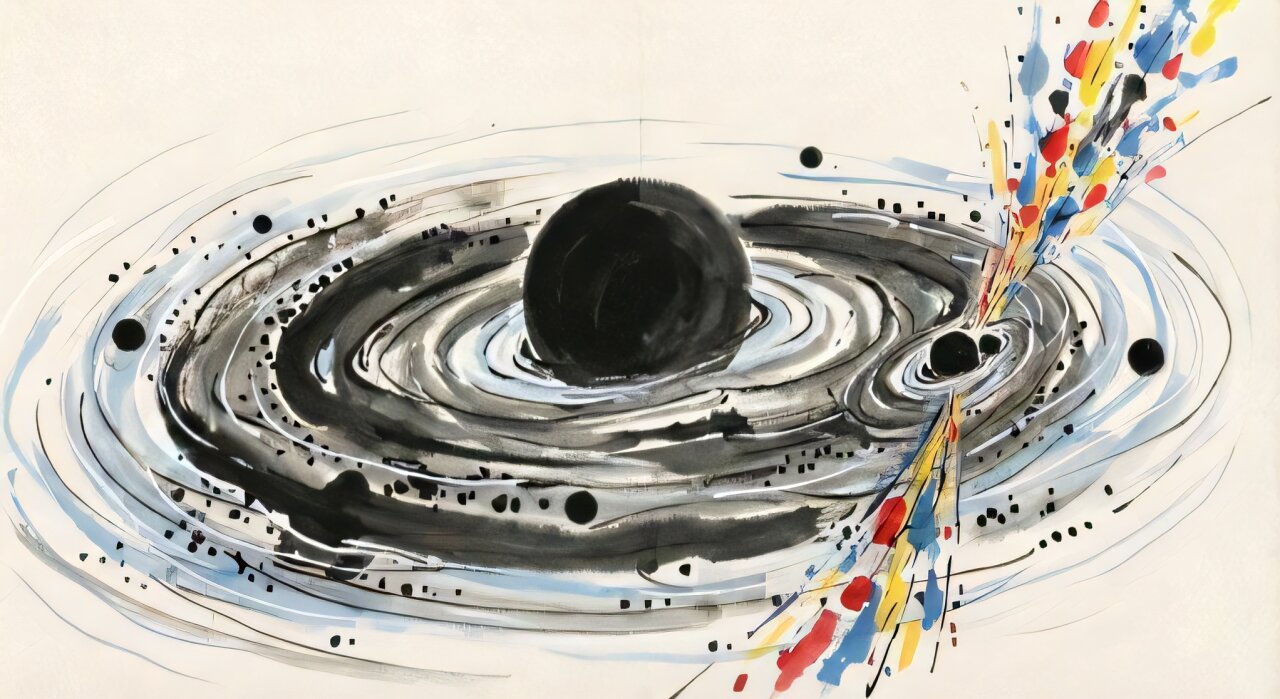
Is the rare gravitational wave event related to a gamma-ray burst?
Gravitational waves are ripples in spacetime caused by violent cosmic events. It was believed that collisions between black holes were “invisible” to conventional telescopes, as they do not emit light. However, the 2024 event S241125n appears to contradict this view. Approximately 11 seconds after the gravitational wave signal, NASA’s Swift observatory detected a short gamma-ray burst in the same region of the sky, and shortly thereafter, the new Chinese satellite Einstein Probe detected an X-ray afterglow in that area.
Scientists note that the correlation between the gravitational wave signal and the gamma-ray burst is unlikely to be mere coincidence. The team’s joint analysis, published in The Astrophysical Journal, estimates the overall false alarm rate to be approximately one instance per 30 years of observation. “This estimate is deliberately conservative, and the true probability of a chance alignment may be even lower. However, in the interest of scientific rigor, we cannot yet draw a definitive conclusion. Regardless, this is clearly a very intriguing event,” the researchers explain.
Interestingly, the total energy, luminosity, and duration of this source are similar to those typical of a short gamma-ray burst. However, the photon indices differ from the typical values. The photon index of pulsed radiation is softer than typical, whereas that of afterglow is harder than typical. This suggests that this source may possess a unique emission mechanism or some other propagation effect.
A great distance from the event
One of the most striking aspects of S241125n is its extreme distance. The gravitational waves traveled approximately 4.2 billion light-years to reach Earth (redshift z ≈ 0.73), indicating that this collision occurred when the Universe was much younger. The black holes involved were extremely massive.
The analysis indicates that the combined mass of the pair was significantly greater than 100 solar masses, making them among the most massive known mergers of stellar-mass black holes. By comparison, most of the black hole mergers detected by LIGO involve total masses of several dozen solar masses. Such a massive merger is rare and intriguing, as it suggests that each black hole could have formed on its own through previous mergers or exotic formation processes.
The detection of mergers between massive objects at z~0.73 also indicates that these events can be observed over vast distances. Being able to “listen” to black holes merging billions of light-years away—and perhaps even see a flash of light from them—is a significant achievement in modern astrophysics. This poses a challenge for researchers in explaining how black hole pairs of this size can produce electromagnetic fireworks—a phenomenon not expected in the vacuum of space.
A merger in the active center of a galaxy
A research team led by scientists from China (the University of Science and Technology of China, the Shanghai Astronomical Observatory, and Ningbo University) and Italy (International Centre for Relativistic Astrophysics, National Institute for Astrophysics, and University of Ferrara) could have produced a short gamma-ray burst. They suggest that the two black holes merged within a dense disk of gas and dust surrounding the galaxy’s central supermassive black hole—an environment known as an active galactic nucleus (AGN).
In these bustling galactic nuclei, vast amounts of material orbit the central black hole, creating a naturally “fuel-rich” environment. If a binary black hole system were to merge within such a disk, the merger would not occur in isolation; rather, it would take place amidst a dense cluster of matter.
According to the team’s model, when the black holes merged, the resulting new black hole received a powerful boost (relative velocity) due to the asymmetric emission of gravitational waves. This ejected black hole, now moving through the surrounding gas, will rapidly devour the material in its path. The accretion rate may have been hyper-Eddington, significantly exceeding the normal limit at which a black hole can stably consume matter.
In essence, the merger turned the black hole into an insatiable engine. It is believed that such intense accretion in a magnetic environment triggers relativistic jets, and the rotational energy of the spinning black hole powers the dual jets of radiation and particles, which are ejected outward at nearly the speed of light. As the jet broke through the dense disk of the active galactic nucleus, it generated shock waves in the dense gas. At first, the jet’s energy was trapped inside the disk, heating the gas. But when the jet finally broke through to the surface of the disk, those photons were able to escape. Result: a burst of highly energetic radiation emanating from the galactic nucleus.
Essentially, the team argues that this process would result in a brief burst of gamma rays—not from the merger of neutron stars, as is usually the case, but from the merger of black holes in an unusual environment. Such a “shock breakout” from the disk would produce a Comptonized (thermalized) gamma-ray spectrum that is strikingly consistent with Swift observations: the GRB’s initial emission was unusually soft (with low-energy photons) compared to typical short gamma-ray bursts.
Expanding the possibilities of multi-messenger astronomy
If this link between gravitational waves and gamma-ray bursts is confirmed, it will mark the start of a new era in the study of black hole mergers, using both our ears and our eyes. Prior to this, the merger of binary black holes had only been detected through gravitational waves; S241125n demonstrates that, under specific conditions, they can be observed (in high-energy light). This will provide rich opportunities to study the environmental conditions around merging black holes and the physics of jet formation in dense media. Such a two-approach measurement could even refine our estimates of cosmic expansion by using the event as a “standard siren” (a gravitational-wave distance indicator) with a specific redshift of the host galaxy.
This event also demonstrates the importance of collaboration in multi-messenger astronomy: gravitational-wave detectors recorded the sound of the merger, while gamma-ray and X-ray telescopes captured its burst, and together they paint a much more complete picture than either could on its own.
As the astronomical community carefully analyzes this event, further data may provide even more evidence to support the theory. The authors suggest looking for characteristic signatures in the gravitational wave signal, such as the residual orbital eccentricity of the dynamic medium in the AGN disk. They also recommend conducting in-depth observations of the region to identify the host galaxy (likely a distant galaxy with a bright, active central nucleus).
In summary, the potential detection of a gamma-ray burst resulting from a black hole merger is an exciting and unexpected development. This suggests that, under the right circumstances, even the darkest cosmic collisions can illuminate the Universe. Seven years after the first gravitational wave was detected, this event—which occurred halfway across the observable Universe and involved black holes with masses exceeding 100 times that of the Sun—could become our next promising candidate in multi-messenger astronomy, paving the way for new methods of studying the cosmos.
According to phys.org

