

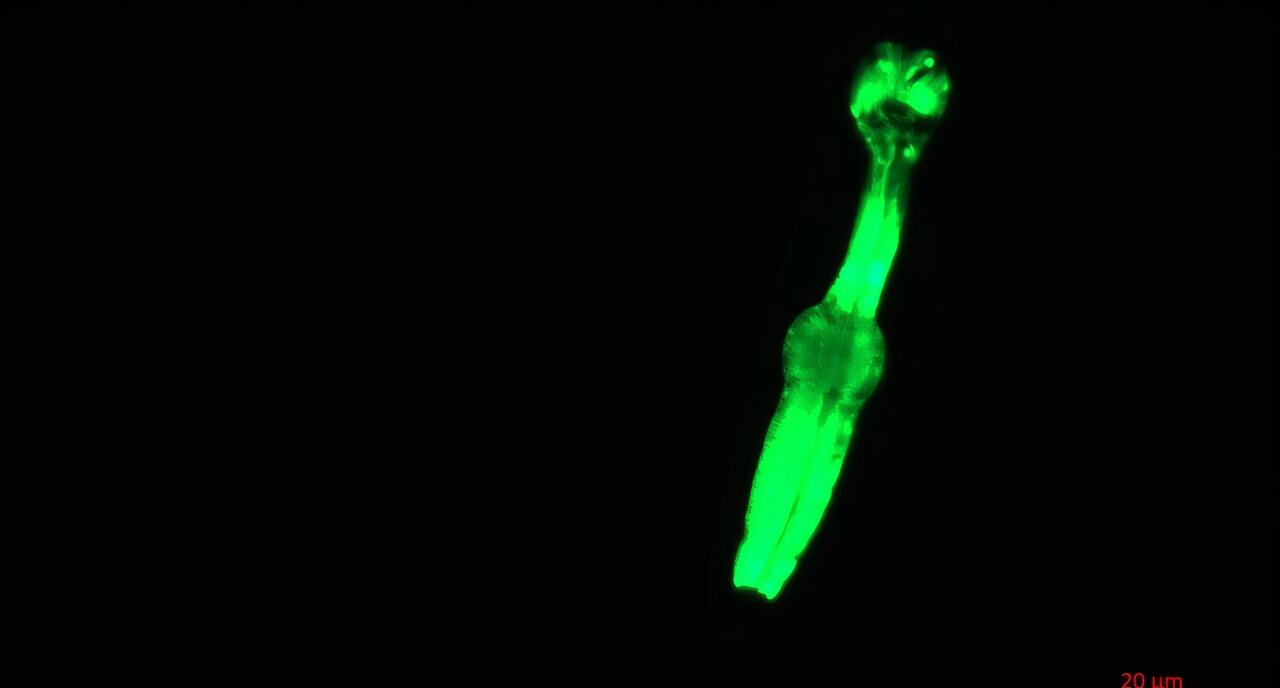
British scientists have sent an experimental capsule containing Caenorhabditis elegans nematodes into orbit. These tiny creatures will be used to study the effects of weightlessness and cosmic radiation on living organisms.
Worms in Orbit
Northrop Grumman’s CRS-24 cargo spacecraft launched today from Cape Canaveral Space Force Station. On board are not only a variety of supplies needed by the International Space Station crew, but also some very unusual “astronauts”—microscopic Caenorhabditis elegans worms.
Nematodes are tiny in size, have a very simple body structure and nervous system, and have a rapid reproductive cycle. This is precisely why they have long been a favorite subject for scientific experiments.
They were sent into space to test their resilience to the harsh conditions there. After the cargo spacecraft docks with the ISS, a special capsule containing the nematodes will remain on the station for some time. And then it will be transported there for 15 weeks, where it will be exposed to extreme temperature fluctuations and the effects of intense cosmic radiation.
Why is all this necessary?
Ironically, the experiment involving worms in space has garnered the most attention due to the success of the Artemis II mission. The successful flyby of the Moon has shown that humanity’s continued exploration of deep space is inevitable. However, this raises the pressing question of just how harmful prolonged exposure to space is to human health.
After all, from an evolutionary standpoint, humans are not adapted to life in zero gravity or in environments with high levels of radiation. Moreover, medical studies have documented significant changes occurring in astronauts’ bodies, though these changes typically disappear shortly after their return to Earth. On the other hand, humans have been flying into space for 65 years now, and there has been no significant decrease in life expectancy among astronauts.
But no one can say what will happen if people start spending not years, but decades in space. Especially if they start going there at a young age or even as children. How will space affect people several generations down the line who have grown up there?
That is precisely why scientists are so interested in studying Caenorhabditis elegans. Of course, these organisms are extremely different from us in biological terms. However, they are still living creatures, and their life cycle is much faster than that of humans. Consequently, they can demonstrate how space affects living organisms over many generations and, ultimately, give us an idea of whether we could live there.
According to phys.org

