

Specialists from the German Space Agency talked about their plans to create rovers for Mars and the Moon. These devices are intended for a wide variety of tasks. The primary means of achieving such
multifunctionality is modularity.
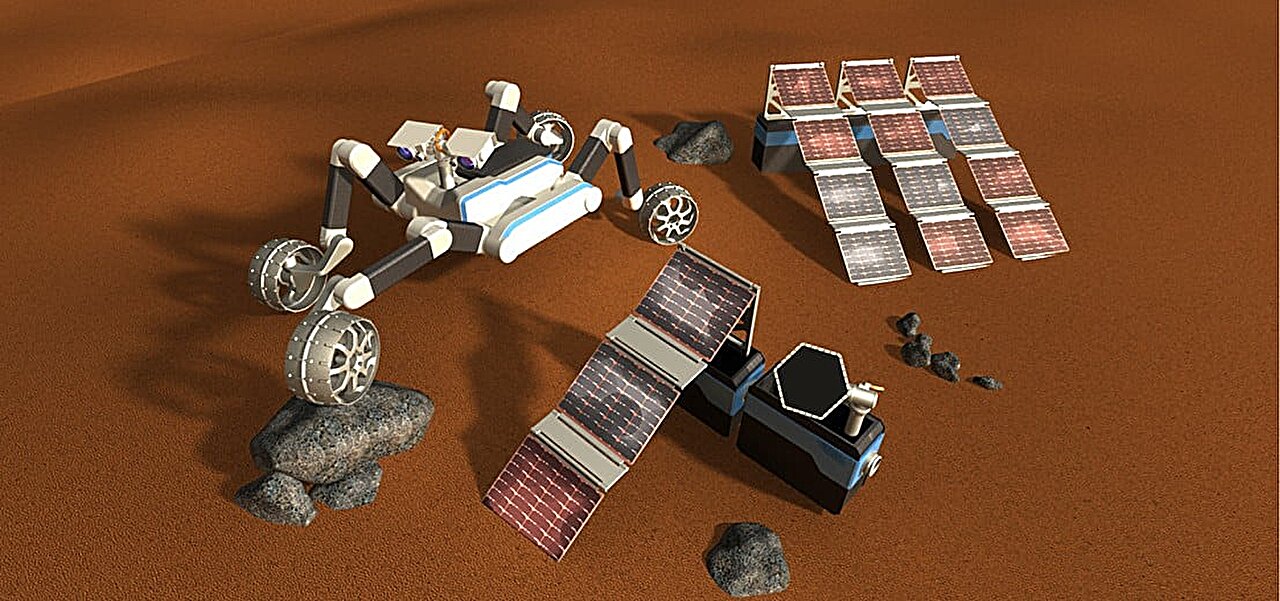
What will European Mars rovers be like?
A study by several robotics developers from the German Space Agency DLR was recently published in the journal Acta Astronautica. They presented their vision of what future rovers for missions to the Moon and Mars should be like. The concept was named TransRoPorter.
Along with the usual challenges posed by radiation, lack of air, and sudden temperature changes, the developers cited the need to interact with humans as the main difficulty in developing future Mars and Moon rovers.
At the same time, they have to perform various tasks to meet their needs: from carefully studying the terrain using various devices to simply dragging loads. In other words, the payload for them should, on the one hand, be provided with power and, on the other hand, be a sturdy container if necessary.
Modularity
European experts know how to achieve this. The answer is modularity, i.e., the creation of several separate blocks that can be connected together in the desired combination and provide the necessary functions. This is a fairly popular concept, but so far no one has tested a space robot based on it.
The rovers will also use a mixed propulsion system. Simply put, they will have legs with wheels at the ends. This design is considered to be the best compromise between energy efficiency and the ability to overcome obstacles.
After more than 1,500 simulations, some critical design options began to emerge. There was no clear winner, as the choice involved compromises. Parameters such as hip torque and ground clearance were the measurements most affected by the rover’s configuration, with some of them leading to unacceptable results for any of these values.
The stability of the system appeared to be relatively consistent regardless of design variations, and energy consumption appeared to vary most depending on the presence (or absence) of a payload, regardless of how the rover was configured.
According to phys.org

