

New observations and simulations conducted by a team of scientists led by the MPE have shown that a massive binary star near the center of our galaxy is responsible for the formation of a series of mysterious gas clouds—compact clusters of gas that feed the supermassive black hole Sagittarius A*.
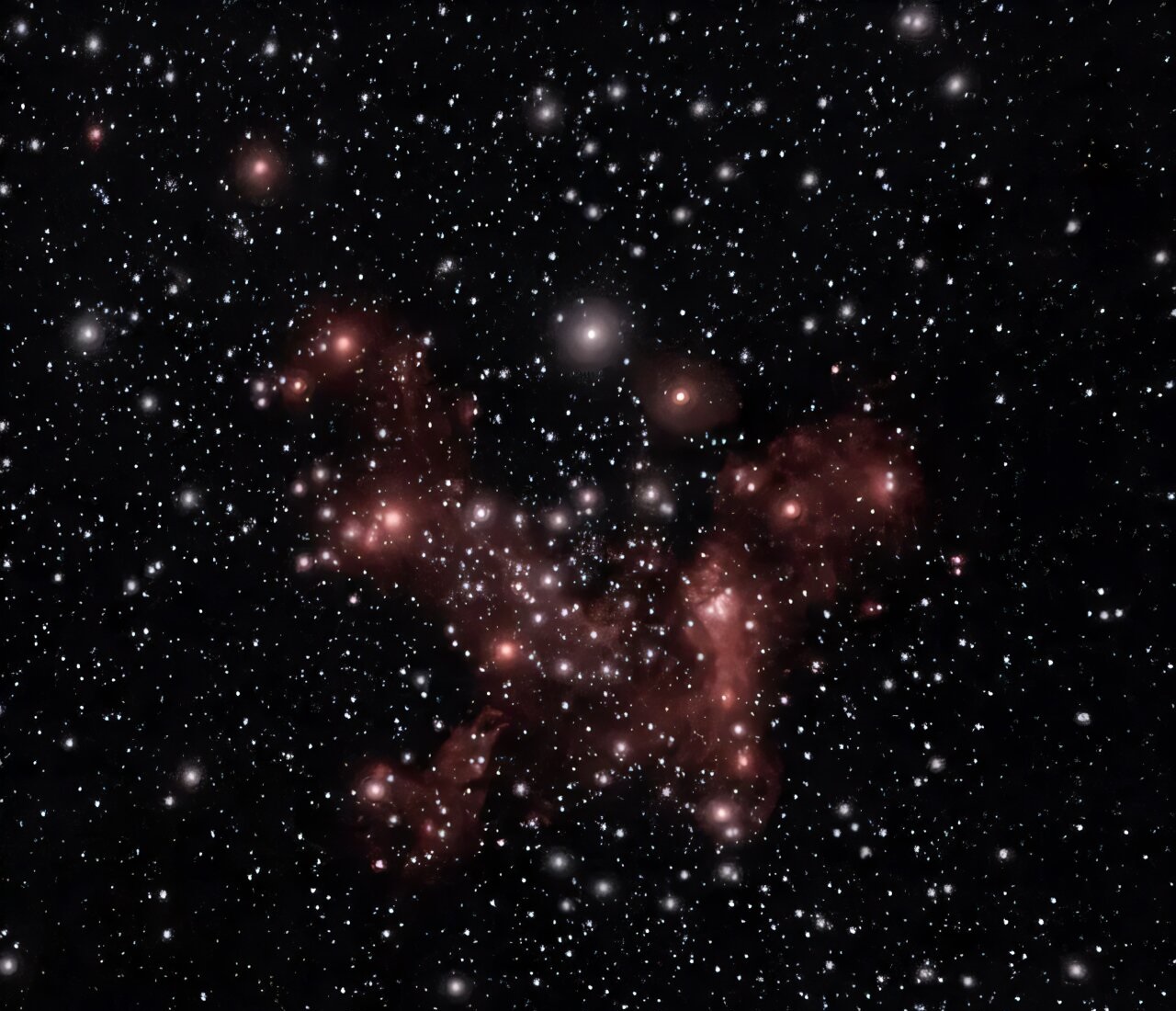
Gravitational conditions at the center of our galaxy
The center of our galaxy is an extremely dense and dynamic region. At its heart lies the supermassive black hole Sagittarius A* (Sgr A*), surrounded by stars, gas, and dust moving under the influence of immense gravitational forces. This environment serves as a natural laboratory for studying the behavior of matter near a black hole and the mechanisms by which new matter is drawn into such objects.
Over the past 20 years, astronomers have used infrared observations to detect several compact gas clouds near Sgr A*. These clusters provide important clues for understanding how gas might eventually be drawn into a black hole. However, their exact origin and the physical processes responsible for their formation remain unclear.
Family of G gas clouds near a black hole
In 2012, astronomers discovered the first compact ionized gas cloud, named G2. It has a mass several times that of Earth and emits light from hydrogen and helium, which is typical of hot, dusty gas. G2 orbits Sgr A* in an elongated orbit and has a faint tail-like structure, G2t. A review of previous observations revealed a similar object, G1, moving in a similar orbit.
G1, G2, and G2t were identified as denser clusters within the overall gas flow. Moderate fluctuations in density can give the impression of crowding, since the brightness of a cloud increases in proportion to the square of its density. Scientists recently discovered that gas from the tail of G2 has condensed into a third compact cluster following a similar trajectory; it could have been named G3, if that name had not already been assigned to another object. Together, these objects form a coherent structure—the G1–2–3 streamer—that traces the material flowing through the center of the Galaxy.
Calculations show that the fall of a single such cluster, with a mass roughly equal to that of Earth, once every ten years could provide enough material to sustain the current activity of Sgr A*. Therefore, understanding the mechanisms behind the formation of these clusters is key to explaining how a black hole obtains its fuel.
Analysis of the orbits of gas clouds
Several hypotheses have been proposed regarding its origin: stellar winds from massive stars, explosive events such as novae, or tidal disruption by Sgr A*. To test these hypotheses, an international team led by MPE used the SINFONI and ERIS spectrographs, equipped with adaptive optics, to perform high-resolution infrared spectroscopy. Focusing on the Brackett‑γ hydrogen emission line, they reconstructed the orbits of the three clouds based on their positions and velocities.
The analysis showed that G1, G2, and G2t follow orbits with nearly identical orientation and shape. The probability that three unrelated objects would have such specific orbital parameters is negligible. This suggests that all three clusters share a common origin.
A binary star as the creator of gas clouds
By tracing the gas jet backward in space and measuring its radial velocity, the researchers identified a likely source: the massive binary contact binary star IRS 16SW, located in a disk of young stars orbiting Sgr A* in a clockwise direction. The slight differences between the orbits of the G clouds can be explained by the intrinsic orbital motion of this binary star.
Hydrodynamic modeling further supports this conclusion. They show that gas clouds can form where the stellar winds from a binary star collide with the surrounding medium, creating a shock wave between the two stars. There, gas accumulates and compresses, eventually breaking away in separate clumps that move inward—as observed in the G1–2–3 streamer.
These results suggest that stellar winds from massive stars at the center of the Galaxy may be continuously supplying material to the black hole. The result integrates stellar evolution, gas dynamics, and black hole accretion into a single coherent picture, showing how star formation and black hole growth may be linked in our galaxy.
According to phys.org

