

Researchers at Johns Hopkins University have reported an important discovery related to dark matter. The mysterious diffuse glow of gamma rays near the center of the Milky Way may be caused by collisions between its particles.
Dark matter is a hypothetical form of matter that is believed to not participate in electromagnetic interactions and accounts for about a quarter of the mass-energy of the Universe. Since dark matter is a fundamental building block of the cosmos, studying it is important for understanding how the structure of galaxy clusters that we observe today developed and evolved.
Scientists around the world are searching for evidence of dark matter. Among them are researchers from Johns Hopkins University. In their research, they drew attention to a phenomenon that has been troubling the scientific community for many decades. It is about the diffuse gamma-ray glow near the center of the Milky Way. There are two main hypotheses explaining its appearance. According to the first, their source is rapidly rotating neutron stars. According to the other, it is all about the collision of dark matter particles.
Today, the Milky Way is a relatively closed system, with no materials entering or leaving it. But this was not always the case. During the first billion years, many smaller galaxies containing dark matter became part of it as building blocks. As dark matter particles were drawn toward the center of the galaxy and clustered together, the number of dark matter collisions increased.
An international team of researchers used supercomputers to create maps of the distribution of dark matter in the Milky Way, taking into account its formation history for the first time. When researchers included more realistic collisions with galaxies, their simulated maps matched the actual gamma-ray maps obtained by the Fermi space telescope.
These matching maps extend the triad of evidence suggesting that the excess gamma radiation in the center of the Milky Way may originate from dark matter. Gamma radiation emitted from collisions of dark matter particles will produce the same signal and have the same properties as that observed in the real world, researchers say, although this is not definitive proof.
An alternative explanation for the phenomenon is radiation emitted by rapidly rotating old neutron stars (millisecond pulsars). However, according to researchers, this theory is incomplete. To explain the observed pattern, there have to be more pulsars than astronomers have observed.
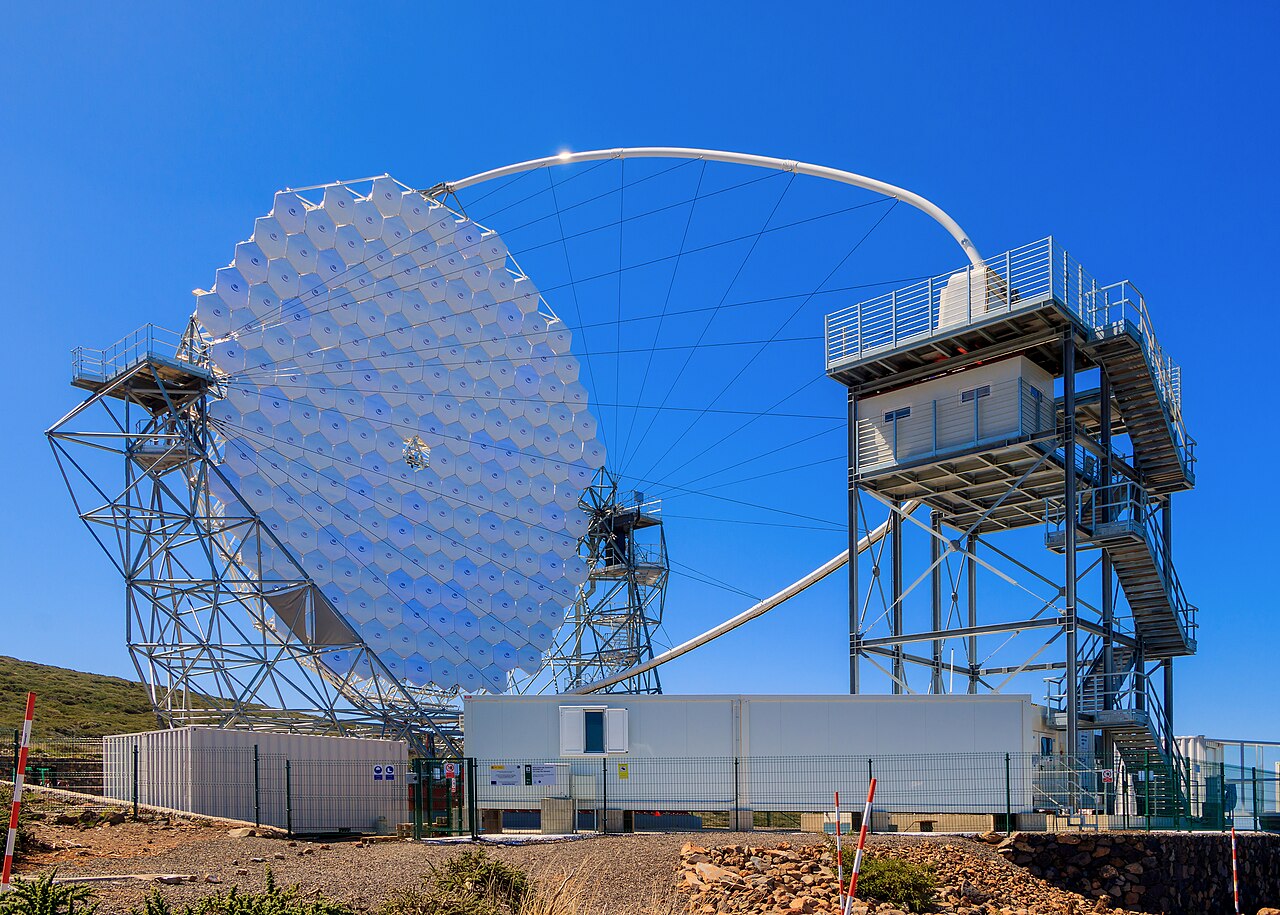
The final answer may come with the construction of a new gamma-ray telescope called the Cherenkov Telescope Array. Researchers believe that its higher-resolution data will finally help solve this paradox. They are already planning a new experiment that will either confirm or refute the dark matter hypothesis.
Earlier, we reported on how astronomers discovered a tiny “brick” of dark matter at the edge of the Universe.
According to Phys.org

