

Two years ago, amateur astronomers discovered a mysterious giant nebula near the Andromeda Galaxy, which was named SDSO-1. However, its location was unclear. Now, experts from the Spanish scientific center CEFCA have been able to resolve this issue.
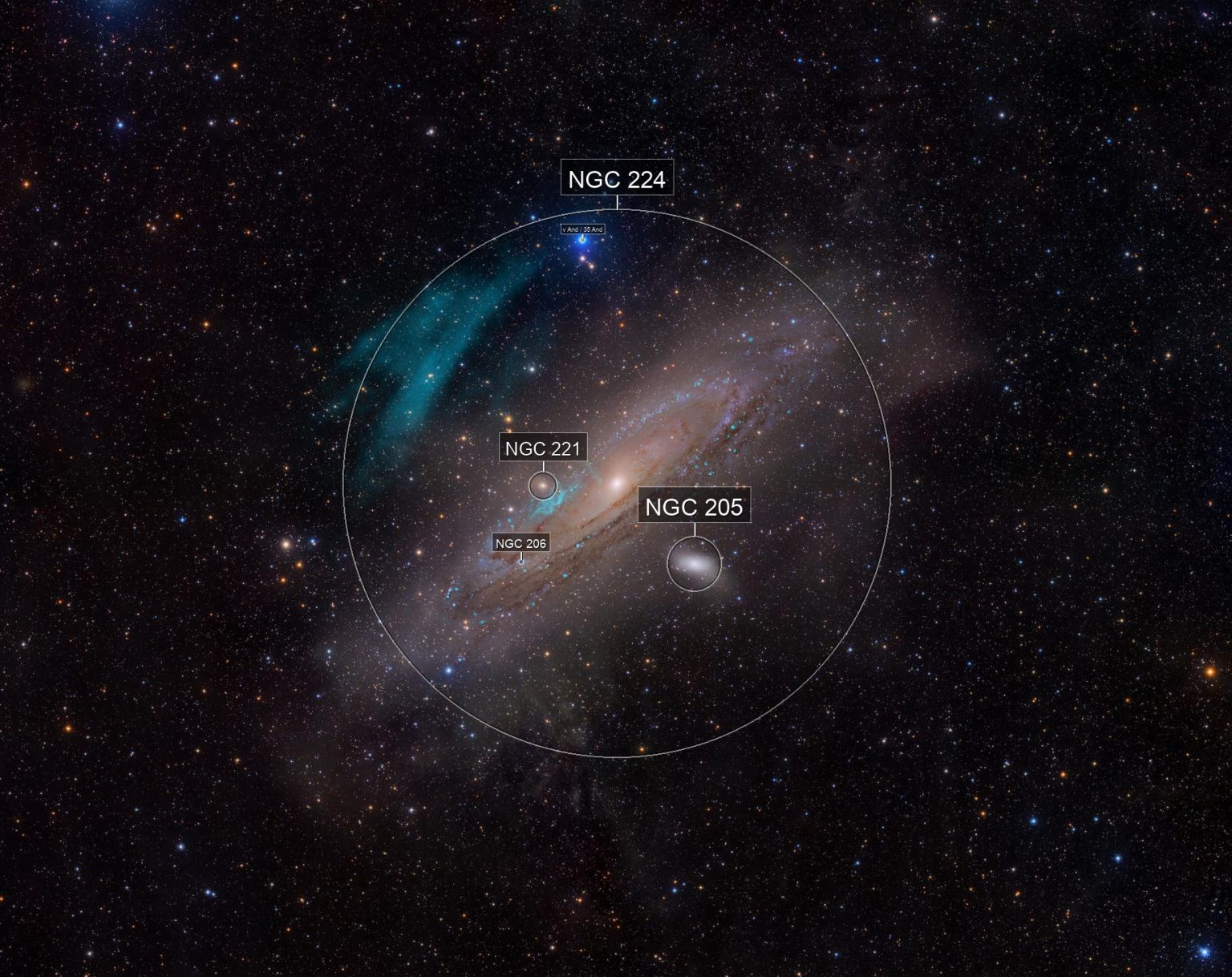
Mysterious nebula
The Andromeda Galaxy is the closest large neighbor to the Milky Way. Therefore, among all the star systems beyond it, it is the best studied. However, two years ago, it turned out that even it hides incredible mysteries. This is exactly what happened in January 2023, when a group of amateur astronomers took a very long exposure photograph of it and discovered a huge nebula nearby, which they named SDSO-1.
There is nothing surprising about the fact that something previously unseen was discovered in images with record exposure. After all, very diffuse objects reflect very few photons, so the more light particles you collect over time, the finer the structures you see. But this method leaves one big question: how far away is this structure and, accordingly, how large is it?
SDSO-1 could be located directly next to Andromeda, in which case this gas cloud itself would have to be the size and weight of a galaxy. Or it could be located somewhere in the vicinity of the Milky Way, in which case it would have to be significantly smaller in size.
CEFCA study
It was precisely this mystery that the Centro de Estudios de Física del Cosmos de Aragon (CEFCA) sought to unravel. To study SDSO-1, they used two instruments: the JAST80 telescope at the Javalambre Observatory and the MEGARA spectrograph installed on the Gran Telescopio Canarias.
The first allowed us to detect regions in the nebula where the gas behaves more calmly and forms separate layers. The second allowed us to study the spectrum of SDSO-1. This method is usually used to determine the chemical composition of space objects, but when they move at high speeds, the Doppler effect occurs — a shift in the same lines that are the “signature” of a chemical element.
This shift can be used to determine the speed of movement, in this case of gas in SDSO-1. It turned out to be between 10 and 30 km/s. This is much less than in the Andromeda Nebula and very similar to what can be seen in the Milky Way. Moreover, the layers mentioned can only be seen if the nebula is located somewhere nearby.
So it appears that SDSO-1 is a relatively small object located on the edge of the Milky Way, although how far away this nebula actually is, and therefore how large it is, remains to be explored.
According to www.cefca.es

