

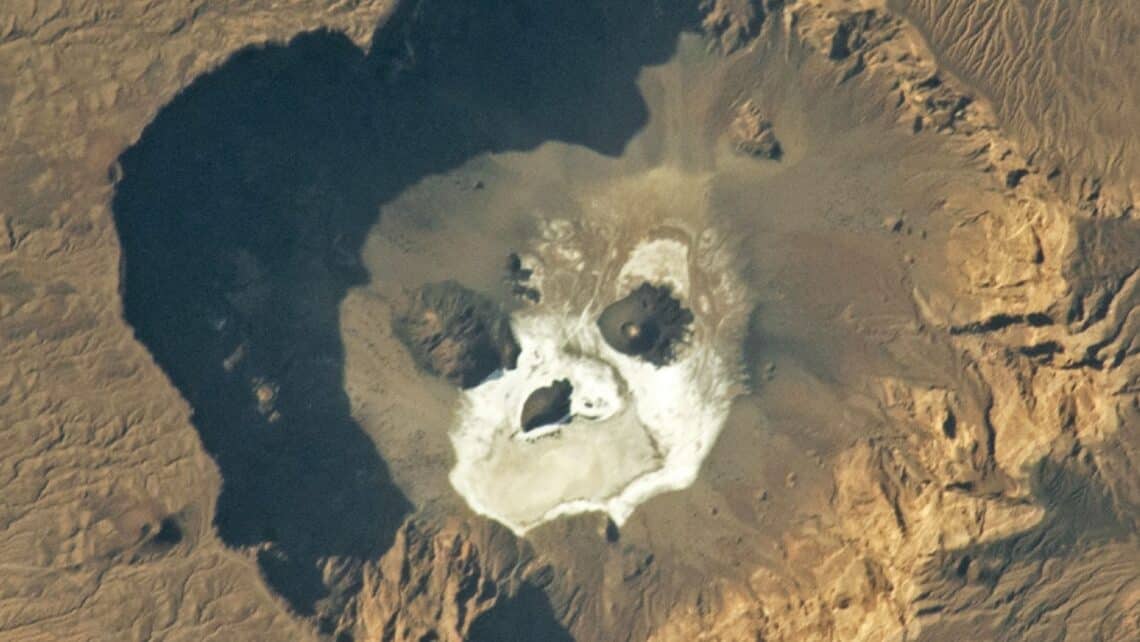
A NASA astronaut aboard the International Space Station photographed an unusual geological formation in the Sahara Desert that resembles a giant skull. This site is located in the Tibesti mountain region in northern Chad and is known as Trou au Natron.
Trou au Natron is one of several volcanic depressions (or calderas) formed as a result of the collapse of an underground cavity filled with magma after a volcanic eruption. Its diameter is about 8 km, and its depth reaches almost 1 km. Despite its impressive size, this structure remains poorly studied. The reason lies in its isolated location and the complex security situation in this region of Chad.
From orbit, the crater has clear contours, truly resembling a skull with “eye sockets,” a “nasal cavity,” and clearly defined “cheeks” of white color. However, there is nothing supernatural about this. This view is the result of a combination of natural factors: slag cones, white salt crusts consisting of natron, and the unique distribution of light and shadow on the terrain.
According to geological data, about 14,000 years ago, this caldera was filled with a deep lake. Its formation is probably linked to the melting of glaciers or a period of increased humidity in the climate. Today, the bottom of the crater is covered with a layer of alkaline salts — a mixture of soda, sodium bicarbonate, chloride, and sulfate known as natron. It is this salt that forms a bright white crust, visible even from space.
Nowadays, Trou au Natron is considered one of the most inhospitable areas in the region. Due to the high alkalinity and almost complete absence of water, even microorganisms can hardly survive there. However, wild animals still inhabit the surrounding Tibesti Mountains, including gazelles, desert foxes, and jackals. In addition, this region remains home to the Toubou people, who lead a semi-nomadic lifestyle adapted to the extreme conditions of the desert.
According to scientists, such discoveries are extremely important for understanding the Earth’s climatic past. The area, which today seems lifeless, may have been a fully functioning aquatic ecosystem in prehistoric times. Studying such geological structures helps us reconstruct how our planet’s climate has changed over thousands of years and how these changes have affected landscapes and life in general.

