

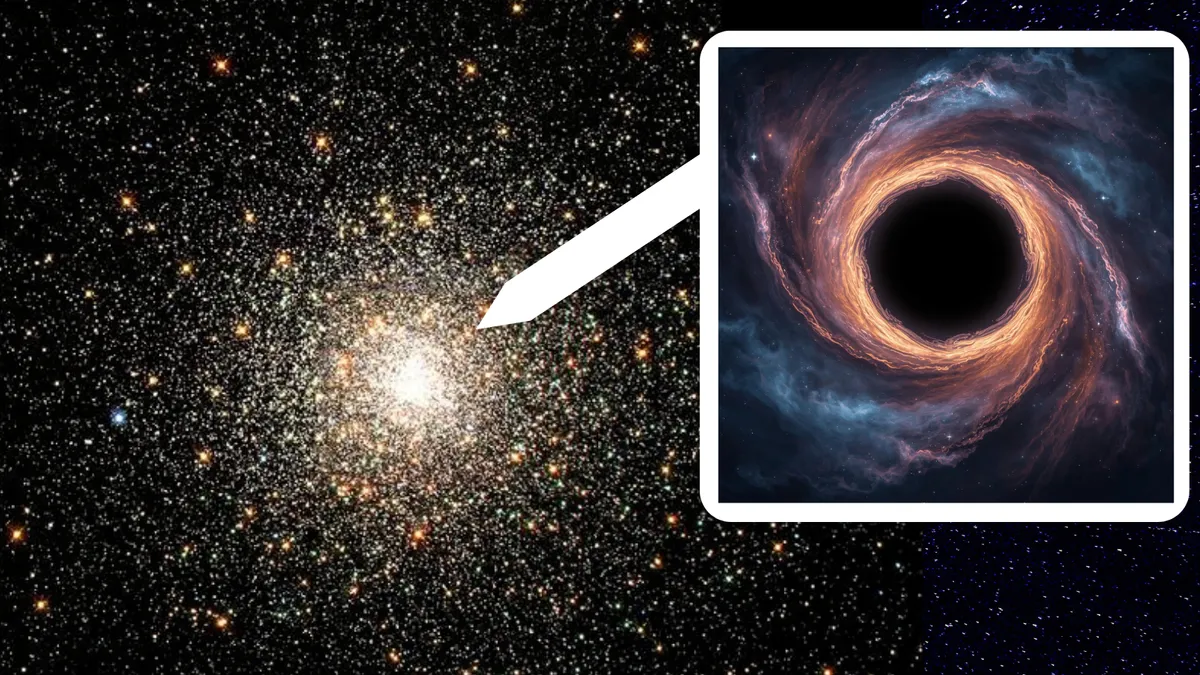
The most massive black holes in the Universe do not appear to form from the collapse of individual stars, but rather as a result of repeated mergers within the densest star clusters. An international team of scientists reached this conclusion after analyzing gravitational waves—ripples in spacetime detected by ground-based detectors.
Analysis of the Merger Catalog
Researchers at Cardiff University (United Kingdom) analyzed 153 black hole merger events from the fourth release of the LIGO–Virgo–KAGRA catalog (a network of gravitational-wave detectors).
The analysis identified two distinct groups of objects. One consists of low-mass black holes formed during supernova explosions and the subsequent gravitational collapse of the core. The other consists of more massive objects with characteristic chaotic rotation, indicating a series of successive mergers in dense stellar environments.
Cluster-based signature
The key clue lies in the nature of black holes’ rotation. Massive objects exhibit rapid rotation with random axis orientations—a characteristic typical of bodies that have undergone several generations of mergers in globular clusters, spherical stellar systems where stars are packed extremely tightly together.
“This is the exact signature we would expect to see if black holes were repeatedly merging in dense star clusters,” noted study co-author Isobel Romero-Shaw.
Gap in the mass range
The results also confirm the existence of the long-predicted “instability gap”—a range of masses within which stars do not leave black holes behind at all. According to this model, the most massive stars are completely destroyed in a supernova explosion before they have a chance to collapse.
Scientists have set the lower limit of this range at approximately 45 solar masses: in their view, black holes heavier than this threshold form specifically through mergers.
Open questions
“The largest black holes in the current sample seem to tell us about the dynamics of clusters, rather than just stellar evolution,” explained study lead Fabio Antonini.
At the same time, he leaves the question open: perhaps the discovered objects point to flaws in existing models of stellar evolution—or simply indicate an alternative formation pathway that has been underestimated until now. The results were published on May 7, 2026, in the journal Nature Astronomy.
According to space.com

