

Specialists at the Goddard Space Flight Center have successfully installed two sunshields on the inner segment of the Roman Space Telescope. This is an important step towards its launch.
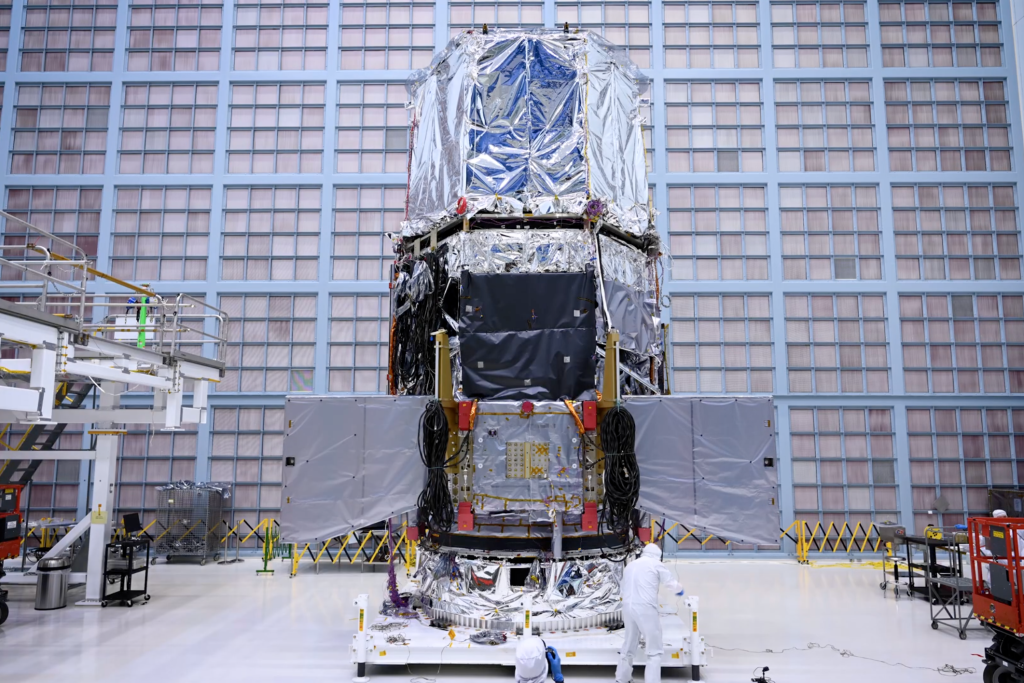
The Roman telescope is designed for observations in the near-infrared range. Maintaining the low temperature of its instruments is critical to the success of its mission.
For this purpose, the telescope was equipped with a sunshield. It consists of six panels, each covered with solar batteries. The two central panels will remain fixed to the outer cylindrical assembly (the observatory’s outer shell), while the other four will unfold and rise to align with the central panels once Roman is in space. Each of them measures approximately 2.1 by 2.1 meters and is 7.6 centimeters thick.
“Essentially, they are giant aluminum sandwiches with metal sheets as thick as a credit card on top and bottom and a central section consisting of a honeycomb structure,” said Conrad Mason, an aerospace engineer at NASA’s Goddard Space Flight Center.
This design makes the panels lightweight but rigid, and the material helps to limit heat transfer from the side facing the sun to the back side — a significant achievement, considering that the front side will heat up to a temperature sufficient to boil water (102 °C), while the back side will be much colder than even the harshest Antarctic winter (-135 °C). Each panel will be wrapped in a special polymer film to soften the heat, with 17 layers on the side facing the sun and one layer on the shaded side.
Now that the Roman inner segment has been fully assembled, it has to go through 70 days of thermal vacuum testing. Engineers and scientists will test the telescope’s instruments under conditions that simulate space. After testing, the sun visor will be temporarily removed while the team connects the outer and inner parts of Roman, and then reinstalled to complete the assembly of the observatory.
At present, the launch of Roman is still planned for no later than May 2027. At the same time, the team aims to send it into space as early as autumn 2026.
According to NASA

