

NASA engineers performed a unique operation. They repaired JunoCam, a camera installed on board the Juno spacecraft. At that moment, it was 600 million kilometers from Earth, orbiting Jupiter.
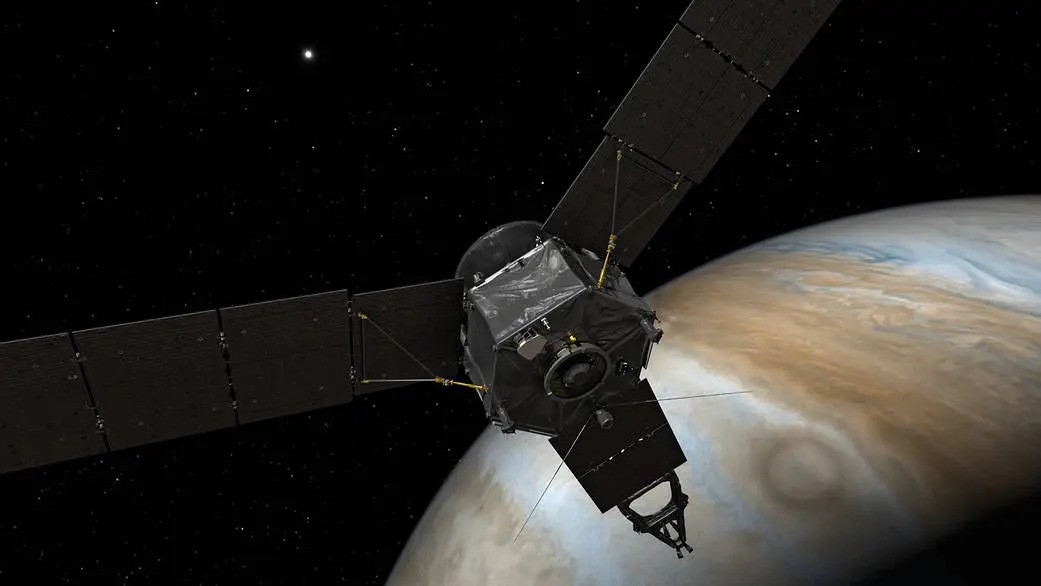
Situation with JunoCam
On July 16, at a conference of the Institute of Electrical and Electronics Engineers Nuclear & Space Radiation Effects in Nashville, the results of a unique operation to restore one of the cameras on the Juno spacecraft were presented.
The Juno spacecraft has been orbiting Jupiter for many years. At the same time, it has a fairly elongated orbit and periodically approaches the giant planet. Its electronic components are mounted inside a titanium casing, but the optical components are located outside it.
During the first 35 flights, the camera worked normally. Then, at around 47 orbits, signs of radiation damage began to appear in the images, and by 56 orbits, they were all seriously damaged.
Repair operation
Although the team knew that the problem might be related to radiation, it was difficult to determine what was damaged in JunoCam from a distance of hundreds of millions of kilometers. The clues pointed to a damaged voltage regulator, which is vital for powering the JunoCam.
With few options for restoration, the team turned to a process called annealing, during which the material is heated for a certain period of time and then slowly cooled. Although this process has not been fully studied, the idea is that heating can reduce defects in the material.
Test images sent to Earth during annealing showed a slight improvement in the first week. This was followed by a significant improvement in the images just a few days before the close approach to Io. By the time Juno approached the surface of the volcanic moon at a distance of 930 miles (1,500 kilometers), the images were almost as good as on the day the camera was launched, revealing detailed views of Io’s northern polar region, showing mountain ranges, plains, and previously unmapped volcanoes with large lava fields.
Useful experience
To date, the solar-powered spacecraft has orbited Jupiter 74 times. Recently, during its 74th orbit of Jupiter, noise reappeared on the image.
Since the first experiments with JunoCam, the Juno team has applied derivatives of this annealing technique to several instruments and engineering subsystems on the spacecraft.
“Juno is teaching us how to create and maintain spacecraft tolerant to radiation, providing insights that will benefit satellites in orbit around Earth,” said Scott Bolton, Juno’s principal investigator from the Southwest Research Institute in San Antonio. “I expect the lessons learned from Juno will be applicable to both defense and commercial satellites as well as other NASA missions.”
According to phys.org

