

Thanks to the Chandra and James Webb Space Telescopes (JWST), astronomers have discovered one of the earliest known galaxy clusters. It began to form just a billion years after the Big Bang.
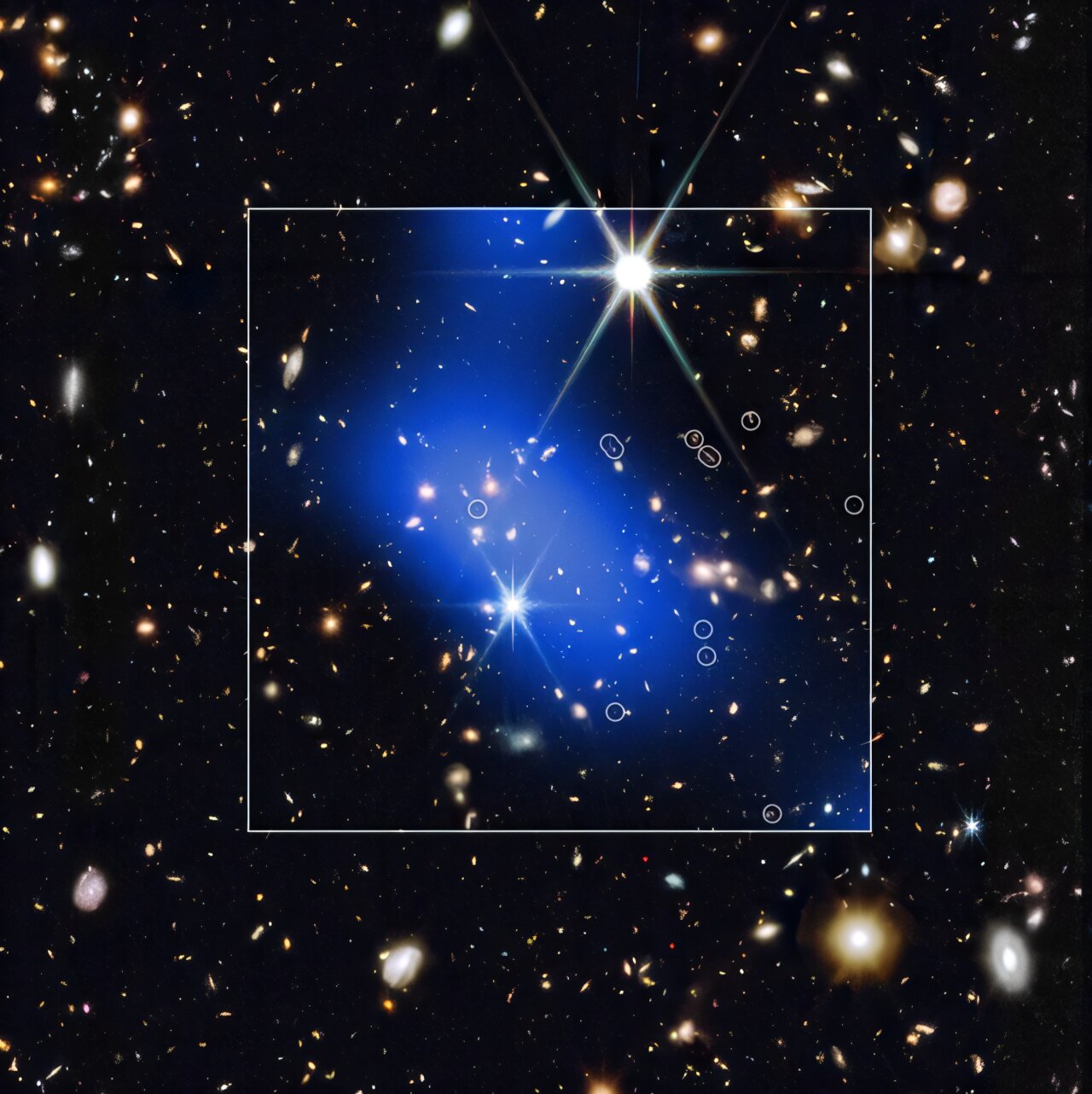
Galactic clusters are the largest structures in the Universe. They consist of hundreds or even thousands of individual galaxies surrounded by clouds of superheated gas, as well as large amounts of invisible dark matter. Astronomers use galaxy clusters to measure the expansion of the Universe, study the role of dark energy and dark matter, and conduct other important space research.
Most existing cosmological models predict that the first galaxy clusters should have begun to form no earlier than 2–3 billion years after the Big Bang, when the density of galaxies reached the necessary level. However, a new discovery made using the Chandra and JWST telescopes casts doubt on existing theories. They managed to detect a protocluster that existed at a time when the Universe was less than a billion years old.
The object, known as JADES-ID1, has a mass approximately 20 trillion times greater than that of the Sun. We see it in its early stages of formation. The available data show that JADES-ID1 has two properties that confirm the presence of a protocluster: a large number of galaxies held together by gravity (JWST has found at least 66 potential members) that are also located in a huge cloud of hot gas discovered by Chandra. As the cluster forms, gas falls inward and is heated by shock waves, reaching temperatures of millions of degrees and emitting X-rays.
What makes JADES-ID1 exceptional is that it appeared in space history at a surprisingly early stage. Most models of the Universe predict that there would not have been enough time and sufficient galaxy density for a protocluster of this size to form. The previous record holder for X-ray protoclusters was discovered much later, approximately three billion years after the Big Bang.
“We thought we’d find a protocluster like this two or three billion years after the big bang – not just one billion,” said co-author Qiong Li from the University of Manchester in the UK. “Before, astronomers found surprisingly large galaxies and black holes not long after the big bang, and now we’re finding that clusters of galaxies can also grow rapidly.”
In billions of years, JADES-ID1 should evolve from a protocluster into a massive galaxy cluster similar to those we see much closer to Earth.
According to NASA

