

NASA used the James Webb Space Telescope (JWST) and SPHEREx to study the interstellar comet 3I/ATLAS. They were able to determine the composition of its coma.
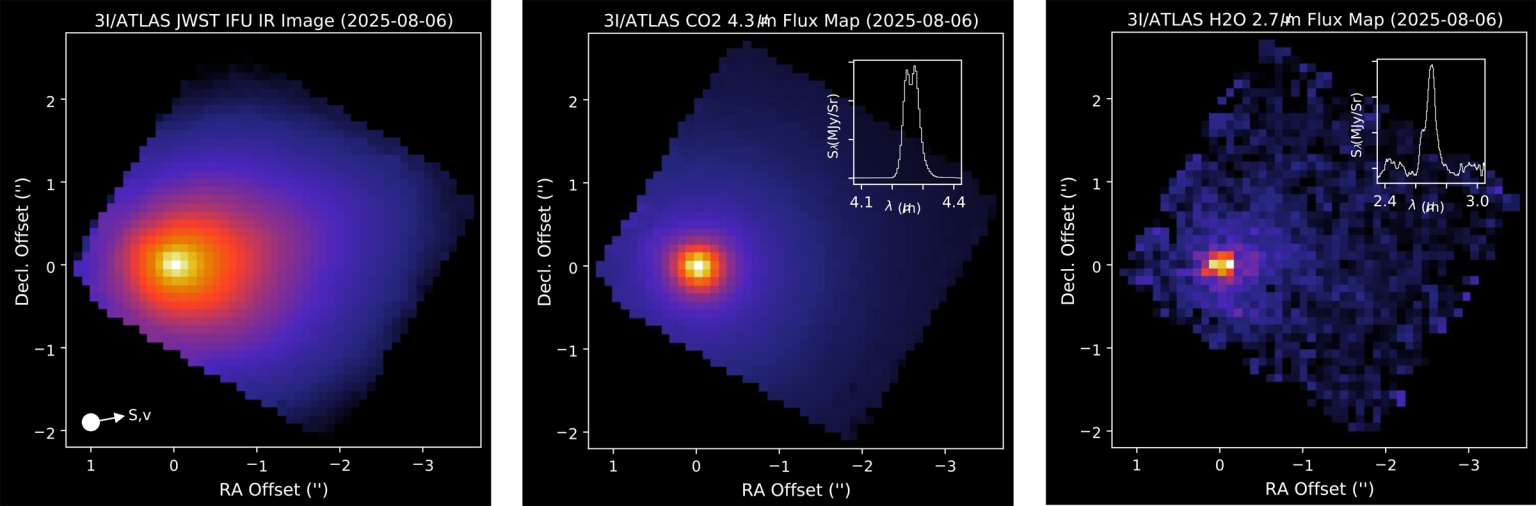
3I/ATLAS was discovered in early July. It became only the third object of interstellar origin found in the Solar System, which led to increased attention from the scientific community. Although speculative claims that the comet is actually an alien spacecraft have not been confirmed, it is of enormous scientific value. Analysis showed that 3I/ATLAS most likely came from the thick disk of the Milky Way. This means that it is billions of years older than our Solar System.
As 3I/ATLAS approaches the Sun, its nucleus heats up and the ice and volatile substances on its surface sublimate, forming a gas and dust cloud called a coma. Its analysis provides insight into the nature of the interstellar visitor and a better understanding of the conditions in which it formed.
NASA used two of its space telescopes to study the coma of an interstellar comet: JWST and the recently launched SPHEREx. Preprints of scientific articles written based on the results of their observations are already available online.
JWST managed to capture images of the 3I/ATLAS coma. At the time of imaging, it was located at a distance of 3.32 AU from the Sun. Analysis showed that the coma consisted mainly of carbon dioxide (CO₂). Traces of water, carbon monoxide, and carbonyl sulfide were also detected. The ratio of carbon dioxide to water in the coma of an interstellar comet is one of the highest ever observed in comets. This may indicate that 3I/ATLAS contains ice exposed to higher levels of radiation than comets in the Solar System, or that it formed near the CO₂ ice line in its parent protoplanetary disk. Low water content in comets may also be due, for example, to the difficulty of heat penetrating the comet’s core.
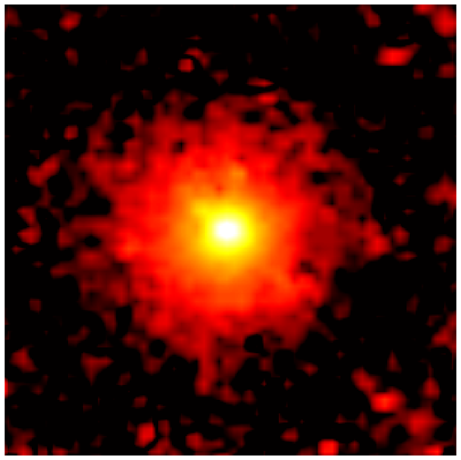
As for SPHEREx, it also managed to detect carbon dioxide in the comet’s coma at low water vapor content. Researchers suggest that the comet ejects pieces consisting of a mixture of water and dry ice. The evaporation of the latter creates a cooling effect that suppresses the sublimation of water ice and the formation of water vapor.

