

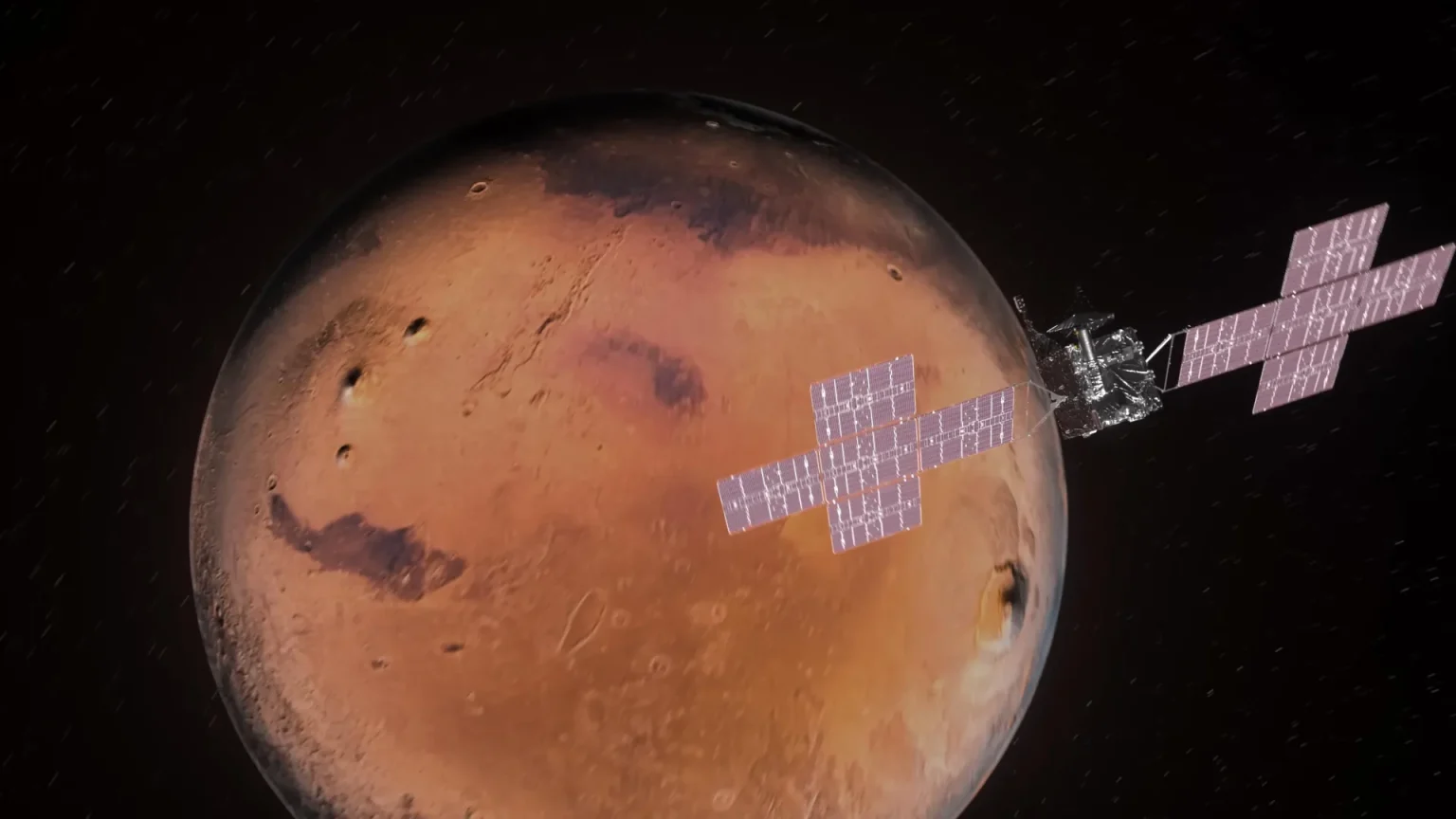
NASA’s Psyche probe will perform a gravity assist maneuver near Mars—it will use the planet’s gravitational pull to accelerate and change course on its way to the metal-rich asteroid 16 Psyche. This flight will be the first opportunity to test the onboard instruments under real-world conditions.
Why fly past Mars?
NASA’s Psyche is heading toward the asteroid belt between Mars and Jupiter, where it is scheduled to enter orbit around the asteroid 16 Psyche in 2029. It uses a solar-powered xenon ion propulsion system—which is fuel-efficient but not particularly powerful.
To reach its destination without wasting fuel, the mission employed a classic technique: flying close to the planet and allowing its gravity to “boost” the spacecraft. On February 23, the team performed a trajectory correction. NASA’s Psyche fired its engines for 12 hours to get precisely on course.
On May 15, NASA’s Psyche spacecraft will fly past Mars at a distance of 4,500 km from the planet’s surface, traveling at a speed of about 20,000 km/h. Scientists will use this flyby to calibrate the spacecraft’s instruments for the first time using a real, large-scale object.
The multispectral camera will capture thousands of images of Mars, which the team will use to refine their imaging techniques before applying them to an asteroid in orbit. The first images were released on May 7; so far, Mars looks like a tiny dot in them.
What will the camera see?
Psyche is approaching Mars from the night side, so at first the planet will appear as a thin crescent illuminated by a narrow band of sunlight.
After the flyby, Mars will turn so that its nearly fully illuminated side faces the cameras. Both phases will yield images with different lighting angles—useful for calibration and simply beautiful.
Further research
Scientists will also attempt to detect a faint dust ring around Mars. According to the hypothesis, micrometeorites striking the Martian moons Phobos and Deimos eject dust particles into the interplanetary space, and under certain lighting conditions, this dust may become visible in the image.
At the same time, the probe’s magnetometer will study how Mars’ magnetic field interacts with the solar wind, while the gamma-neutron spectrometer will record changes in the cosmic ray flux during the flyby.
According to sciencedaily.com

