

The Hubble and James Webb telescopes have captured amazing images of the open clusters NGC 460 and NGC 456. They are located in the Small Magellanic Cloud, a dwarf galaxy that is a satellite of the Milky Way.
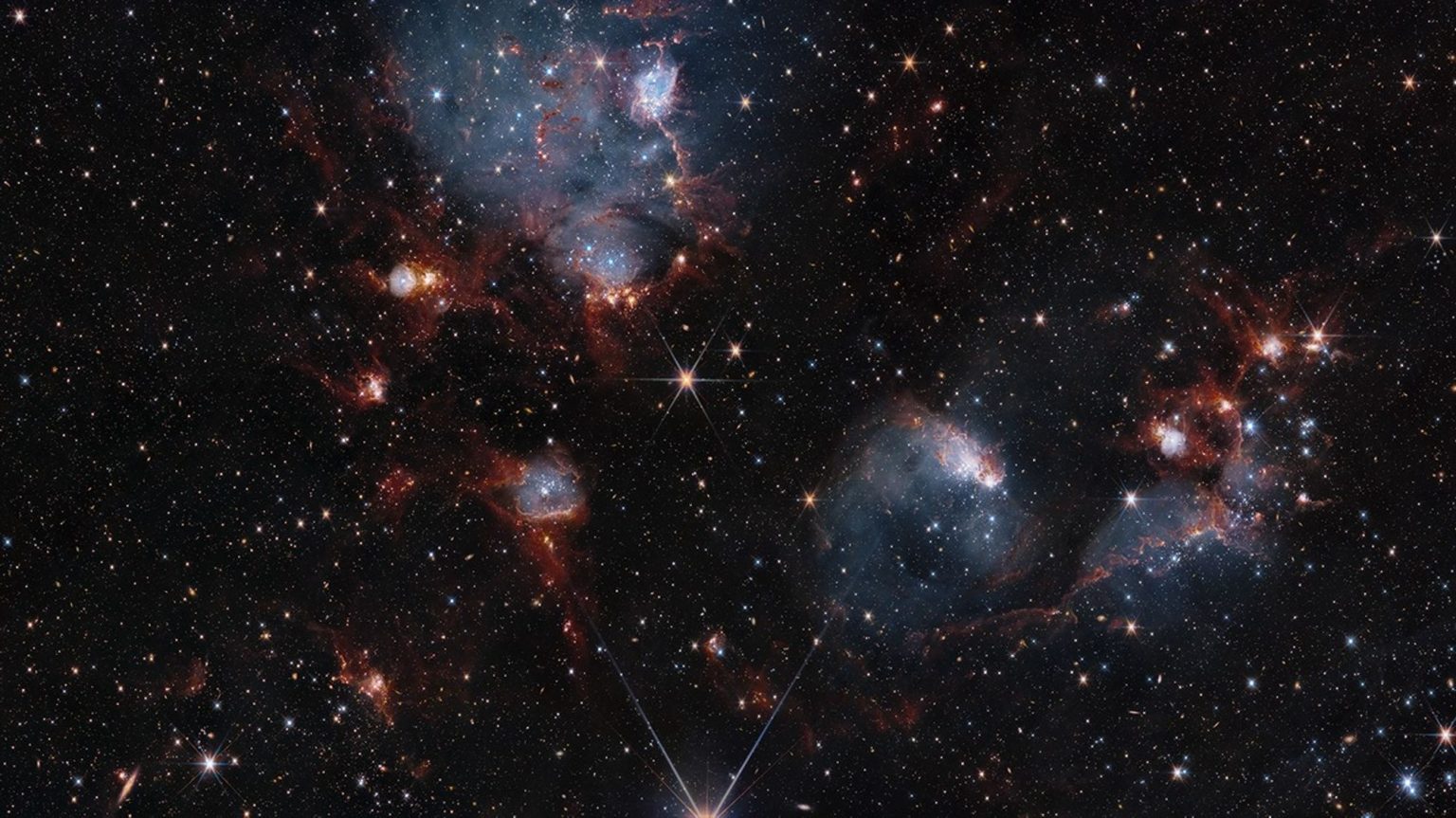
Two images of the cluster duo
NASA has released an amazing image obtained thanks to two space telescopes: Hubble and James Webb. More precisely, these are two images combined into one to show the amazing interaction between stars and gas in outer space.
Two open clusters are visible in the image: NGC 460 and NGC 456. They are located in the Small Magellanic Cloud, a dwarf galaxy orbiting the Milky Way. This system is undergoing active star formation, and both clusters are part of the much larger N83-84-85 complex.
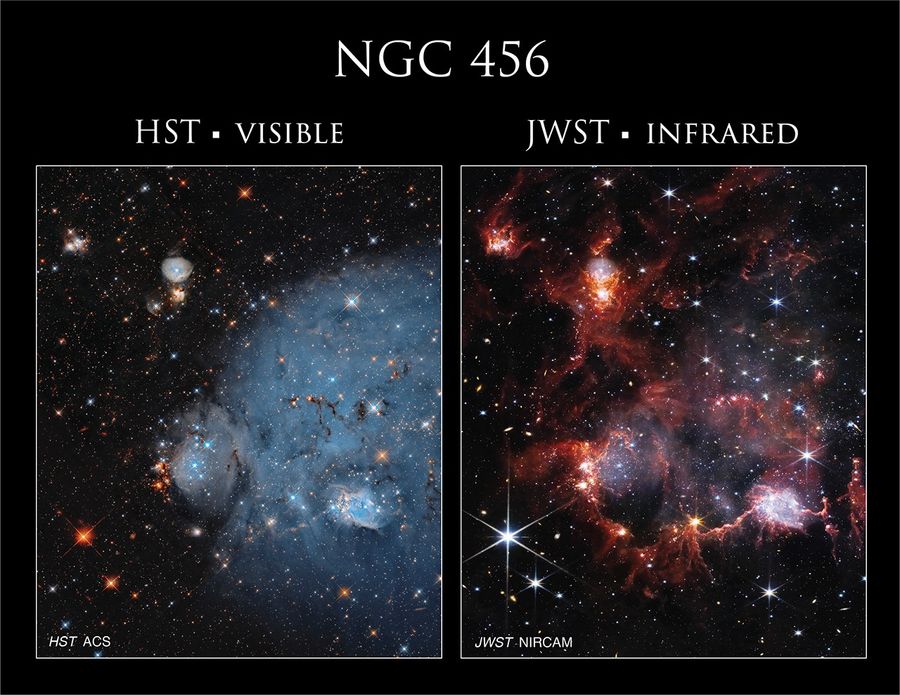
Here are scattered star clusters consisting of weakly gravitationally bound young stars. The age of the stars that make up NGC 460 and NGC 456 is about 10 million years, which means we are observing them shortly after their birth.
Gas and stars
The most interesting thing about the image is that it shows the interaction between dust and stars. What helps here is that the two space telescopes operate in slightly different parts of the electromagnetic spectrum.
Hubble, looking at the universe in the visible spectrum, captures glowing, ionized gas when stellar radiation blows “bubbles” in clouds of gas and dust (blue color). James Webb’s infrared vision reveals clumps and thin filamentary structures of dust (red).
In images obtained by the Hubble Telescope, dust is often visible as a silhouette against the light that blocks it, but as James Webb shows, dust heated by starlight emits its own infrared glow.
The nodes visible in these images are sites of active star formation. Scientists are also very interested in spectral O-type stars in the N83-84-85 region, which are extremely hot and rare. In the entire Milky Way, out of its 400 billion stars, there are only 20,000 of them.
According to science.nasa.gov

