

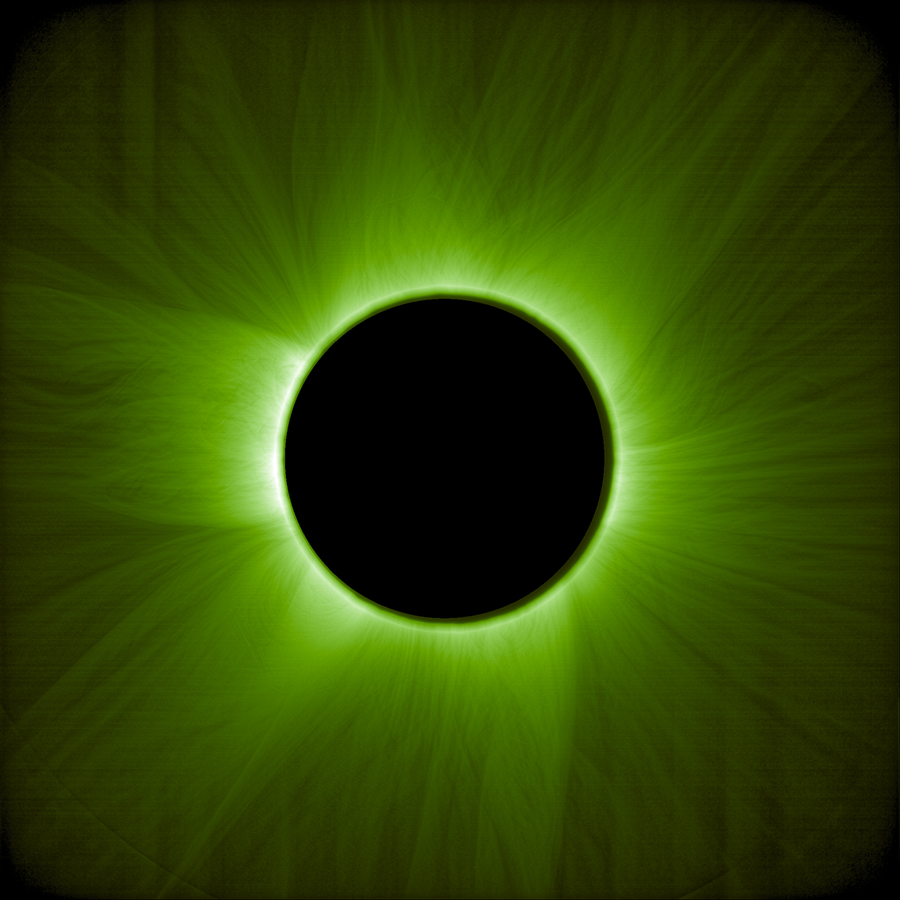
Two ESA (European Space Agency) satellites have learned to create artificial solar eclipses when needed—and for the first time have captured detailed images of the Sun’s inner corona in a region inaccessible to other space telescopes. The Proba 3 mission has published its first scientific results in Astrophysical Journal Letters.
Artificial eclipse
During a total solar eclipse, the Moon perfectly blocks the Sun’s disk, allowing scientists to see the inner corona—a rarefied and extremely hot layer of plasma. This is where the solar wind originates—a constant stream of charged particles—but because solar eclipses are so brief, such observations are always limited in duration. Total eclipses occur on average only once every 18 months and last just a few minutes. Under normal conditions, the Sun simply blinds telescopes.
Proba 3 solves this problem differently: one spacecraft carries a 1.4-meter-diameter screen that blocks the solar disk, while the second—144 meters behind—takes images with the ASPIICS coronagraph (An Occultation by a Small Spacecraft Imager for the Inner Corona of the Sun, i.e., a coronagraph for imaging the inner corona). The distance between the satellites is maintained with an accuracy of one millimeter—otherwise, the system simply won’t work.
What we managed to see
ASPIICS can image a section of the lower corona at a distance of just 70,000 km from the Sun’s surface (which is 0.1 times the Sun’s radius)—no other space coronagraph has ever operated this close to the photosphere.
In the new images, researchers have identified small-scale structures: plasma clumps, outflows, jets, and waves. The telescope captures an image every 30 seconds, allowing it to track even fleeting processes.
“Matter is constantly in motion within the Sun’s atmosphere. It appears to be much more complex and heterogeneous than previous studies have suggested,” comments Matthew Owens of the University of Reading.
In addition to studying the corona, Proba-3 performs other tasks. Using a radiometer, it measures the total energy that Earth receives from the Sun, which is important for climate models. Another instrument studies our planet’s radiation belts as satellites pass through its magnetosphere.
Technical challenges and plans
Despite its scientific achievements, the mission experienced a major setback: from mid-February to mid-March 2026, the ESA lost contact with the main spacecraft for the entire month. Contact was suddenly reestablished. Engineers are currently resolving the issue through software updates.
The mission’s official budget runs through the end of 2026, but fuel reserves will last until the summer of 2028—and the mission’s principal investigator, Andrei Zhukov of the Royal Observatory of Belgium, is counting on continued funding.
A better understanding of the solar wind has practical implications: it helps to more accurately predict space weather, which is important for protecting power grids, satellites, and astronauts.
According to Sky & Telescope

