

Engineers promise that humans will eventually fly to Mars. A new engine, which has already passed the initial testing phases, will be able to get them there quickly. It will work by accelerating ions of lithium converted into plasma.
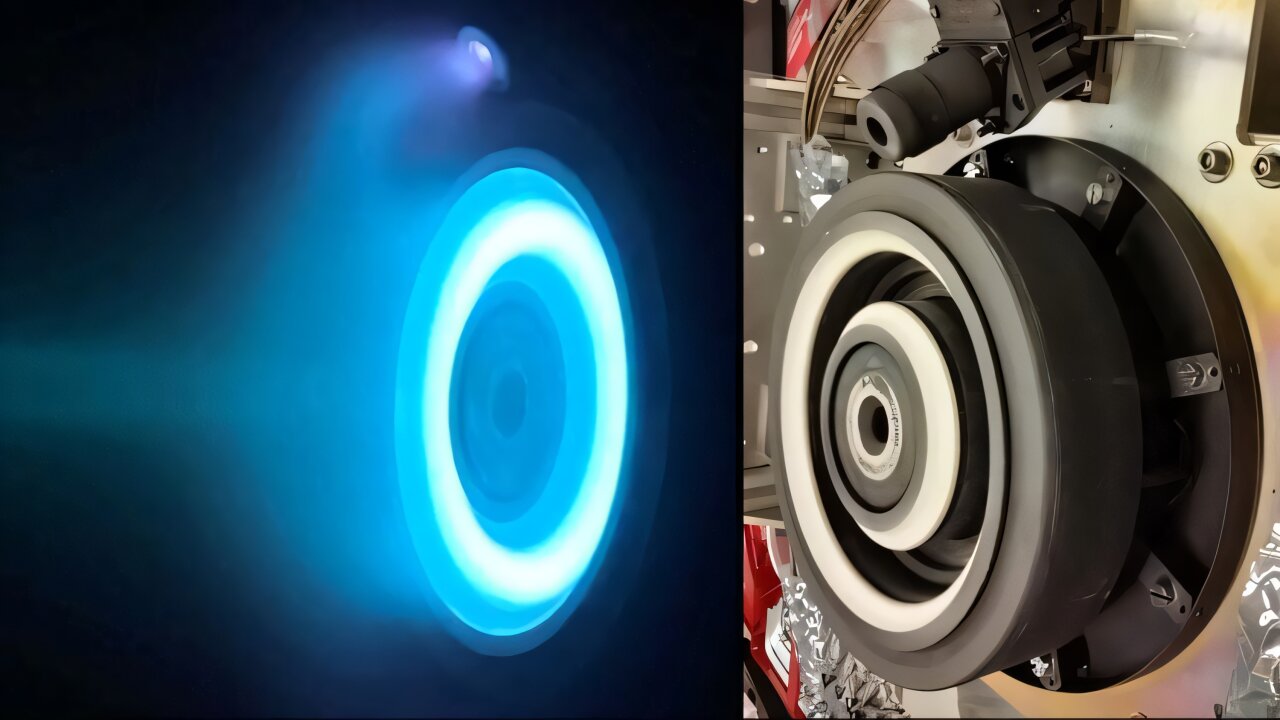
Next-generation electric power plant
You are taking part in the fourth manned mission to Mars, and you’re told that the Odyssey spacecraft will provide the smoothest flight of your life. It is equipped with a recently tested electric propulsion engine, whose final testing phases were completed during the first three missions.
The mission begins, the spacecraft moves at a snail’s pace, and you start to wonder if it’s broken. A week goes by, and you’re traveling at over 400,000 km (250,000 miles) per hour, amazed at how fast you’re moving and realizing that this mission might turn out to be even cooler than you thought.
This scenario is unlikely to become a reality for at least another ten years, but that hasn’t stopped NASA’s talented engineers from developing and testing next-generation engines designed to eventually carry humans to Mars and send spacecraft to various corners of the Solar System. The fact is that NASA engineers recently tested a next-generation electric power system that set new records using lithium-metal vapor as fuel, and which has the potential to radically transform the state of power systems for future space exploration.
New engine power record
These tests marked a significant achievement, as they set a new U.S. record of 120 kW—a power output estimated to be 25 times greater than that of NASA’s Psyche spacecraft, which is currently on its way to asteroid 16 Psyche and is equipped with the most powerful electric motors ever built.
Although Psyche is currently traveling at a speed of approximately 135,000 km/h (84,000 mph), its maximum speed at the end of its flight toward the asteroid 16 Psyche is estimated to be 200,000 km/h (124,000 mph). In addition to their speed, which gradually increases during continuous operation, electric propulsion systems offer significant fuel savings—up to 90%—compared to the chemical rockets in use today.
“Designing and building these thrusters over the last couple of years has been a long lead-up to this first test,” said James Polk, a senior scientist at NASA’s Jet Propulsion Laboratory. “It’s a huge moment for us because we not only showed the thruster works, but we also hit the power levels we were targeting. And we know we have a good testbed to begin addressing the challenges to scaling up.”
Change in the timeline for a potential future Mars mission
Although 120 kW is a new record, NASA estimates that the upcoming crewed mission to Mars will require 2 to 4 MW of power, generated by multiple engines and requiring more than 23,000 hours (958 days/2.6 years) of operation. To do this, the engines must withstand temperatures exceeding 2,800 °C (5,000 °F), which they achieved during testing.
The reason for extending the mission’s duration is the estimated duration of a full crewed mission to Mars, which is approximately 2.6 years. This is because the launch window for a mission to Mars opens only once every two years due to the orbital characteristics of both planets. Although no mission has yet returned from the Red Planet, this launch window also applies in the opposite direction—from Mars to Earth. Generally, if the launch takes place within this window, spacecraft take about 6–7 months to reach Mars.
However, a manned mission would require a much larger spacecraft to accommodate the astronauts, food, fuel, water, and other mission essentials. For a mission lasting approximately 2.6 years, this would mean a 6–9-month journey to Mars, followed by about 18 months on the Martian surface until the next launch window opens, and then another 6–9 months on the return trip to Earth. However, the significantly smaller fuel capacity resulting from the electrical propulsion system could potentially change these timelines.
According to phys.org

