

Scientists have analyzed satellite data on our planet from the past few years. They were interested in changes in the level of illumination in urban areas. It turned out that the situation was more complicated than they had imagined.
Humans’ light
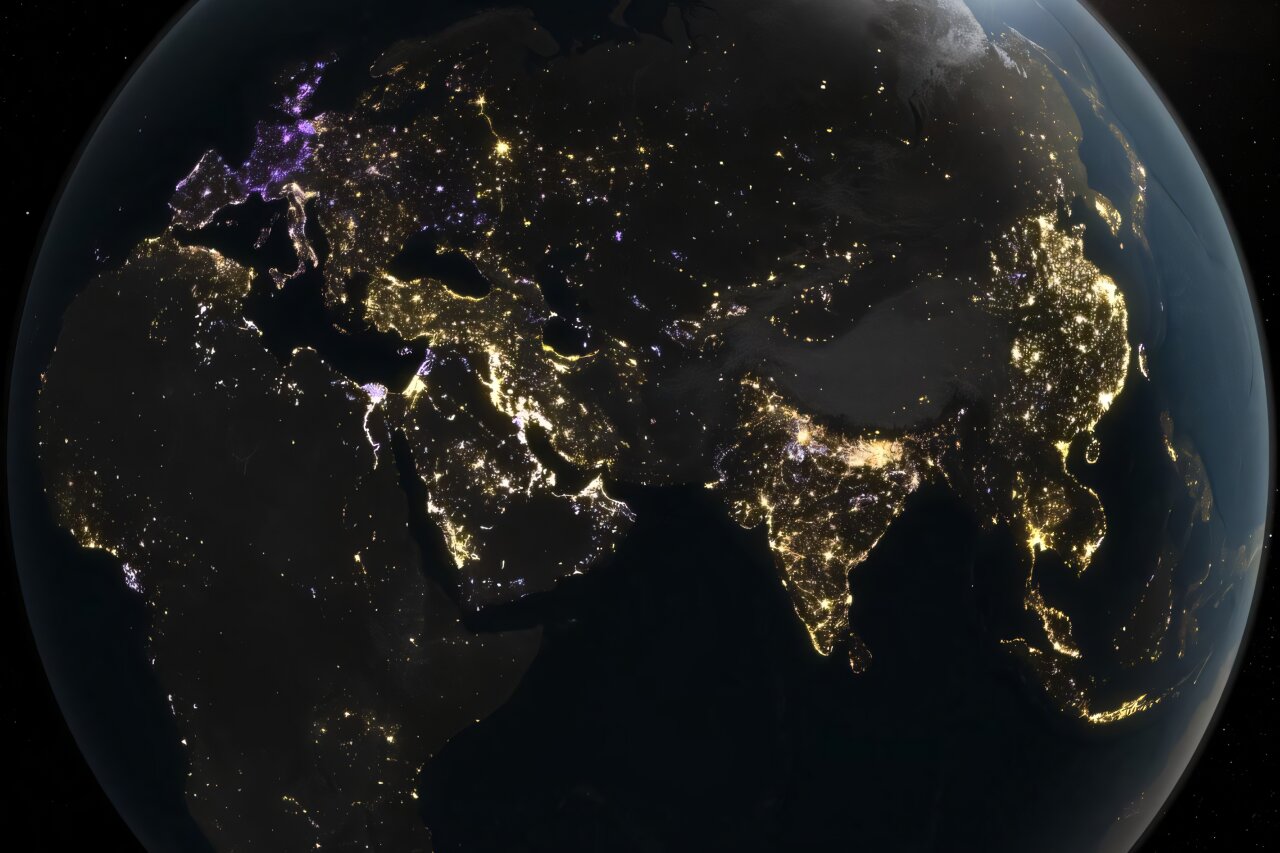
Everyone is used to the idea that Earth looks like a blue ball from space. However, that’s only true if you look at its day side. If you look at it at night—and even from low orbit—you’ll see a completely different picture: a dark surface dotted with the bright lights of major cities. Physical evidence of humanity’s existence is visible even from space.
However, a study recently published in the journal Nature by a team of researchers led by scientists from the University of Connecticut offers a new perspective on this situation. Traditionally, scientists interpret the nighttime lights against the darkened surface of the Earth in a very straightforward way: the power of human civilization is constantly growing. In some places, this process moves faster; in others, it moves more slowly. And nighttime lights are a good indicator of how quickly a particular region is developing.
Why is the light fading?
However, observations made between 2014 and 2022 show that the situation regarding nighttime lighting has changed in a far more complex way during this period. Specifically, the total amount of light has increased by 34%. However, at the same time, in some regions and at certain points in time, it fell by 18%. This was particularly the case during the COVID-19 pandemic and periods of military conflict, including in Ukraine.
However, it does not necessarily follow that a decline in visibility reflects any negative trends. For in Europe, during the same period, the number of sources of nighttime lighting increased, but its brightness decreased. The reason for this situation is quite simple: this was the time when energy-saving standards were being actively implemented there.
Overall, researchers note that the new data suggests that the success of a given area should be assessed solely based on how it appears at night when viewed from orbit. Because in many countries, this decline may not be a sign of problems, but rather of greater development.
In fact, this new approach allows us to view the development of civilization almost as we always have. There is no uniform increase in the Earth’s nighttime illumination. Human civilization “flickers.” Some regions are becoming less bright, while others are becoming brighter, but overall light pollution is still gradually increasing.
According to phys.org

