

Using the James Webb Space Telescope (JWST), astronomers have found evidence of an atmosphere on the extremely hot super-Earth TOI-561 b. Its surface is believed to be covered by a global ocean of magma.
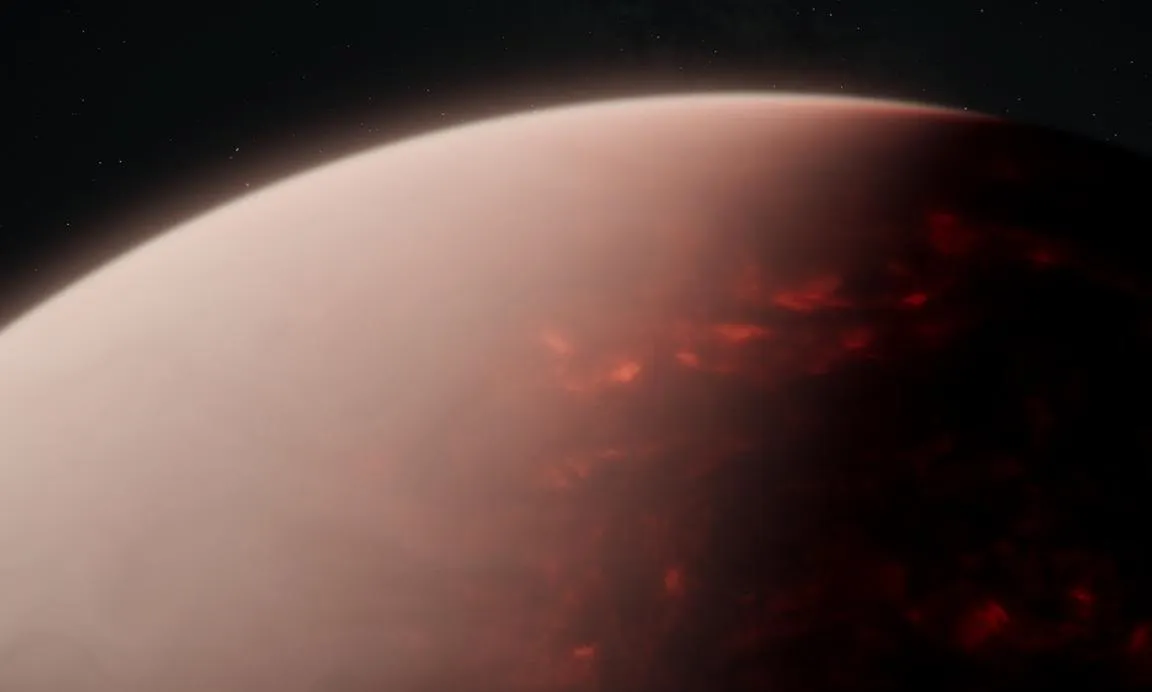
TOI-561 b orbits an orange dwarf located 280 light-years from Earth. At present, astronomers have confirmed the existence of four exoplanets in this system. However, TOI-561 b is of particular interest.
With a radius 1.4 times that of Earth and an orbital period of less than 11 hours, TOI-561 b belongs to a rare class of objects known as ultra-short-period exoplanets. Although its host star is only slightly smaller and cooler than the Sun, the exoplanet orbits so close to it that it is likely tidally locked. TOI-561 b constantly faces the same side toward its star, whose temperature far exceeds the melting point of rocks. As a result, it is covered by a global ocean of magma.
One of the unusual features of this extreme world is its abnormally low density. A team of researchers from the University of Birmingham has suggested that TOI-561 b may have a dense atmosphere, which makes the exoplanet appear larger than it actually is.
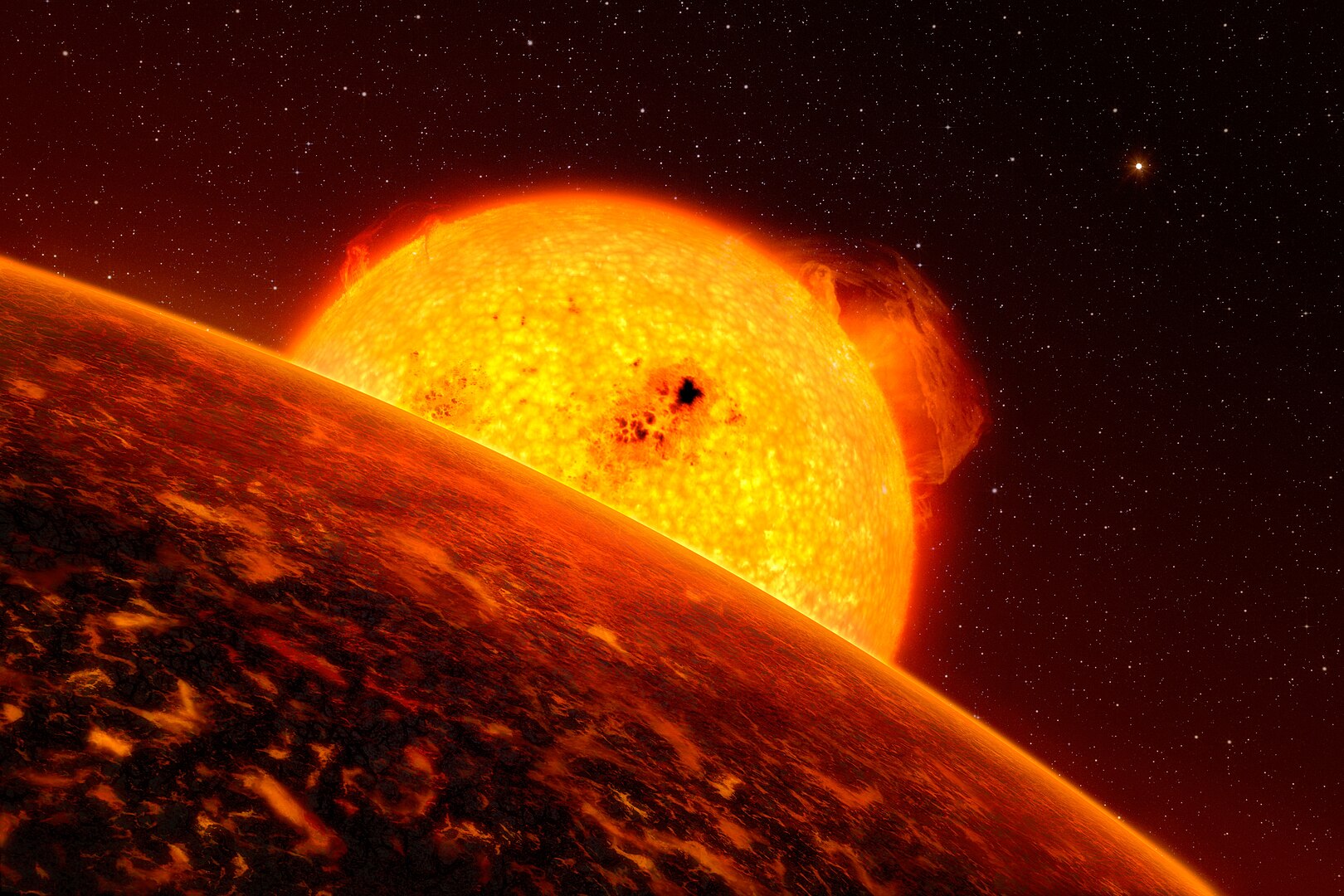
To test this hypothesis, scientists used the JWST. If TOI-561 b were a bare rock with no atmosphere, the temperature on its day side would be around 2700 °C. However, JWST observations showed that it is “only” 1800 °C.
To explain these results, the team considered several different scenarios. A magmatic ocean could have removed some of the heat, but without an atmosphere, the night side would have been solid, limiting heat loss from the day side. It is also possible that there was a thin layer of vaporous rock on the surface of the magma ocean, but this alone would have had a much smaller cooling effect than observed in reality.
Therefore, the most likely explanation is that TOI-561 b has a dense atmosphere. It appears to be rich in volatile substances. Gases such as water vapor absorb some wavelengths of near-infrared radiation emitted by the surface before they pass through the entire atmosphere. The planet will appear colder because the telescope captures less light. It is also possible that bright silicate clouds exist in the atmosphere of TOI-561 b, which cool it by reflecting some of the starlight.
Earlier, we reported on how astronomers managed to photograph an analogue of the planet Tatooine from Star Wars.
According to birmingham.ac.uk

