

Astronomers from Northwestern University (USA) have obtained the first direct image of a unique exoplanet orbiting two stars simultaneously, reminiscent of the legendary Tatooine from Star Wars. This rare discovery opens up new horizons for understanding planet formation in complex systems. The discovery was reported in Astronomy and Astrophysics.
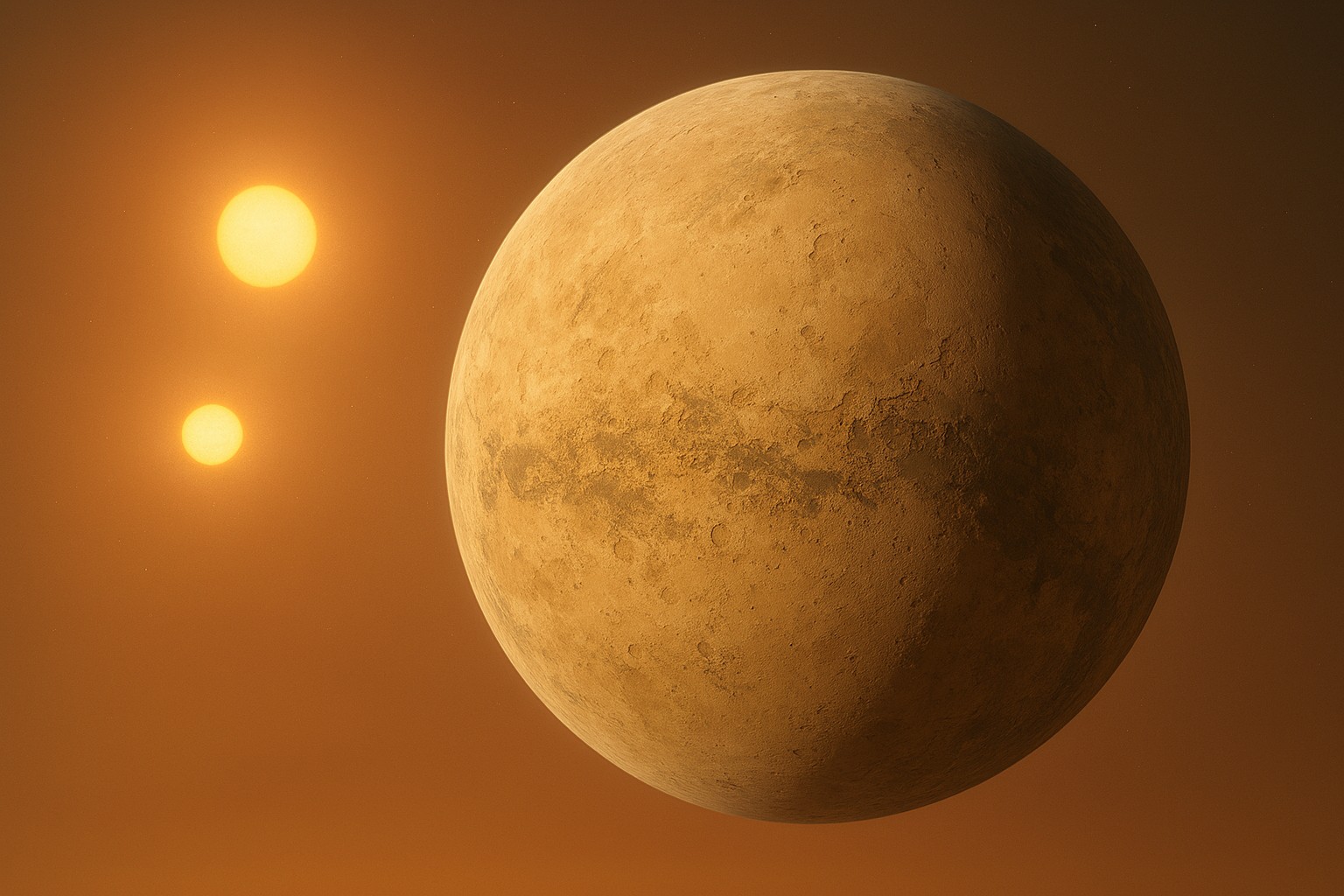
Although direct images of exoplanets are rare, this discovery is exceptional. The new world, located in a system where it orbits its suns, is six times closer than any other directly photographed planet in a binary system. This gives astrophysicists a unique opportunity to study how planets form and move in such extreme conditions.
“Of the more than 6,000 known exoplanets, only a very small fraction orbit binary stars,” explains senior author Jason Wang. “And direct images of such systems can be counted on one hand. This is the only type of system where we can simultaneously track the orbits of both stars and planets.”
Planet of the Miocene epoch
The confirmed planet is six times larger than Jupiter. Although it is hotter than any planet in the Solar System, it is relatively cool compared to other exoplanets that have been directly photographed. It is located approximately 446 light-years from Earth, which is “almost close” by cosmic standards.
The exoplanet was formed only about 13 million years ago, so it is relatively young. “This is a relatively young age in the scale of the Universe. But it was formed at a time when dinosaurs had long been extinct on Earth,” explains Wang.
The team was also struck by how close the exoplanet orbits its stars. The stars orbit each other closely, completing one revolution in just 18 Earth days. However, it takes the planet 300 years to orbit the pair. This is slightly longer than it takes Pluto to orbit our Sun.
Treasure in the archive
The planet was not discovered immediately. A team led by Natalie Jones found it by carefully checking archival data collected several years ago by the Gemini Planet Imager (GPI) instrument in Chile. This special device, which Jason Wang helped develop as a graduate student, can “mute” the dazzling light of stars to see dim planets around them.
“We observed more than 500 stars and found only one new planet, which gives an idea of their rarity,” Wang noted. Almost a decade later, he instructed that the data be checked again before the instrument was upgraded and moved to Hawaii.
This discovery is an important step for astronomy. Observing how three bodies—two stars and a planet—move in space will allow us to test and refine theories of planet formation. Scientists eagerly await future observations to see this extraordinary orbital dance in action.
We previously reported on how life could exist on planets similar to Tatooine.
According to Phys

