

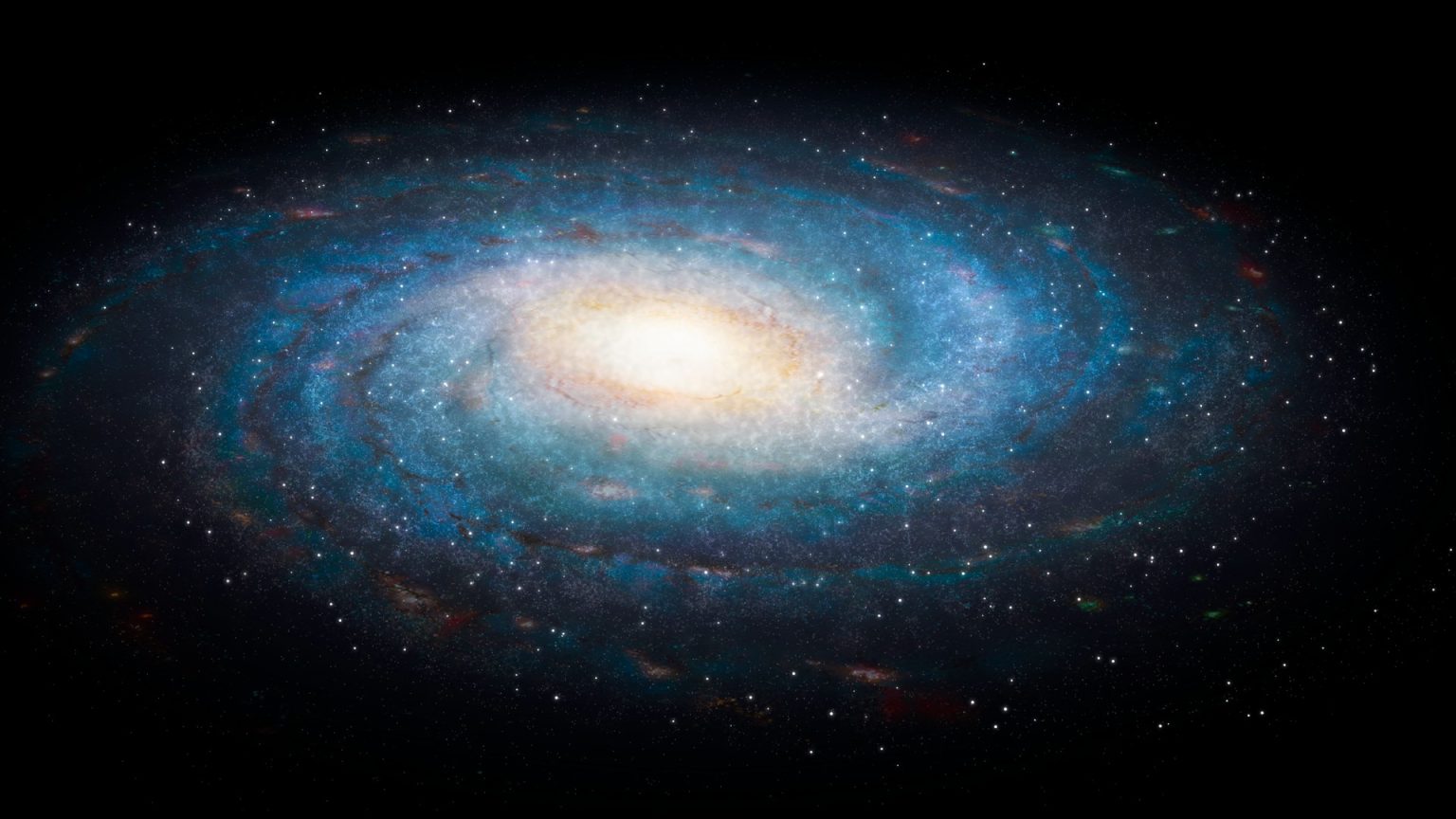
Imagine the Milky Way not as a silent pinwheel of stars, but as something that sings softly. Scattered across its plane are millions of pairs of dead stars, mostly white dwarfs, which circle one another and, as they move, create waves in spacetime. Individually, these waves are too weak to be detected. Together, they merge into a constant background hum. And to capture this hum, a European space mission called LISA is currently being prepared.
LISA – a device for measuring the galactic hum of gravitational waves
LISA (Laser Interferometer Space Antenna)—a space antenna based on a laser interferometer—will launch three spacecraft that will move along a vast triangle, measuring distortions in spacetime as gravitational waves pass through. Of all the signals it hopes to detect, this galactic hum is the most likely. Almost everything else LISA might detect depends on uncertain physical processes, but binary stars in the Milky Way definitely exist and definitely “chirp”. Each such binary system emits weak gravitational waves. Individually they are almost imperceptible, but together they form a kind of gravitational wave background “buzz” that LISA should register.
Herein lies the subtlety that two researchers from Paris have now drawn attention to. The hum is not the same in all directions. The distribution of matter in the Galaxy is asymmetric: many stars are clustered in its center, while there are few at the edges, so the signal is naturally stronger in some parts of the sky than in others. Astronomers already knew this, but they hadn’t considered its rotation.
Stars orbit the center of the Galaxy at a speed of 230 kilometers per second (about 140 miles per second). As they approach or move away from us, the gravitational waves they emit stretch or compress, just as the pitch of a passing siren rises or falls. This is the Doppler effect—the same phenomenon that causes light from distant galaxies to become redder as they move away, and it’s applied here to pulsations in spacetime.
The key point is that the shift varies in every direction across the sky, since each ray of sight crosses a different part of the galaxy’s rotation.
Accounting for the Doppler effect of galactic rotation
The team developed the first precise formula for this rotation-related Doppler effect. Then they asked a pointed practical question: what would happen if the LISA analysts overlooked this? Using two independent statistical methods, they found that the answer was disappointing. If rotation is ignored, the properties of the hum will be estimated with an error comparable to the precision of the experiment itself, which will distort estimates of the number of binary stars in the galaxy and their mass.
The solution to this problem is reassuring and straightforward: accounting for rotation does not introduce new unknown variables, but merely adjusts the model that analysts already know how to build. And there is also an attractive bonus. Since the hum encodes the galaxy’s motion, LISA will one day be able to measure the Milky Way’s rotation independently of any studies of starlight, offering a new perspective on its hidden dark-matter structure.
According to phys.org

