

Parker Solar Probe is a spacecraft that, during its years of operation, has come closer to the Sun than any other Earth probe. The results of its studies confirm the models of breaks and reconnections in the magnetic field lines of our star, developed a decade ago.
Magnetic activity of the Sun
The models of the Sun’s magnetic field behavior developed ten years ago remain valid today. This conclusion was reached by scientists from the Southwest Research Institute. The basis for this was the results of the Parker Solar Probe.
The magnetic field of our star has a rather turbulent life. Its lines of force are severely distorted in many places. They often break apart, followed by reconnection in a new configuration. All this can be accompanied by explosions, which we know as solar flares and which often affect the operation of equipment on our planet.
Predicting sunny weather is one of the main tasks of astronomy. However, understanding the nature of the processes leading to reconnection is not so simple. The first models of this process were developed back in the 1990s, but they always lacked evidence.
Model validation
The sun is not so close to Earth. And theories explaining magnetic reconnection are based on a relatively short history of observations. We simply do not know how typical the solar cycles of recent decades have been. And the events of recent years have led many scientists to suggest that things may not be quite as we think.
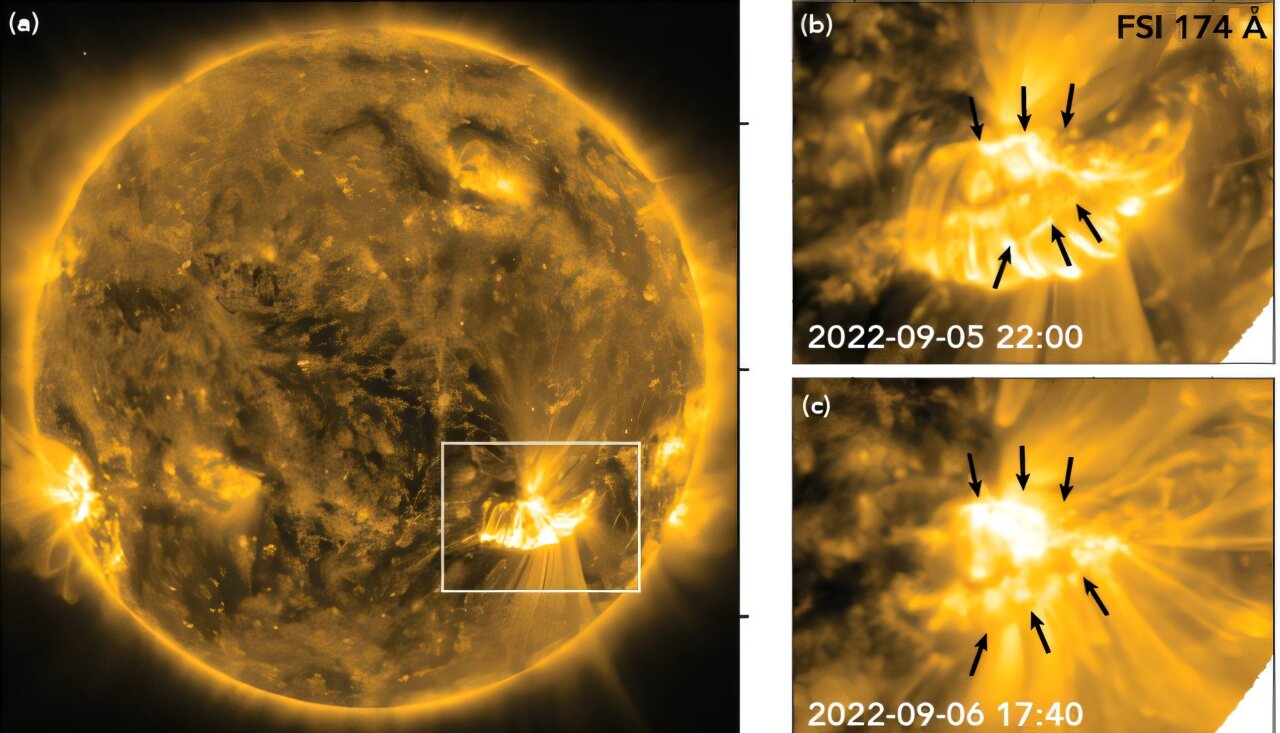
The Parker Solar Probe’s record proximity to the Sun has opened up new opportunities for research. The approach on September 6, 2022, revealed a huge eruption, which for the first time made it possible to depict and study the properties of plasma and the magnetic field in detail. Using a combination of in-situ imaging and diagnostic techniques, as well as additional observations from the European Space Agency’s Solar Orbiter, a team led by the Southwest Research Institute confirmed that the Parker Solar Probe flew through the reconnection region of the solar atmosphere for the first time.
NASA’s MMS mission has given researchers insight into how reconnection occurs in the near-Earth environment on a smaller scale. The 2022 PSP observations now provide researchers with the missing link connecting Earth-scale reconnection with solar-scale reconnection. Scientists will continue to work to determine whether reconnection mechanisms accompanied by turbulence or oscillations and waves in magnetic fields are present in solar regions that Parker Solar Probe has identified as having active reconnection.
According to phys.org

