

Every carbon atom in our bodies is like a traveler through time and space. New scientific research reveals the incredible journey of this building block of life: it turns out that it may have left our Milky Way galaxy altogether, only to return again later.
Carbon, a fundamental element of life, is created in the depths of stars. When stars die in supernova explosions, they scatter these “building blocks” throughout the Universe. This is how carbon enters the composition of new planets and asteroids and ultimately becomes the basis for organisms.
Galactic Express
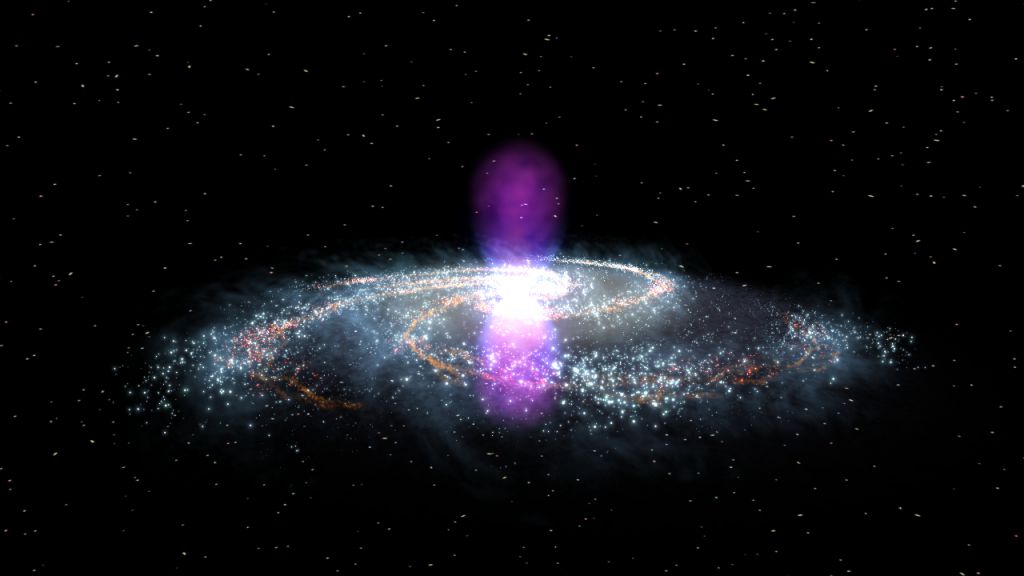
A study published in The Astrophysical Journal Letters shows that carbon’s journey does not end there. In galaxies such as our Milky Way, there are giant invisible structures called the extragalactic environment. These are peculiar “halos” of hot gas extending into intergalactic space.
“Imagine a giant train station that constantly pushes material out and pulls it back in,” explains Samantha Garza, a research leader at the University of Washington.
Powerful supernova explosions eject heavy elements such as carbon from the galaxy into this environment. But they do not disappear forever. The dynamics of the halo work like a cosmic conveyor belt: it pulls the material back in, where gravity can use it to form new stars and planets.
A discovery that changes perceptions
Scientists have known for many years that the interstellar medium contains hot gases enriched with oxygen. However, new data from the Hubble Space Telescope has confirmed for the first time that colder material, particularly carbon, also circulates there.
“We can now confirm that the intergalactic medium is a giant reservoir for both carbon and oxygen,” says Garza. “And in star-forming galaxies, this material falls back, continuing the cycle of recycling.”
Fuel for the future
This discovery is key to understanding the evolution of galaxies. The continuous cycle of “ejection-return” provides fuel for the birth of new stars and planetary systems.
“If you can maintain this cycle, then theoretically you have enough fuel to continue forming stars,” the researcher notes.
So, next time you look up at the night sky, remember: the atoms that make up our bodies once made an epic journey beyond the Milky Way, only to return and give us the opportunity to live.
We previously reported on how Venus’ atmosphere was actively losing carbon and oxygen.
According to newsweek.com

