

For quite some time, Uranus and Neptune have been classified as “ice giants.” This view suggests that they should be similar to each other and at the same time very different from other gas giants. However, it is quite possible that we simply get a wrong understanding of them.
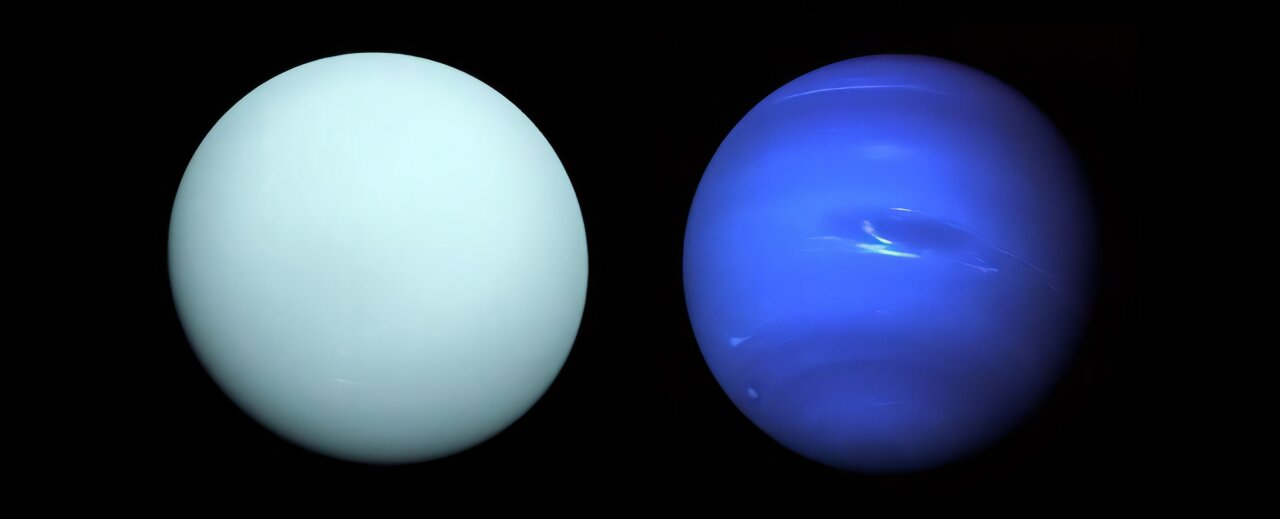
Uranus and Neptune
A study accepted for publication in the journal Astronomy & Astrophysics and available on the arXiv preprint server could change our understanding of Uranus and Neptune. At least, that is what its authors from the University of Zurich claim, saying that it is not entirely correct to group these two planets under the term “ice giants.”
This classification was originally developed as an attempt to distinguish the seventh and eighth planets of the Solar System from Jupiter and Saturn. It bases its understanding of these worlds on the fact that, unlike their larger relatives, both consist of ice rather than gases.
In a new study, scientists used a series of computer models of the internal structure of two planets. They take into account the equatorial radius, pressure, polar radius, orbital period, and gravitational characteristics. The result caused scientists to doubt the validity of the claim that these two planets are indeed similar to each other.
Simulations have shown that both Uranus and Neptune consist of a mixture of frozen gases and rock. However, there are almost ten times more of the latter on Uranus than on Neptune. That is, a more accurate description of Uranus would be “rock giant.”
Problems with researching ice giants
If the models are correct, it is possible that Neptune is actually much closer in its properties to Saturn and Jupiter than to Uranus. And the latter may be a super-Earth that has grown to an extremely large size.
It is still not very clear what distant giants actually are, because we see powerful atmospheres, but we have no idea how deep they extend. An orbital mission could answer many questions, but Voyager 2 remains the only spacecraft to date that has explored Uranus and Neptune.
In 1986 and 1989, it reached them only thanks to a mutual alignment occurring once every 175 years. Now a similar mission would be too complicated because of the enormous distance between these worlds. China is currently preparing to launch Tianwen-4, while NASA is considering the Uranus Orbiter and Probe mission. As for Neptune, more than half a dozen missions have been proposed, including NASA’s Neptune Odyssey mission.
According to phys.org

