

Scientists have known for quite some time that there is a powerful debris ring around Fomalhaut. Now they have determined that this ring is twisted, and the planet is to blame.
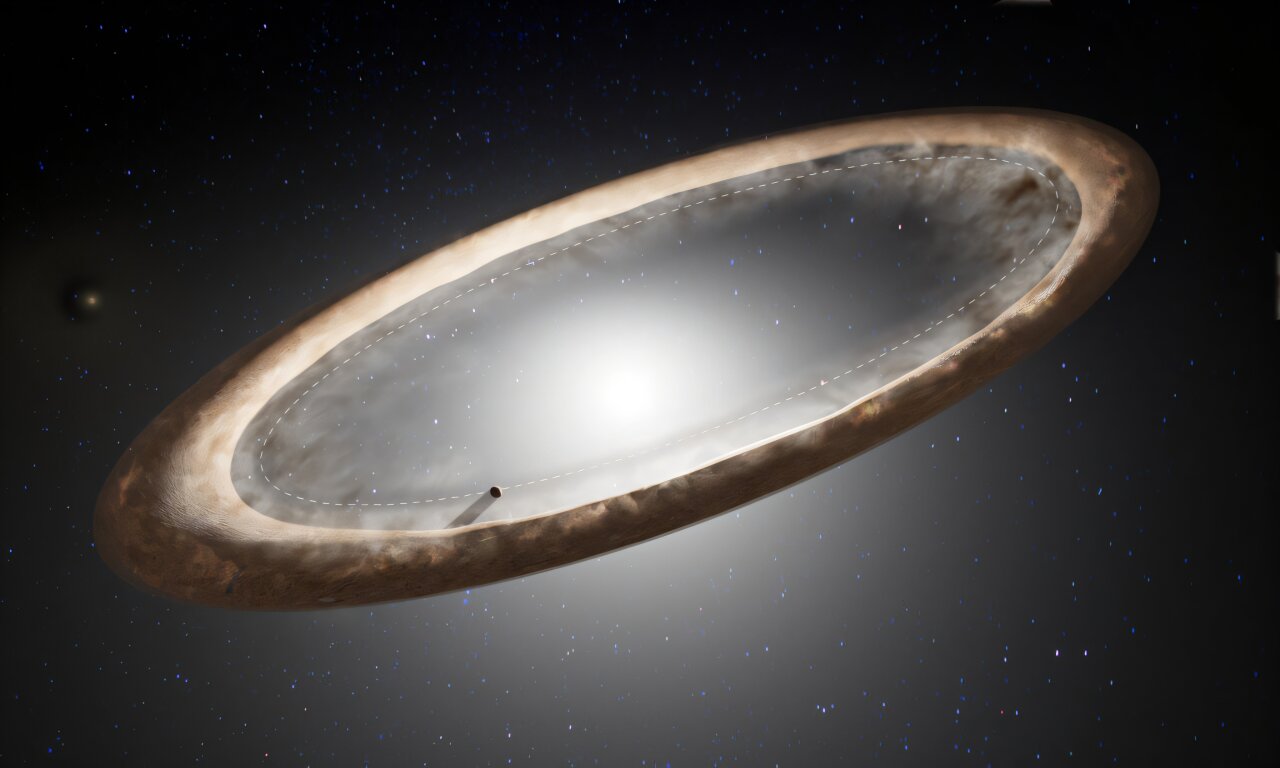
Mystery of Fomalhaut’s disk
Astronomers using the Atacama Large Millimeter/submillimeter Array (ALMA) have obtained the highest-resolution image to date, revealing new details of the unusual and mysterious architecture of the debris disk surrounding Fomalhaut, one of the brightest and best-studied stars in our galaxy.
Disc structures made of debris are huge belts of dust and rocky bodies, similar to the asteroid belt in our Solar System, but much larger. The disproportion (or eccentricity) of Fomalhaut’s disk has fascinated astronomers for almost two decades.
An international research team led by astronomers from the Center for Astrophysics (Harvard & Smithsonian Institute and Johns Hopkins University) has published two articles analyzing these new observations. They discovered that Fomalhaut’s disk is not simply eccentric — its eccentricity varies depending on the distance from the star.
New approach to disk simulation
Unlike previous models, which assume uniform or “fixed” eccentricity, their new data-driven model reveals that the shape of the disk becomes less elongated (or less eccentric) with increasing distance from Fomalhaut. This morphology is known as a negative eccentricity gradient. You can imagine landslides between the star and the center of the ring, very similar to Saturn’s rings, if Saturn were not sitting neatly in the middle.
Using high-resolution ALMA images at 1.3 mm wavelengths, the team fitted a new model to the data accounting for the disk’s radius, width, and asymmetry, with an eccentric ring model that can change its eccentricity with distance from the star. The best model indicated a sharp decrease in eccentricity with distance, as predicted by dynamic theories of how planets can form debris disks, but these have not yet been observed anywhere in the universe.
Ancient hidden planets
This negative gradient provides clues about hidden planets, as yet invisible to astronomers, orbiting around Fomalhaut. The new model suggests that a massive planet rotating within the Fomalhaut disk could have shaped its eccentricity profile in the early stages of the exoplanetary system’s history. The unusual shape of the debris disk probably formed in the early days of the system, during the protoplanetary disk phase, and it has been preserved in this form for over 400 million years thanks to the constant attraction and repulsion of this planet.
The team of scientists also ruled out the possibility that the eccentricity of the ring was fixed in relation to the distance from the star. In other words, they were unable to find a model with fixed eccentricity that could explain the unusual features in Fomalhaut’s disk. By comparing old and new models, researchers can now better interpret this disk and reconstruct the history and current state of this dynamic system.
Researchers hope that this new model will be further tested using new ALMA observations that have recently been approved. Scientists are striving to find new clues that will help detect the hidden planet.
The team shared the eccentricity model code developed for this published study so that other astronomers could apply it to similar systems.
According to phys.org

