

GJ 1132 b is an Earth-like exoplanet. Recently, it has been the focus of attention for the James Webb Space Telescope. Some of its observations suggest that it has an atmosphere, while others suggest that it does not. In a new study, scientists have attempted to answer this question.
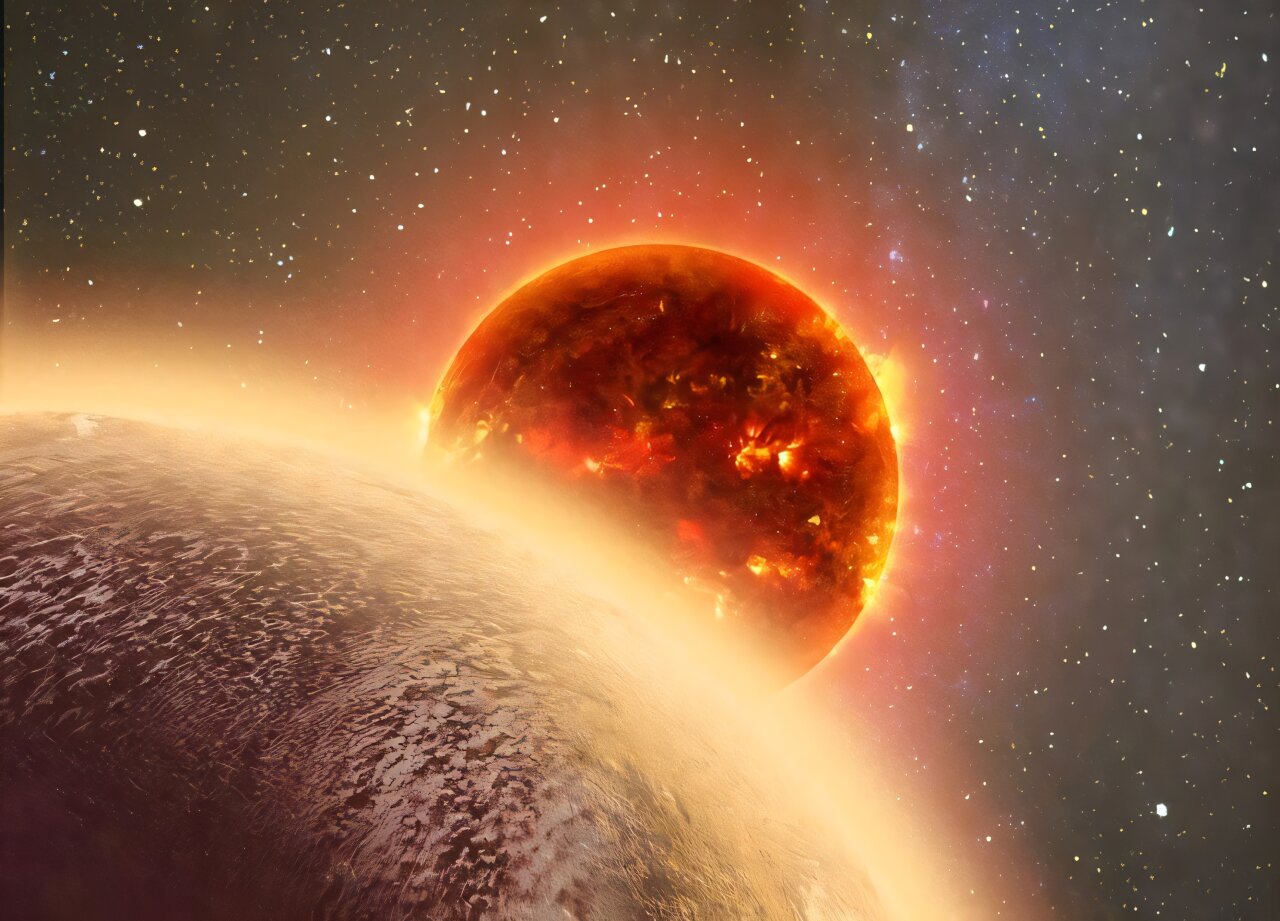
Problem exoplanet
Many people think that scientists should have answers to all questions when they are researching a problem, but in reality, all they have is observational data and theories that explain it to a greater or lesser extent. An illustration of this is the situation with the planet GJ 1132 b, about which an article was recently published that was interpreted in an extremely negative light.
GJ 1132 b is a planet orbiting a star located 41 light-years away from us, which is relatively close. Furthermore, in terms of mass and size, it is only slightly larger than Earth. At the same time, it is located at a distance of 0.0153 AU and orbits its star in just 1.6 days.
It is a hot super-Earth, and no one really expects to find life there, but it is still interesting to know if it has any atmosphere at all. Fortunately, we now have an excellent instrument for studying this question: the James Webb Space Telescope. One of its tasks, even at the design stage, was to study the gas envelopes of exoplanets.
James Webb’s research
However, in the case of GJ 1132 b, everything turned out to be quite complicated. The fact is that James Webb had already observed the planet twice. And the first study suggests that it definitely has a thick atmosphere of water vapor, while the second suggests that it is completely devoid of a gas envelope. Each study is based on its own set of observational data.
In order to understand all this, modern research was needed. It is based not only on two preliminary data sets, but also on two more that followed. Together, they indicate that the probability of a thin atmosphere existing on GJ 1132 b remains, but it is very small.
And if we don’t use the data from the very first observation, it becomes clear that the planet has no atmosphere. Scientists decided to check whether any factors could have influenced the results and found that yes, the impression of the planet with atmosphere could have caused an excessive number of cold regions on the surface of its star.
According to phys.org

