

Scientists have calculated that sub-Neptunes are the most common type of planet orbiting Sun-like stars in our galaxy. However, they are virtually nonexistent around the most common type of star—red dwarfs.
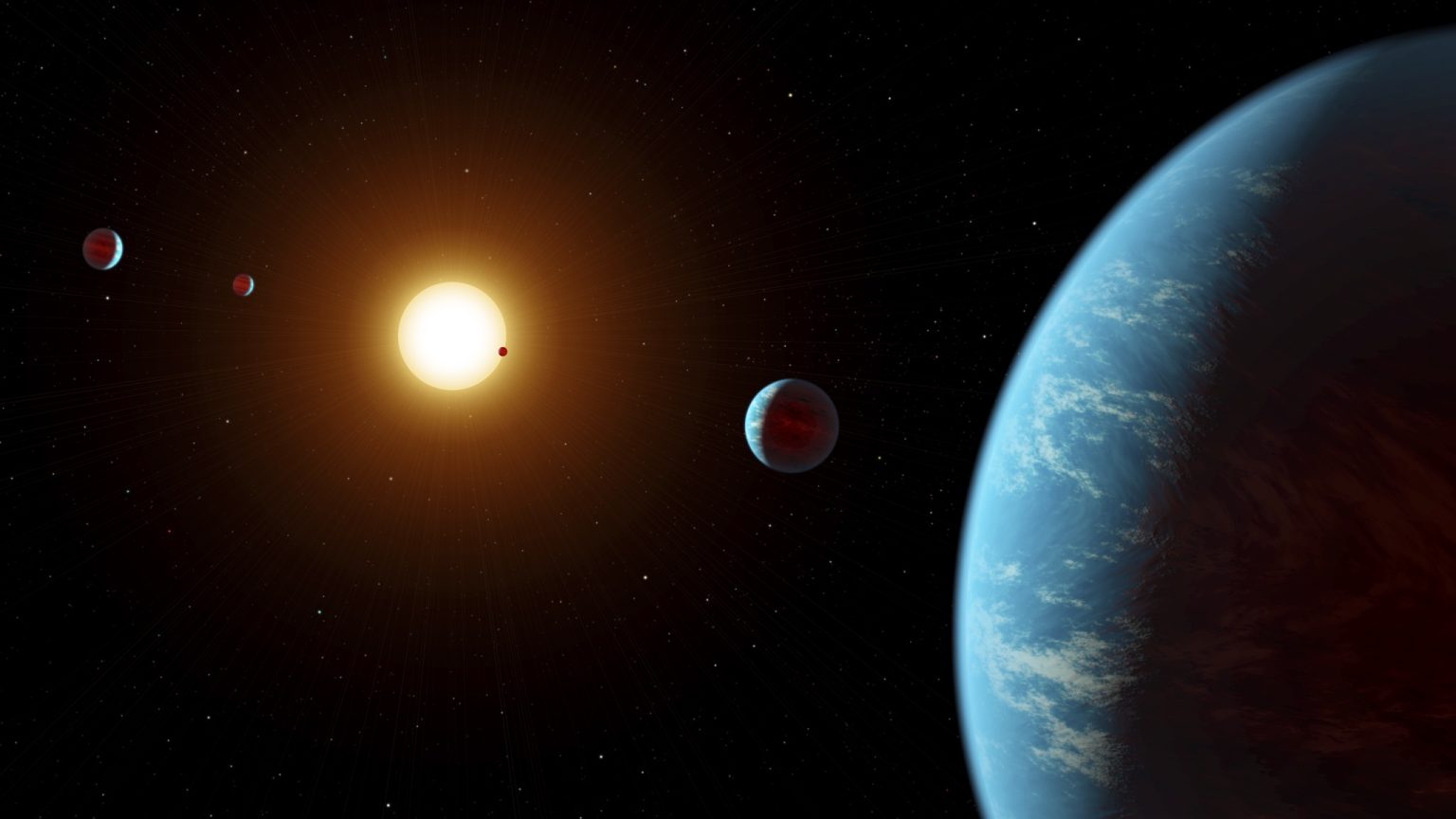
The most common planets in the Galaxy
For 30 years now, scientists have been discovering planets orbiting other stars. Of course, they can’t see all of them, but over time, researchers have managed to compile a substantial amount of statistics and can confidently state that there is at least one planet for every star in our galaxy.
But what kind of worlds are these? After all, observations show that they can be extremely diverse: ranging from rocky bodies smaller than Earth and virtually devoid of an atmosphere to gas giants so large that they can almost be considered brown dwarfs. The answer to this question is provided in a new article by researchers at McMaster University.
Its authors drew on data collected by the TESS space telescope. They found that the most common types of planets orbiting Sun-like stars are sub-Neptunes and large super-Earths. These are planets whose masses can be up to ten times that of Earth and which contain large amounts of water and gases.
Red dwarfs
However, the same study highlights the following paradox. The most common type of star in the Galaxy is not at all like the Sun, but rather red dwarfs. These small stars have masses ranging from a few to 40 percent of the Sun’s mass, and their luminosity is hundreds or thousands of times less than the Sun’s.
Most known exoplanets orbit precisely around these stars, in relatively tight systems. And the paradox is that the most common type of planet in these systems is small super-Earths. And there are practically no mini-Neptunes at all. All of this is so surprising that it makes one wonder whether planets around different stars really do form according to the same scenario.
Although there is a much simpler explanation for this difference. Red dwarfs are known for their powerful flares. They pose a threat to the atmospheres and hydrospheres of the planets orbiting these stars. But it is quite possible that water withstands intense radiation much better than gas. That is why the only planets remaining around red dwarfs are those whose mass consists not of volatile substances, but of water and rock.
The authors of the study emphasize that all of this still needs to be thoroughly verified. After all, just 30 years ago, the only planetary system we knew of was our own. And even now, it is the only one that can be considered well-studied.
According to phys.org

